JEE MAIN 2022 · 26 JUL S1Integrated rate laws and half-life (zero and first order)TRANSCRIBED
For a reaction , the half lives are and when the concentration of reactant A is and respectively. The order of the reaction is ______.
Every Chemical Kinetics question JEE Main has set, grouped by the idea it tests rather than the order of the syllabus. 231 questions across 8 distinct ideas. Free to read, answer key on every one.
Questions
231
Distinct ideas
8
Share of marks
5.5%
Difficulty
MEDIUM
A chapter is not one subject — it is a handful of procedures the examiner reuses. These are the ones Chemical Kinetics questions actually test.
121–140 OF 231 · NEWEST FIRST
For a reaction , the half lives are and when the concentration of reactant A is and respectively. The order of the reaction is ______.
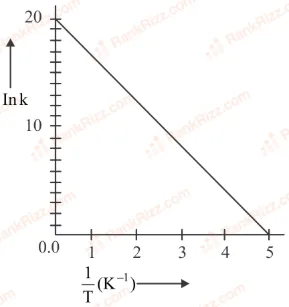
For a reaction, given below is the graph of vs . The activation energy for the reaction is equal to _____ cal mol. (Given: cal K mol)
Which of the following forms of hydrogen emits low energy particles?
Deuterium
Proton
Tritium
Protium
Which one of the following given graphs represents the variation of rate constant (k) with temperature (T) for an endothermic reaction?
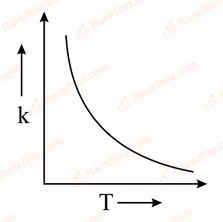
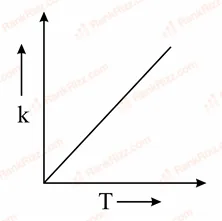
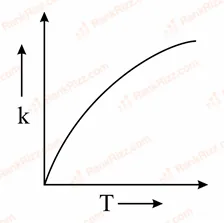
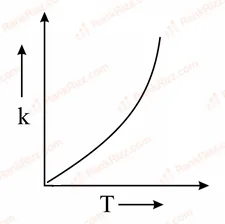
For the following graphs,
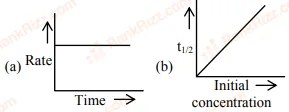
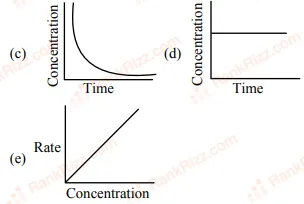
Choose from the options given below, the correct one regarding order of reaction is:
(b) zero order (c) and (e) First order
(a) and (b) Zero order (e) First order
(b) and (d) Zero order (e) First order
(a) and (b) Zero order (c) and (e) First order
For a reaction of order n, the unit of the rate constant is:
The reaction that occurs in a breath analyser, a device used to determine the alcohol level in a person's blood stream is
If the rate of appearance of is 2.67 mol min at a particular time, the rate of disappearance of at the same time is _________ mol min. (Nearest integer)
According to the following figure, the magnitude of the enthalpy change of the reaction A + B M + N in kJ mol is equal to _________. (Integer answer)
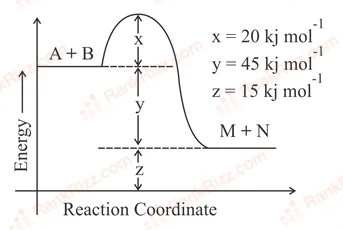
The reaction rate for the reaction
was measured as a function of concentrations of different species. It was observed that
where square brackets are used to denote molar concentrations.
The equilibrium constant K = X (Nearest integer). Value of is _________
(Nearest integer)
The inactivation rate of a viral preparation is proportional to the amount of virus. In the first minute after preparation, 10% of the virus is inactivated. The rate constant for viral inactivation is ___ min.
(Nearest integer) [Use : ln 10 = 2.303; property of logarithm: ]
For a first order reaction, the ratio of the time for 75% completion of a reaction to the time for 50% completion is _________. (Integer answer)
A reaction has a half life of 1 min. The time required for 99.9% completion of the reaction is ___ min.
(Round off to the Nearest integer)
[Use : ln 2 = 0.69, ln 10 = 2.3]
Sucrose hydrolyses in acid solution into glucose and fructose following first order rate law with a half-life of 3.33 h at 25°C. After 9 h, the fraction of sucrose remaining is f. The value of is ______ .
(Rounded off to the nearest integer)
[Assume: ln10 = 2.303, ln 2 = 0.693]
PCl(g) PCl(g) + Cl(g)
In the above first order reaction the concentration of PCl reduces from initial concentration 50 mol L to 10 mol L in 120 minutes at 300 K. The rate constant for the reaction at 300 K is x min. The value of x is ___.
[Given log 5 = 0.6989]
The rate constant of a reaction increases by five times on increase in temperature from 27°C to 52°C. The value of activation energy in kJ mol is ______. (Rounded-off to the nearest integer) [ J K mol]
For the reaction A B, the rate constant k (in s) is given by
The energy of activation in kJ mol is _________. (Nearest integer)
[Given : R = 8.314 J K mol]
The following data was obtained for chemical reaction given below at 975 K.
[NO] = 8 , [H] = 8 , Rate = 7
[NO] = 24 , [H] = 8 , Rate = 2.1
[NO] = 24 , [H] = 32 , Rate = 8.4
The order of the reaction with respect to NO is _________ [Integer answer]
The reaction is an elementary reaction. For a certain quantity of reactants, if the volume of the reaction vessel is reduced by a factor of 3, the rate of the reaction increases by a factor of ________. (Round off to the Nearest Integer).
For a chemical reaction A B, it was found that concentration of B is increased by 0.2 mol L in 30 min. The average rate of the reaction is _________ mol L h. (in nearest integer)
The decomposition of formic acid on gold surface follows first order kinetics. If the rate constant at 300 K is s and the activation energy kJ mol, the rate constant at 200 K is ________ s. (Round off to the Nearest Integer).
[Given J mol K]
OTHER CHEMISTRY CHAPTERS