RankRizz

Electric charge and Coulomb's law — JEE Main Previous Year Questions

Every JEE Main question on Electric charge and Coulomb's law, one of the ideas inside Electrostatics: 42 questions from 2004–2026, 24 of them in the last five years. Newest first, answer key on every one. Free to read.

Questions

42

Years asked

14

Since

2004

Of the chapter

14%

Every Electric charge and Coulomb's law question

21–40 OF 42 · NEWEST FIRST

JEE MAIN 2022 · 24 JUN S2Electric charge and Coulomb's lawTRANSCRIBED

Two identical charged particles each having a mass 1010 g and charge 2.0×10−72.0 \times 10^{-7} C are placed on a horizontal table with a separation of LL between them such that they stay in limited equilibrium. If the coefficient of friction between each particle and the table is 0.250.25, find the value of LL. [Use g=10g = 10 ms−2^{-2}]

  1. A

    12 cm

  2. B

    10 cm

  3. C

    8 cm

  4. D

    5 cm

JEE MAIN 2022 · 29 JUN S2Electric charge and Coulomb's lawTRANSCRIBED

Two point charges QQ each are placed at a distance dd apart. A third point charge qq is placed at a distance xx from mid-point on the perpendicular bisector. The value of xx at which charge qq will experience the maximum Coulomb's force is:

  1. A

    dd

  2. B

    d2\frac{d}{2}

  3. C

    d2\frac{d}{\sqrt{2}}

  4. D

    d22\frac{d}{2\sqrt{2}}

JEE MAIN 2022 · 27 JUN S2Electric charge and Coulomb's lawTRANSCRIBED

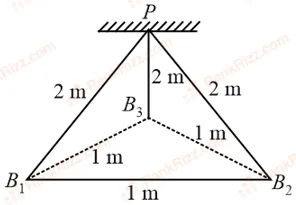
Three identical charged balls each of charge 2C2C are suspended from a common point PP by silk threads of 22 m each (as shown in figure). They form an equilateral triangle of side 11 m. The ratio of net force on a charged ball to the force between any two charged balls will be

Figure for JEE Main 2022 Physics question on Electric charge and Coulomb's law
  1. A

    3:1\sqrt{3} : 1

  2. B

    3:2\sqrt{3} : 2

  3. C

    1:11 : 1

  4. D

    1:41 : 4

JEE MAIN 2022 · 26 JUL S2Electric charge and Coulomb's lawTRANSCRIBED

Three point charges of magnitude 5μC5 \mu C, 0.16μC0.16 \mu C and 0.3μC0.3 \mu C are located at the vertices AA, BB, CC of a right angled triangle whose sides are AB=3 cmAB = 3 \text{ cm}, BC=32 cmBC = 3\sqrt{2} \text{ cm} and CA=3 cmCA = 3 \text{ cm} and point AA is the right angle corner. Charge at point AA experiences ______ N of electrostatic force due to the other two charges.

JEE MAIN 2021 · 24 FEB S2Electric charge and Coulomb's lawTRANSCRIBED

Two electrons each are fixed at a distance 2d. A third charge proton placed at the midpoint is displaced slightly by a distance x(x≪d)x (x \ll d) perpendicular to the line joining the two fixed charges. Proton will execute simple harmonic motion having angular frequency:
(mm = mass of charged particle)

  1. A

    (πε0md32q2)12\left(\frac{\pi\varepsilon_0 md^3}{2q^2}\right)^{\frac{1}{2}}

  2. B

    (2πε0md3q2)12\left(\frac{2\pi\varepsilon_0 md^3}{q^2}\right)^{\frac{1}{2}}

  3. C

    (q22πε0md3)12\left(\frac{q^2}{2\pi\varepsilon_0 md^3}\right)^{\frac{1}{2}}

  4. D

    (2q2πε0md3)12\left(\frac{2q^2}{\pi\varepsilon_0 md^3}\right)^{\frac{1}{2}}

JEE MAIN 2021 · 20 JUL S1Electric charge and Coulomb's lawTRANSCRIBED

A certain charge QQ is divided into two parts qq and (Q−q)(Q - q). How should the charges QQ and qq be divided so that qq and (Q−q)(Q - q) placed at a certain distance apart experience maximum electrostatic repulsion?

  1. A

    Q=q2Q = \frac{q}{2}

  2. B

    Q=2qQ = 2q

  3. C

    Q=4qQ = 4q

  4. D

    Q=3qQ = 3q

JEE MAIN 2021 · 27 JUL S1Electric charge and Coulomb's lawTRANSCRIBED

Two identical tennis balls each having mass mm and charge qq are suspended from a fixed point by threads of length ll. What is the equilibrium separation when each thread makes a small angle θ\theta with the vertical?

  1. A

    x=(q2l2πε0mg)12x = \left(\frac{q^2 l}{2\pi\varepsilon_0 mg}\right)^{\frac{1}{2}}

  2. B

    x=(q2l2πε0mg)13x = \left(\frac{q^2 l}{2\pi\varepsilon_0 mg}\right)^{\frac{1}{3}}

  3. C

    x=(q2l22πε0m2g)13x = \left(\frac{q^2 l^2}{2\pi\varepsilon_0 m^2 g}\right)^{\frac{1}{3}}

  4. D

    x=(q2l22πε0m2g2)13x = \left(\frac{q^2 l^2}{2\pi\varepsilon_0 m^2 g^2}\right)^{\frac{1}{3}}

JEE MAIN 2021 · 25 JUL S1Electric charge and Coulomb's lawTRANSCRIBED

A particle of mass 1 mg and charge qq is lying at the mid-point of two stationary particles kept at a distance 2 m when each is carrying same charge qq. If the free charged particle is displaced from its equilibrium position through distance xx (x<<1x << 1 m). The particle executes SHM. Its angular frequency of oscillation will be ___ ×105\times 10^5 rad s−1^{-1} (if q2=10C2q^2 = 10C^2)

JEE MAIN 2021 · 18 MAR S2Electric charge and Coulomb's lawTRANSCRIBED

An infinite number of point charges, each carrying 1μC1 \mu C charge, are placed along the y-axis at y=1y = 1 m, 2 m, 4 m, 8 m .....
The total force on a 1 C point charge, placed at the origin, is x×103x \times 10^3 N. The value of xx, to the nearest integer, is ___.
[Take 14πε0=9×10⁹\frac{1}{4\pi\varepsilon_0} = 9 \times 10^9 N m2^2 C−2^{-2}]

JEE MAIN 2021 · 25 FEB S2Electric charge and Coulomb's lawTRANSCRIBED

Two small spheres each of mass 10 mg are suspended from a point by threads 0.5 m long. They are equally charged and repel each other to a distance of 0.20 m. The charge on each of the sphere is a21×10−8\frac{a}{21} \times 10^{-8} C. The value of aa will be ______. [Given g=10g = 10 m s−2^{-2}]

JEE MAIN 2021 · 25 FEB S2Electric charge and Coulomb's lawTRANSCRIBED

Two identical conducting spheres with negligible volume have 2.1 nC and −0.1-0.1 nC charges, respectively. They are brought into contact and then separated by a distance of 0.5 m. The electrostatic force acting between the spheres is ______ ×10−9\times 10^{-9} N.
[Given : 4πϵ∘4\pi \epsilon_{\circ} = 19×109\frac{1}{9\times 10^{9}} SI Units}]

JEE MAIN 2019 · 09 JAN S1Electric charge and Coulomb's lawTRANSCRIBED

Three charges +Q+Q, qq, +Q+Q are placed respectively, at distance, 00, d/2d/2 and dd from the origin, on the xx-axis. If the net force experienced by +Q+Q, placed at x=0x = 0, is zero, then value of qq is:

  1. A

    +Q/2+Q/2

  2. B

    +Q/4+Q/4

  3. C

    −Q/4-Q/4

  4. D

    −Q/2-Q/2

JEE MAIN 2019 · 09 JAN S2Electric charge and Coulomb's lawTRANSCRIBED

Charge is distributed within a sphere of radius RR with a volume charge density ρ(r)=Ar2e−2ra\rho(r) = \frac{A}{r^2}e^{-\frac{2r}{a}}, where AA and aa are constants. If QQ is the total charge of this charge distribution, the radius RR is:

  1. A

    a2log⁡(11−Q2πaA)\frac{a}{2}\log\left(\frac{1}{1 - \frac{Q}{2\pi aA}}\right)

  2. B

    alog⁡(11−Q2πaA)a \log\left(\frac{1}{1 - \frac{Q}{2\pi aA}}\right)

  3. C

    alog⁡(1−Q2πaA)a \log\left(1 - \frac{Q}{2\pi aA}\right)

  4. D

    a2log⁡(1−Q2πaA)\frac{a}{2}\log\left(1 - \frac{Q}{2\pi aA}\right)

JEE MAIN 2018 · 16 APR ONLINEElectric charge and Coulomb's lawTRANSCRIBED

Two identical conducting spheres A and B carry an equal charge. They are separated by a distance much larger than their diameters, and the force between them is F. A third identical conducting sphere, C, is uncharged. Sphere C is first touched to A, then to B, and then removed. As a result, force between A and B would be equal to:

  1. A

    3F4\frac{3F}{4}

  2. B

    F2\frac{F}{2}

  3. C

    3F8\frac{3F}{8}

  4. D

    F

JEE MAIN 2013 · 07 APR ONLINEElectric charge and Coulomb's lawTRANSCRIBED

Two charges, each equal to q, are kept at x=−ax = -a and x=ax = a on the x-axis. A particle of mass m and charge q0=−q2q_0 = -\frac{q}{2} is placed at the origin. If charge q0q_0 is given a small displacement (y<<ay << a) along the y-axis, the net force acting on the particle is proportional to :

  1. A

    1y\frac{1}{y}

  2. B

    −1y-\frac{1}{y}

  3. C

    −y-y

  4. D

    yy

JEE MAIN 2013 · 09 APR ONLINEElectric charge and Coulomb's lawTRANSCRIBED

Two balls of same mass and carrying equal charge are hung from a fixed support of length ll. At electrostatic equilibrium, assuming that angles made by each thread is small, the separation, x between the balls is proportional to :

  1. A

    ll

  2. B

    l2l^2

  3. C

    l2/3l^{2/3}

  4. D

    l1/3l^{1/3}

JEE MAIN 2011Electric charge and Coulomb's lawTRANSCRIBED

Two identical charged spheres suspended from a common point by two massless strings of length ll are initially a distance d (d≪l)d \, (d \ll l) apart because of their mutual repulsion. The charge begins to leak from both the spheres at a constant rate. As a result the charges approach each other with a velocity vv. Then as a function of distance xx between them,

  1. A

    v∝x−1v \propto x^{-1}

  2. B

    v∝x1/2v \propto x^{1/2}

  3. C

    v∝xv \propto x

  4. D

    v∝x−1/2v \propto x^{-1/2}

JEE MAIN 2010Electric charge and Coulomb's lawTRANSCRIBED

Two identical charged spheres are suspended by strings of equal lengths. The strings make an angle of 30∘30^\circ with each other. When suspended in a liquid of density 0.80.8 g cm−3^{-3}, the angle remains the same. If density of the material of the sphere is 1616 g cm−3^{-3}, the dielectric constant of the liquid is

  1. A

    4

  2. B

    3

  3. C

    2

  4. D

    1

JEE MAIN 2009Electric charge and Coulomb's lawTRANSCRIBED

A charge QQ is placed at each of the opposite corners of a square. A charge qq is placed at each of the other two corners. If the net electrical force on QQ is zero, then the Q/qQ/q equals

  1. A

    −22-2\sqrt{2}

  2. B

    −1-1

  3. C

    11

  4. D

    −12-\frac{1}{\sqrt{2}}

JEE MAIN 2007Electric charge and Coulomb's lawTRANSCRIBED

If gEg_E and gmg_m are the accelerations due to gravity on the surfaces of the earth and the moon respectively and if Millikan's oil drop experiment could be performed on the two surfaces, one will find the ratio electronic charge on the moonelectronic charge on the earth\frac{\text{electronic charge on the moon}}{\text{electronic charge on the earth}} to be

  1. A

    1

  2. B

    0

  3. C

    gE/gmg_E / g_m

  4. D

    gm/gEg_m / g_E