JEE MAIN 2015 · 04 APR OFFLINENucleophilic substitution (SN1 and SN2)TRANSCRIBED
The synthesis of alkyl fluorides is best accomplished by:
- A
Swarts reaction
- B
Free radical fluorination
- C
Sandmeyer's reaction
- D
Finkelstein reaction
Every Haloalkanes and Haloarenes question JEE Main has set, grouped by the idea it tests rather than the order of the syllabus. 188 questions across 6 distinct ideas. Free to read, answer key on every one.
Questions
188
Distinct ideas
6
Share of marks
3.4%
Difficulty
MEDIUM
A chapter is not one subject — it is a handful of procedures the examiner reuses. These are the ones Haloalkanes and Haloarenes questions actually test.
161–180 OF 188 · NEWEST FIRST
The synthesis of alkyl fluorides is best accomplished by:
Swarts reaction
Free radical fluorination
Sandmeyer's reaction
Finkelstein reaction
The major organic compound formed by the reaction of 1, 1, 1 - trichloroethane with silver powder is:
Acetylene
Ethene
2-Butyne
2-Butene
The major product formed when 1, 1, 1-trichloropropane is treated with aqueous potassium hydroxide is:
2-Propanol
Propyne
Propionic acid
1-Propanol
For the compounds CHCl, CHBr, CHI and CHF, the correct order of increasing C-halogen bond length is:
CHF < CHBr < CHCl < CHI
CHF < CHI < CHBr < CHCl
CHF < CHCl < CHBr < CHI
CHCl < CHBr < CHF < CHI
In S2 reactions, the correct order of reactivity for the following compounds: CHCl, CHCHCl, (CH)CHCl and (CH)CCl is:
CH_3Cl > (CH_3)_2CHCl > CH_3CH_2Cl > (CH_3)_3CCl
CH_3Cl > CH_3CH_2Cl > (CH_3)_2CHCl > (CH_3)_3CCl
CH_3CH_2Cl > CH_3Cl > (CH_3)_2CHCl > (CH_3)_3CCl
(CH_3)_2CHCl > CH_3CH_2Cl > CH_3Cl > (CH_3)_3CCl
In a nucleophilic substitution reaction: R Br + Cl R Cl + Br, which one of the following undergoes complete inversion of configuration?
CHCHCHBr
CHCCHCHBr
CHCHBr
CHCHCHBr
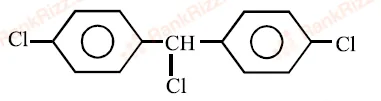
Chlorobenzene reacts with trichloro acetaldehyde in the presence of HSO. The major product formed is:
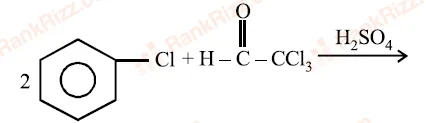
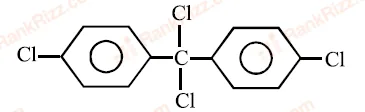
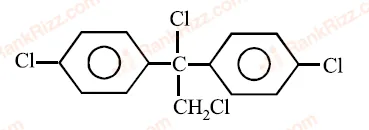
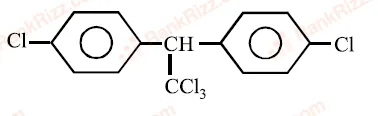
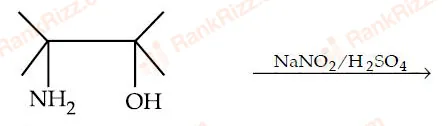
The major product of the reaction is:
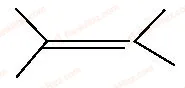
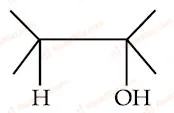
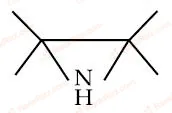
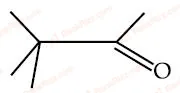
A solution of (-)1-chloro-1-phenylethane in toluene racemises slowly in the presence of a small amount of , due to the formation of :
Carbocation
Free radical
Carbanion
Carbene
In nucleophilic substitution reaction, order of halogens as incoming (attacking) nucleophile is: I^- > Br^- > Cl^-. The order of halogens as departing nucleophile should be :
Br > I > Cl
I > Br > Cl
Cl > Br > I
Cl > I > Br
The order of reactivity of the given haloalkanes towards nucleophile is :
RI > RBr > RCl
RCl > RBr > RI
RBr > RCl > RI
RBr > RI > RCl
The Wurtz-Fittig reaction involves condensation of:
two molecules of aryl halides
one molecule of each of aryl-halide and alkyl-halide.
one molecule of each of aryl-halide and phenol.
two molecules of aralkyl-halides.
Compound (A), , gives a white precipitate when warmed with alcoholic AgNO. Oxidation of (A) gives an acid (B), . (B) easily forms anhydride on heating. Identify the compound (A).
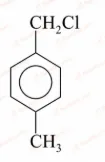
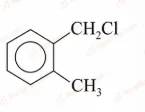
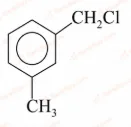
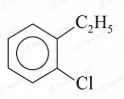
What is DDT among the following:
Greenhouse gas
A fertilizer
Biodegradable pollutant
Non-biodegradable pollutant
Which of the following statements is wrong?
Ethyl chloride on reduction with couple and alcohol gives ethane.
The reaction of methyl magnesium bromide with acetone gives butanol-2.
Alkyl halides follow the following reactivity sequence on reaction with alkenes. \text{R}-\text{I} > \text{R}-\text{Br} > \text{R}-\text{Cl} > \text{R}-\text{I}
may exist in two isomeric forms
Consider the following bromides: 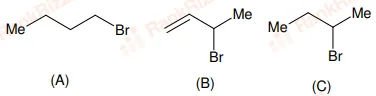
The correct order of reactivity is
B > C > A
B > A > C
C > B > A
A > B > C
Which of the following on heating with aqueous KOH, produces acetaldehyde?
The organic chloro compound, which shows complete stereochemical inversion during a reaction, is
Which of the following is the correct order of decreasing reactivity?
RCH_2 X > R_3 CX > R_2 CHX
RCH_2 X > R_2 CHX > R_3 CX
R_3 CX > R_2 CHX > RCH_2 X
R_2 CHX > R_3 CX > RCH_2 X ( a halogen)
$CH_3Br + Nu^- \longrightarrow CH_3 - Nu + Br^-$
D > C > A > B
D > C > B > A
A > B > C > D
B > D > C > A
OTHER CHEMISTRY CHAPTERS