JEE MAIN 2019 · 11 JAN S2Stratospheric pollution and ozone depletionTRANSCRIBED
The higher concentration of which gas in air can cause stiffness of flower buds?
- A
NO
- B
- C
SO
- D
CO
Every Environmental Chemistry question JEE Main has set from 2004–2024, grouped by the idea it tests rather than the order of the syllabus. 113 questions across 4 distinct ideas. Free to read, answer key on every one.
Questions
113
Distinct ideas
4
Share of marks
0%
Difficulty
EASY
A chapter is not one subject — it is a handful of procedures the examiner reuses. These are the ones Environmental Chemistry questions actually test.
81–100 OF 113 · NEWEST FIRST
The higher concentration of which gas in air can cause stiffness of flower buds?
NO
SO
CO
The maximum prescribed concentration of copper in drinking water is:
3 ppm
5 ppm
0.5 ppm
0.05 ppm
Excessive release of CO into the atmosphere results in:
global warming.
polar vortex.
depletion of ozone.
formation of smog.
The compound that is NOT a common component of photochemical smog is:
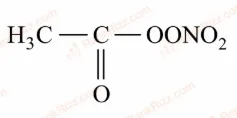
Which is wrong with respect to our responsibility as a human being to protect our environment?
Using plastic bags.
Restricting the use of vehicles
Avoiding the use of floodlighted facilities
Setting up compost tin in gardens
A water sample has ppm level concentration of the following metals: Fe = 0.2; Mn = 5.0; Cu = 3.0; Zn = 5.0. The metal that makes the water sample unsuitable for drinking is:
Zn
Fe
Mn
Cu
The concentration of dissolved oxygen (DO) in cold water can go upto
14 ppm
8 ppm
10 ppm
16 ppm
Water samples with BOD values of 4 ppm and 18 ppm, respectively, are:
Highly polluted and Highly polluted
Clean and Clean
Highly polluted and Clean
Clean and Highly polluted
The upper stratosphere consisting of the ozone layer, protects us from the sun's radiation that falls in the wavelength region of
200 - 315 nm
600 - 750 nm
400 - 550 nm
0.8 - 1.5 nm
The primary pollutant that leads to photochemical smog is:
nitrogen oxides
ozone
acrolein
Sulphur dioxide
Assertion: Ozone is destroyed by CFCs in the upper stratosphere.
Reason: Ozone holes increase the amount of UV radiation reaching the earth.
Assertion and reason are correct, but the reason is not the explanation for the assertion.
The assertion is false, but the reason is correct.
Assertion and reason are incorrect.
Assertion and reason are both correct, and the reason is the correct explanation for the assertion.
Air pollution that occurs in sunlight is
Acid rain
Reducing smog
Fog
Oxidising smog
Water filled in two glasses A and B gave BOD values of 10 and 20, respectively. The correct statement regarding them is:
A is suitable for drinking, whereas B is not
B is more polluted than A
Both A and B are suitable for drinking
A is more polluted than B
The molecule that has minimum or no role in the formation of photochemical smog, is:
NO
The correct set of species responsible for the photochemical smog is:
CO, NO, SO and hydrocarbons
NO, O, O and hydrocarbons
NO, NO and hydrocarbons
NO, NO, O and hydrocarbons
Biochemical oxygen demand (BOD) value can be a measure of water pollution caused by the organic matter. Which of the following statements is correct?
Polluted water has BOD value higher than 10 ppm
Aerobic bacteria decreases the BOD value
Anaerobic bacteria increases the BOD value
Clean water has BOD value higher than 10 ppm
A water sample has ppm level concentration of following anions
F = 10; SO = 100; NO = 50
The anion/anions that make/makes the water sample unsuitable for drinking is/are
Both SO and NO
Only F
Only SO
Only NO
Identify the pollutant gases largely responsible for the discoloured and lustreless nature of marble of the Taj Mahal.
and
and
and
and
Which of the following is a set of greenhouse gases?
O, NO, SO, Cl
CH, O, N, SO
CO, CH, NO, O
O, N, CO, NO
The concentration of fluoride, lead, nitrate and iron in a water sample from an underground lake was found to be 1000 ppb, 40 ppb, 100 ppm and 0.2 ppm, respectively. This water is unsuitable for drinking due to high concentration of:
Nitrate
Iron
Fluoride
Lead
OTHER CHEMISTRY CHAPTERS