How can photochemical smog be controlled?
- A
By using tall chimneys
- B
By complete combustion of fuel
- C
By using catalytic converters in the automobiles/industry
- D
By using catalyst
Every JEE Main question on Stratospheric pollution and ozone depletion, one of the ideas inside Environmental Chemistry: 36 questions from 2008–2023, 30 of them in the last five years. Newest first, answer key on every one. Free to read.
Questions
36
Years asked
10
Since
2008
Of the chapter
32%
Questions on Stratospheric pollution and ozone depletion in each year it was asked.
1–20 OF 36 · NEWEST FIRST
How can photochemical smog be controlled?
By using tall chimneys
By complete combustion of fuel
By using catalytic converters in the automobiles/industry
By using catalyst
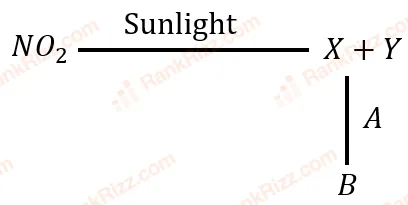
Some reactions of NO relevant to photochemical smog formation are
Identify A, B, X and Y
X = [O], Y = NO, A = O, B = O
X = NO, Y = [O], A = O, B = NO
X = O, Y = NO, A = O, B = O
X = NO, Y = [O], A = O, B = NO
The possibility of photochemical smog formation is more at
Marshy lands
Industrial areas
Himalayan villages in winter
The places with healthy vegetation
Correct statement about smog is
NO is present in classical smog
Both NO and SO are present in classical smog
Photochemical smog has high concentration of oxidizing agents
Classical smog also has high concentration of oxidizing agents
The radical which mainly causes ozone depletion in the presence of UV radiations is :
Cl
NO
H
CH
Formation of photochemical smog involves the following reaction in which A, B and C are respectively.
(i) NO A + B
(ii) B + O C
(iii) A + C NO + O
Choose the correct answer from the options below:
O, NO and NO
O, NO and NO
N, O and O
NO, O and O
Identify X, Y and Z in the following reaction. (Equation not balanced)
X = ClONO, Y = HOCl, Z = NO
X = ClNO, Y = HCl, Z = HNO
X = ClONO, Y = HOCl, Z = HNO
X = ClNO, Y = Cl, Z = NO
Which of the following are the Green house gases?
A. Water vapour
B. Ozone
C. I
D. Molecular hydrogen
Choose the most appropriate answer from the options given below :
A and D only
B and C only
A and B only
C and D only
Which of these reactions is not a part of breakdown of ozone in stratosphere?


A. Ammonium salts produce haze in atmosphere.
B. Ozone gets produced when atmospheric oxygen reacts with chlorine radicals.
C. Polychlorinated biphenyls act as cleansing solvents.
D. 'Blue baby' syndrome occurs due to the presence of excess of sulphate ions in water.
Choose the correct answer from the options below:-
A, B and C only
B and C only
A and D only
A and C only
The photochemical smog does not generally contain
The acid that is believed to be mainly responsible for the damage of Taj Mahal is
sulfuric acid.
hydrofluoric acid.
phosphoric acid.
hydrochloric acid.
On the surface of polar stratospheric clouds, hydrolysis of chlorine nitrate gives A and B while its reaction with HCl produces B and C. A, B and C are, respectively
HOCl, ,
, , HOCl
, , HOCl
HOCl, ,
Polar stratospheric clouds facilitate the formation of
HOCl
ClO
In stratosphere most of the ozone formation is assisted by:
-rays
cosmic rays
visible radiations
ultraviolet radiation
The deposition of X and Y on ground surfaces is referred as wet and dry depositions, respectively. X and Y are:
X = CO, Y = SO
X = Ammonium salts, Y = SO
X = Ammonium salts, Y = CO
X = SO, Y = Ammonium salts
Given below are two statements:
Statement I : Chlorofluoro carbons breakdown by radiation in the visible energy region and release chlorine gas in the atmosphere which then reacts with stratospheric ozone.
Statement II : Atmospheric ozone reacts with nitric oxide to give nitrogen and oxygen gases, which add to the atmosphere.
For the above statements choose the correct answer from the options given below:
Statement I is incorrect but statement II is true
Both statement I and II are false
Statement I is correct but statement II is false
Both statement I and II are correct
Reducing smog is a mixture of:
Smoke, fog and O
Smoke, fog and SO
Smoke, fog and CH = CH - CHO
Smoke, fog and NO
Given below are two statements:
Statement I: An allotrope of oxygen is an important intermediate in the formation of reducing smog.
Statement II: Gases such as oxides of nitrogen and sulphur present in troposphere contribute to the formation of photochemical smog.
In the light of the above statements, choose the correct answer from the options given below:
Both Statement I and Statement II are false
Both Statement I and Statement II are true
Statement I is true but Statement II is false
Statement I is false but Statement II is true
The incorrect statement(s) among (a) - (d) regarding acid rain is (are):
(a) It can corrode water pipes
(b) It can damage structures made up of stone.
(c) It cannot cause respiratory ailments in animals
(d) It is not harmful for trees
(a), (c) and (d)
(c) only
(a), (b) and (d)
(c) and (d)



