JEE MAIN 2023 · 24 JAN S1Gibbs energy and spontaneityTRANSCRIBED
For independent process at 300 K.
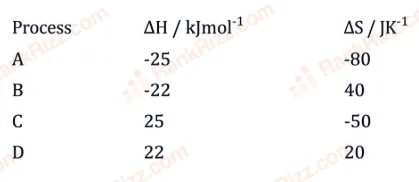
The number of non-spontaneous process from the following is _____.
Every JEE Main question on Gibbs energy and spontaneity, one of the ideas inside Chemical Thermodynamics: 54 questions from 2007–2026, 27 of them in the last five years. Newest first, answer key on every one. Free to read.
Questions
54
Years asked
16
Since
2007
Of the chapter
24%
21–40 OF 54 · NEWEST FIRST
For independent process at 300 K.
The number of non-spontaneous process from the following is _____.
For independent process at 300 K.
| Process | / kJmol | / JK |
|---|---|---|
| A | -25 | -80 |
| B | -22 | 40 |
| C | 25 | -50 |
| D | 22 | 20 |
kJ of heat is required to melt one mole of sodium chloride and the entropy change at the melting point is J K mol at 1 atm. The melting point of sodium chloride is _____ K (Nearest Integer)
The value of log K for the reaction A B at 298 K is ______. (Nearest integer)
Given: kJ mol, J K mol
(Taken )
Consider the graph of Gibbs free energy G vs extent of reaction. The number of statement/s from the following which are true with respect to points (a), (b) and (c) is ______
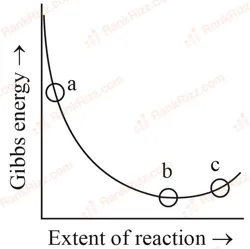
A. Reaction is spontaneous at (a) and (b)
B. Reaction is at equilibrium at point (b) and non-spontaneous at point (c)
C. Reaction is spontaneous at (a) and non-spontaneous at (c)
D. Reaction is non-spontaneous at (a) and (b)
Given below are two statements: One is labelled as Assertion A and the other is labelled as Reason R
Assertion A: The reduction of a metal oxide is easier if the metal formed is in liquid state than solid state.
Reason R: The value of becomes more on negative side as entropy is higher in liquid state than solid state.
In the light of the above statements, choose the most appropriate answer from the options given below
Both A and R are correct and R is the correct explanation of A
Both A and R are correct but R is NOT the correct explanation of A
A is correct but R is not correct
A is not correct but R is correct
The standard entropy change for the reaction
is J K at K
[Given : The standard enthalpy change for the reaction is kJ mol]. The temperature in K at which the reaction attains equilibrium is (Nearest Integer) ______
The incorrect expression among the following is:
For isothermal process
(at constant P)
During which of the following processes, does entropy decrease?
(A) Freezing of water to ice at 0°C
(B) Freezing of water to ice at -10°C
(C) N(g) + 3H(g) 2NH(g)
(D) Adsorption of CO(g) and lead surface
(E) Dissolution of NaCl in water
(A), (B), (C) and (D) only
(B) and (C) only
(A) and (E) only
(A), (C) and (E) only
For a given chemical reaction A B at 300 K the free energy change is -49.4 kJ mol and the enthalpy of reaction is 51.4 kJ mol. The entropy change of the reaction is ___ JK mol.
Assuming ideal behaviour, the magnitude of log K for the following reaction at 25°C is . The value of x is ______. (Integer answer)
[Given: J mol; J mol; R = 8.314 J K mol]
Data given for the following reaction is as follows:
FeO + C Fe + CO
Substance (kJ mol) (J mol K)
FeO -266.3 57.49
C 0 5.74
Fe 0 27.28
CO -110.5 197.6
The minimum temperature in K at which the reaction becomes spontaneous is _________. (Integer answer)
For the reaction 2NO(g) NO(g), when J K and kJ mol the magnitude of at 298 K for the reaction is _________ kJ mol. (Nearest integer)
For the reaction:
A(l) 2B(g)
kcal, cal K at 300K.
Hence in kcal is
For a dimerization reaction,
at 298K, , , then the will be .....J.
The reaction , for which kJ mol and JK mol is not feasible at 298 K. Temperature above which reaction will be feasible is
2040.5 K
1890.0 K
2480.3 K
2380.5 K
A process has J mol and J K mol. Out of the values given below choose the minimum temperature above which the process will be spontaneous:
20 K
5 K
12 K
4 K
For the chemical reaction , the standard reaction Gibbs energy depends on temperature T (in K) as (in kJ mol) . The major component of the reaction mixture at T is:
Y if T = 300 K
Y if T = 280 K
X if T = 350 K
X if T = 315 K
The standard reaction Gibbs energy for a chemical reaction at an absolute temperature T is given by where A and B are non-zero constants. Which of the following is true about this reaction?
Exothermic if
Endothermic if
Endothermic if and
Exothermic if and
A process will be spontaneous at all temperatures if:
and
and
and
and