RankRizz

First law: work, heat and internal energy — JEE Main Previous Year Questions

Every JEE Main question on First law: work, heat and internal energy, one of the ideas inside Chemical Thermodynamics: 55 questions from 2004–2026, 34 of them in the last five years. Newest first, answer key on every one. Free to read.

Questions

55

Years asked

14

Since

2004

Of the chapter

24%

Every First law: work, heat and internal energy question

21–40 OF 55 · NEWEST FIRST

JEE MAIN 2024 · 06 APR S1First law: work, heat and internal energyTRANSCRIBED

An ideal gas, Cˉv=52R\bar{C}_v = \frac{5}{2}R, is expanded adiabatically against a constant pressure of 1 atm until it doubles in volume. If the initial temperature and pressure is 298 K298 \text{ K} and 5 atm5 \text{ atm}, respectively then the final temperature is _______ K (nearest integer). [Cˉv\bar{C}_v is the molar heat capacity at constant volume]
JEE MAIN 2024 · 08 APR S1First law: work, heat and internal energyTRANSCRIBED
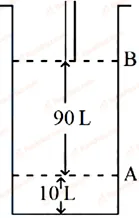
Figure for JEE Main 2024 Chemistry question on First law: work, heat and internal energy

Consider the figure provided. 1 mol of an ideal gas is kept in a cylinder, fitted with a piston, at the position A, at 18°C18°C. If the piston is moved to position B, keeping the temperature unchanged, then 'xx' L atm work is done in this reversible process. x=x = ______ L atm. (nearest integer) [Given: Absolute temperature =°C+273.15= °C + 273.15, R=0.08206 L atm mol−1K−1R = 0.08206 \text{ L atm mol}^{-1} \text{K}^{-1}]

JEE MAIN 2024 · 08 APR S2First law: work, heat and internal energyTRANSCRIBED

ΔvapH⊖\Delta_{vap}H^{\ominus} for water is +40.79 kJ mol−1+40.79 \text{ kJ mol}^{-1} at 1 bar and 100°C100°C. Change in internal energy for this vapourisation under same condition is _____ kJ mol−1\text{kJ mol}^{-1}. (Given R=8.3 JK−1mol−1R = 8.3 \text{ JK}^{-1}\text{mol}^{-1})

JEE MAIN 2024 · 27 JAN S1First law: work, heat and internal energyTRANSCRIBED

If three moles of an ideal gas at 300300 K expand isothermally from 30 dm330 \text{ dm}^3 to 45 dm345 \text{ dm}^3 against a constant opposing pressure of 8080 kPa, then the amount of heat transferred is _________ J.

JEE MAIN 2024 · 30 JAN S1First law: work, heat and internal energyTRANSCRIBED

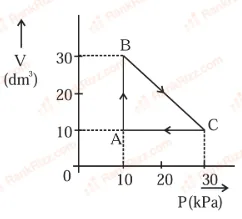
An ideal gas undergoes a cyclic transformation starting from the point AA and coming back to the same point by tracing the path A→B→C→AA \rightarrow B \rightarrow C \rightarrow A as shown in the diagram. The total work done in the process is _____ J.

Figure for JEE Main 2024 Chemistry question on First law: work, heat and internal energy
JEE MAIN 2023 · 30 JAN S2First law: work, heat and internal energyTRANSCRIBED

1 mole of ideal gas is allowed to expand reversibly and adiabatically from a temperature of 27°27°C. The work done is 33 kJ mol−1^{-1}. The final temperature of the gas is ______ K (Nearest integer). Given Cv=20C_v = 20 J mol−1^{-1} K−1^{-1}

JEE MAIN 2023 · 30 JAN S1First law: work, heat and internal energyTRANSCRIBED

When 2 litre of ideal gas expands isothermally into vacuum to a total volume of 6 litre, the change in internal energy is ______ J. (Nearest integer)

JEE MAIN 2023 · 24 JAN S2First law: work, heat and internal energyTRANSCRIBED

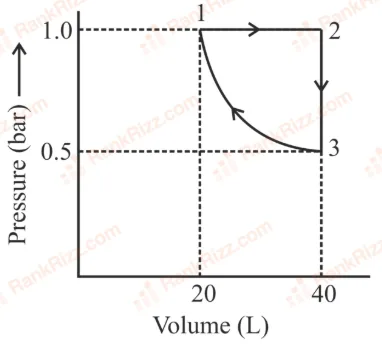
One mole of an ideal monoatomic gas is subjected to changes as shown in the graph. The magnitude of the work done (by the system or on the system) is _____ J (nearest integer)

Figure for JEE Main 2023 Chemistry question on First law: work, heat and internal energy

Given: log 2 = 0.3, ln 10 = 2.3

JEE MAIN 2023 · 08 APR S1First law: work, heat and internal energyTRANSCRIBED

When a 60 W electric heater is immersed in a gas for 100 s in a constant volume container with adiabatic walls, the temperature of the gas rises by 5°C. The heat capacity of the given gas is JK−1^{-1} (Nearest integer)

JEE MAIN 2022 · 29 JUN S2First law: work, heat and internal energyTRANSCRIBED

2.2 g of nitrous oxide (N2_2O) gas is cooled at a constant pressure of 1 atm from 310 K to 270 K causing the compression of the gas from 217.1 mL to 167.75 mL. The change in internal energy of the process, Δ\DeltaU is '-x'J. The value of 'x' is ______.
[nearest integer]
(Given: atomic mass of N = 14 g mol−1^{-1} and of O = 16 g mol−1^{-1}. Molar heat capacity of N2_2O is 100 JK−1^{-1} mol−1^{-1})

JEE MAIN 2022 · 28 JUN S1First law: work, heat and internal energyTRANSCRIBED

4.04.0 L of an ideal gas is allowed to expand isothermally into vacuum until the total volume is 2020 L. The amount of heat absorbed in this expansion is ______ L atm.

JEE MAIN 2022 · 27 JUL S1First law: work, heat and internal energyTRANSCRIBED

The molar heat capacity for an ideal gas at constant pressure is 20.785 J K−1 mol−120.785 \text{ J K}^{-1} \text{ mol}^{-1}. The change in internal energy is 5000 J5000 \text{ J} upon heating it from 300 K300 \text{ K} to 500 K500 \text{ K}. The number of moles of the gas at constant volume is ______ (Given: R=8.314 J K−1 mol−1R = 8.314 \text{ J K}^{-1} \text{ mol}^{-1})

JEE MAIN 2022 · 26 JUN S2First law: work, heat and internal energyTRANSCRIBED

A fish swimming in water body when taken out from the water body is covered with a film of water of weight 3636 g. When it is subjected to cooking at 100°100°C, then the internal energy for vaporization in kJ mol−1^{-1} is ______ [integer]
[Assume steam to be an ideal gas. Given ΔvapH∘\Delta_{vap}H^\circ for water at 373373 K and 11 bar is 41.141.1 kJ mol−1^{-1} : R=8.31R = 8.31 J K−1^{-1} mol−1^{-1}]

JEE MAIN 2022 · 27 JUL S2First law: work, heat and internal energyTRANSCRIBED

A gas (Molar mass = 280 g mol−1^{-1}) was burnt in excess O2O_2 in a constant volume calorimeter and during combustion the temperature of calorimeter increased from 298.0 K to 298.45 K. If the heat capacity of calorimeter is 2.5 kJ K−1^{-1} and enthalpy of combustion of gas is 9 kJ mol−1^{-1} then amount of gas burnt is _____ g.

JEE MAIN 2021 · 25 FEB S1First law: work, heat and internal energyTRANSCRIBED

The reaction of cyanamide, NH2CN(s)NH_2CN_{(s)} with oxygen was run in a bomb calorimeter and ΔU\Delta U was found to be −742.24-742.24 kJ mol−1^{-1}. The magnitude of ΔH298\Delta H_{298} for the reaction
NH2CN(s)+32O2(g)→N2(g)+O2(g)+H2O(l)NH_2CN_{(s)} + \frac{3}{2}O_{2(g)} \to N_{2(g)} + O_{2(g)} + H_2O_{(l)} is ______ kJ. (Rounded off to the nearest integer) [Assume ideal gases and R = 8.314 J mol−1^{-1} K−1^{-1}]

JEE MAIN 2021 · 25 FEB S2First law: work, heat and internal energyTRANSCRIBED

Five moles of an ideal gas at 293 K is expanded isothermally from an initial pressure of 2.1 MPa to 1.3 MPa against at constant external pressure 4.3 MPa. The heat transferred in this process is ______ kJ mol−1^{-1}.
(Rounded-off to the nearest integer)
[Use R=8.314R = 8.314 J mol−1^{-1} K−1^{-1}]

JEE MAIN 2021 · 16 MAR S2First law: work, heat and internal energyTRANSCRIBED

At 25°C, 50 g of iron reacts with HCl to form FeCl2FeCl_2. The evolved hydrogen gas expands against a constant pressure of 1 bar. The work done by the gas during this expansion is ________ J. (Round off to the Nearest Integer)
[Given: R=8.314R = 8.314 J mol−1^{-1} K−1^{-1}. Assume, hydrogen is an ideal gas]
[Atomic mass of Fe is 55.85 u]

JEE MAIN 2021 · 25 JUL S2First law: work, heat and internal energyTRANSCRIBED

A system does 200 J of work and at the same time absorbs 150 J of heat. The magnitude of the change in internal energy is _________J. (Nearest integer)

JEE MAIN 2020 · 04 SEP S2First law: work, heat and internal energyTRANSCRIBED

Five moles of an ideal gas at 1 bar and 298 K is expanded into vacuum to double the volume. The work done is:

  1. A

    Cv(T2−T1)C_v(T_2 - T_1)

  2. B

    −RT(V2−V1)-RT(V_2 - V_1)

  3. C

    −RTln⁡V2/V1-RT \ln V_2/V_1

  4. D

    Zero

JEE MAIN 2020 · 08 JAN S1First law: work, heat and internal energyTRANSCRIBED

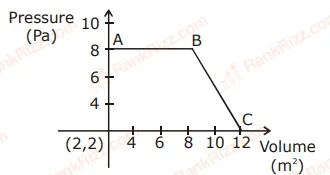
The magnitude of work done by a gas that undergoes a reversible expansion along the path ABC shown in the figure is __________.

Figure for JEE Main 2020 Chemistry question on First law: work, heat and internal energy