JEE MAIN 2020 · 08 JAN S2First law: work, heat and internal energyTRANSCRIBED
At constant volume, 4 mol of an ideal gas when heated from 300K to 500K changes its internal energy by 5000J. The molar heat capacity at constant volume is
Every JEE Main question on First law: work, heat and internal energy, one of the ideas inside Chemical Thermodynamics: 55 questions from 2004–2026, 34 of them in the last five years. Newest first, answer key on every one. Free to read.
Questions
55
Years asked
14
Since
2004
Of the chapter
24%
41–55 OF 55 · NEWEST FIRST
At constant volume, 4 mol of an ideal gas when heated from 300K to 500K changes its internal energy by 5000J. The molar heat capacity at constant volume is
Which one of the following equations does not correctly represent the first law of thermodynamics for the given processes involving an ideal gas? (Assume non-expansion work is zero)
Isochoric process:
Isochoric process:
Cyclic process:
Adiabatic process:
An ideal gas undergoes isothermal compression from 5 m to 1 m against a constant external pressure of 4 N m. The heat released in this process is 24 J mol K and is used to increase the pressure of 1 mole of Al. The temperature of Al increases by:
K
1 K
K
2 K
An ideal gas is allowed to expand from 1 L to 10 L against a constant external pressure of 1 bar. The work done in kJ is:
+10.0
-2.0
-0.9
-9.0
During compression of a spring the work done is 10 kJ and 2 kJ escaped to the surroundings as heat. The change in internal energy, (in kJ) is:
-8
8
12
-12
5 moles of an ideal gas at 100 K are allowed to undergo reversible compression till its temperature becomes 200 K. If J K, calculate and for the process. (R = 8.0 J K mol)
J; J
kJ; kJ
kJ; kJ
kJ; kJ
The combustion of benzene (l) gives CO(g) and HO(l). Given that heat of combustion of benzene at constant volume is kJ mol at 25C; the heat of combustion (in kJ mol) of benzene at constant pressure will be:
(R = 8.314 JK mol)
-3267.6
4152.6
-452.46
3260
An ideal gas undergoes a cyclic process as shown in Figure.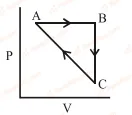
kJ mol, kJ mol
kJ mol, kJ mol
Heat absorbed by the system during process CA is:
-5 kJ mol
+5 kJ mol
18 kJ mol
-18 kJ mol
is equal to:
Isobaric work
Adiabatic work
Isothermal work
Isochoric work
A gas undergoes change from state A to state B. In this process, the heat absorbed and work done by the gas is 5 J and 8 J, respectively. Now gas is brought back to A by another process during which 3 J of heat is evolved. In this reverse process of B to A.
6 J of the work will be done by the gas
6 J of the work will be done by the surroundings on gas
10 J of the work will be done by the surroundings on gas
10 J of the work will be done by the gas on gas
If 100 mole of decompose at 1 bar and 300 K, the work is done (kJ) by one mole of as it expands against 1 bar pressure is:
J K mol
124.50
249.00
498.00
62.25
Which of the following statements/relationships is not correct in thermodynamic changes?
(isothermal reversible expansion of a gas)
(isothermal reversible expansion of an ideal gas)
(isothermal reversible expansion of an ideal gas)
For a system of constant volume heat involved directly changes to internal energy.
A piston filled with 0.04 mol of an ideal gas expands reversibly from 50.0 mL to 375 mL at a constant temperature of 37.0°C. The values of q and w for the process will be
(R = 8.314 J/mol K) (ln7.5 = 2.01)
q = -208 J, w = +208 J
q = +208 J, w = +208 J
q = +208 J, w = -208 J
q = -208 J, w = -208 J
An ideal gas is allowed to expand both reversibly and irreversibly in an isolated system. If is the initial temperature and is the final temperature, which of the following statements is correct?
for reversible process but for irreversible process
for both reversible and irreversible processes
An ideal gas expands in volume from m to m at K against a constant pressure of N m. The work done is
J
kJ
kJ
kJ