JEE MAIN 2026 · 28 JAN S1Work done in thermodynamic processes and P-V diagramsTRANSCRIBED
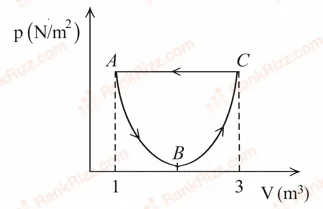
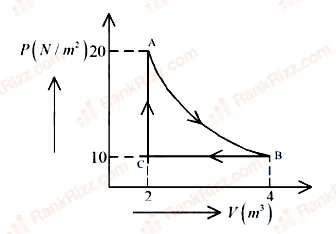
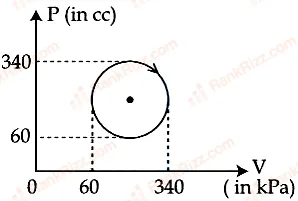
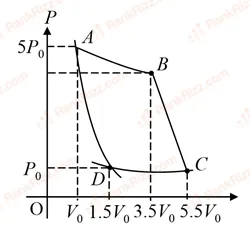
In the following p- V diagram the equation of state along the curved path is given by where a is a constant. The total work done in the closed path is
- A
- B
- C
- D
Every JEE Main question on Work done in thermodynamic processes and P-V diagrams, one of the ideas inside Thermodynamics: 30 questions from 2009–2026, 11 of them in the last five years. Newest first, answer key on every one. Free to read.
Questions
30
Years asked
15
Since
2009
Of the chapter
16%
Questions on Work done in thermodynamic processes and P-V diagrams in each year it was asked, the latest 12 of 15.
1–20 OF 30 · NEWEST FIRST
In the following p- V diagram the equation of state along the curved path is given by where a is a constant. The total work done in the closed path is
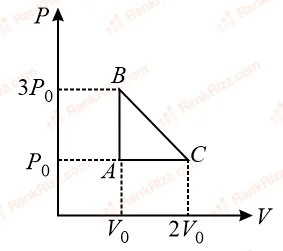
A thermodynamic system is taken through the cyclic process as shown in the figure. The total work done by the system during the cycle is ______ J.
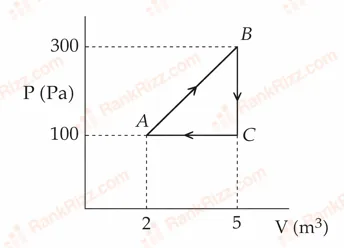
The magnitude of heat exchanged by a system for the given cyclic process ABCA (as shown in figure) is (in SI unit) :
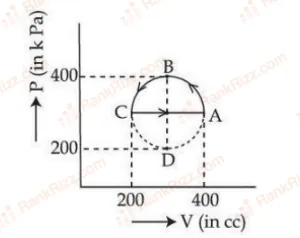
zero
An ideal gas exists in a state with pressure , volume . It is isothermally expanded to 4 times of its initial volume , then isobarically compressed to its original volume. Finally the system is heated isochorically to bring it to its initial state. The amount of heat exchanged in this process is:
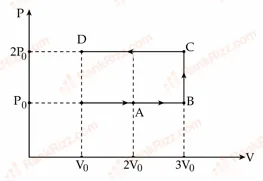
Using the given P - V diagram, the work done by an ideal gas along the path ABCD is :
An ideal gas has undergone through the cyclic process as shown in the figure. Work done by the gas in the entire cycle is ______ J. (Take )
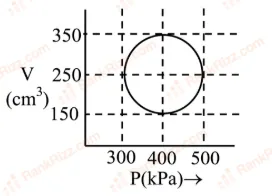
A real gas within a closed chamber at undergoes the cyclic process as shown in figure. The gas obeys equation for the path to . The net work done in the complete cycle is (assuming ):
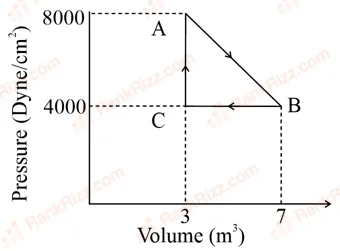
A thermodynamic system is taken from an original state to an intermediate state by a linear process as shown in the figure. Its volume is then reduced to the original value from to by an isobaric process. The total work done by the gas from to and to would be :
J
J
J
J
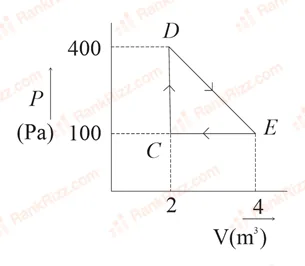
The heat absorbed by a system in going through the given cyclic process is :
A thermodynamic system is taken through cyclic process. The total work done in the process is :
J
J
J
Zero
A thermodynamic system is taken from an original state D to an intermediate state E by the linear process shown in the figure. Its volume is then reduced to the original volume from E to F by an isobaric process. The total work done by the gas from D to E to F will be
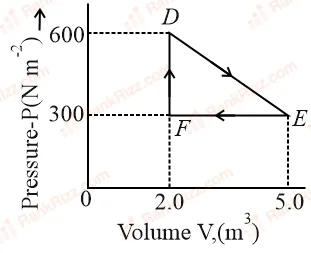
-450 J
450 J
900 J
1350 J
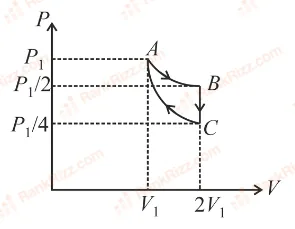
If one mole of an ideal gas at is allowed to expand reversibly and isothermally (A to B) its pressure is reduced to one-half of the original pressure (see figure). This is followed by a constant volume cooling till its pressure is reduced to one-fourth of the initial value . Then it is restored to its initial state by a reversible adiabatic compression (C to A). The net work done by the gas is equal to:
0
In the reported figure, there is a cyclic process on a sample of 1 mol of a diatomic gas. The temperature of the gas during the process and are and () respectively.
Choose the correct option out of the following for work done if processes and are adiabatic.
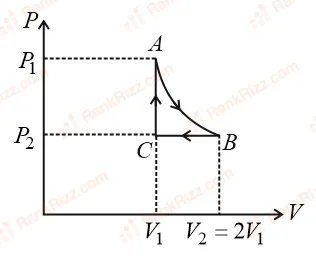
mole of a perfect gas undergoes a cyclic process ABCA (see figure) consisting of the following processes.
: Isothermal expansion at temperature so that the volume is doubled from to and pressure changes from to
: Isobaric compression at pressure to initial volume .
: Isochoric change leading to change of pressure from to
Total work done in the complete cycle ABCA is:
0
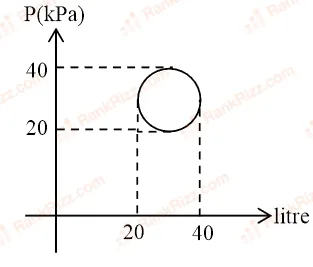
In the reported figure, heat energy absorbed by a system in going through a cyclic process is ___ J.
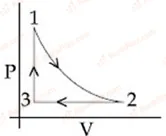
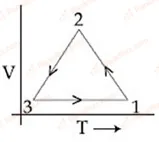
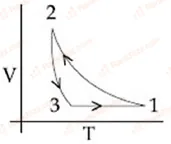
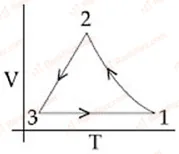
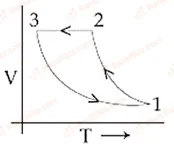
Which of the following is an equivalent cyclic process corresponding to the thermodynamic cyclic given in the figure? Where, is adiabatic. (Graphs are schematic and are not to scale)
Three different processes that can occur in an ideal monoatomic gas are shown in the vs diagram. The paths are labelled as , and . The change in internal energies during these processes are taken as , and and the work done as , and . The correct relation between these parameters are:
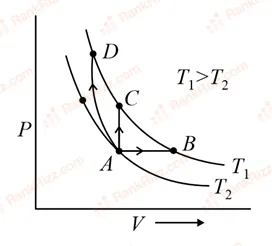
, , ,
, , ,
, ,
,
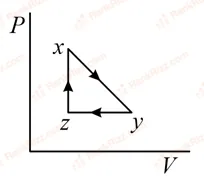
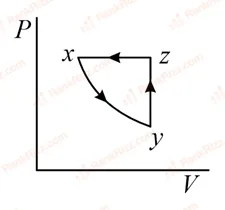
A thermodynamic cycle xyzx is shown on a V-T diagram.
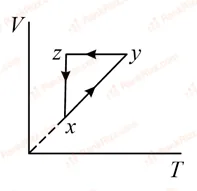
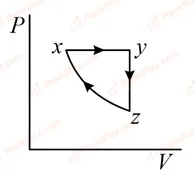
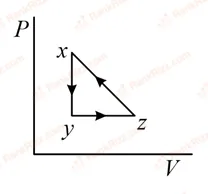
The P-V diagram that best describes this cycle is: (Diagrams are schematic and not to scale)
For the given cyclic process CAB as shown for a gas, the work done is:
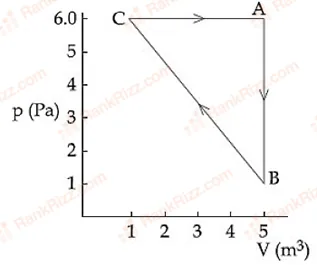
10 J
5 J
1 J
30 J
One mole of an ideal monatomic gas is taken along the path ABCA as shown in the PV diagram. The maximum temperature attained by the gas along the path BC is given by: