RankRizz

Isothermal and adiabatic processes — JEE Main Previous Year Questions

Every JEE Main question on Isothermal and adiabatic processes, one of the ideas inside Thermodynamics: 54 questions from 2006–2026, 33 of them in the last five years. Newest first, answer key on every one. Free to read.

Questions

54

Years asked

14

Since

2006

Of the chapter

28%

When JEE Main asked it

Questions on Isothermal and adiabatic processes in each year it was asked, the latest 12 of 14.

20265
20259
20247
20237
20225
20216
20205
20192
20181
20151
20141
20131

Every Isothermal and adiabatic processes question

1–20 OF 54 · NEWEST FIRST

JEE MAIN 2026 · 23 JAN S2Isothermal and adiabatic processesTRANSCRIBED

One mole of an ideal diatomic gas expands from volume VV to 2V2 V isothermally at a temperature 27oC27^{o}C and does W joule of work. lf the gas undergoes same magnitude of expansion adiabatically from 27oC27^{o}C doing the same amount of work WW, then its final temperature will be (close to) ____ ∘C.^{\circ}C.
(log⁡e2=0.693)(\log_{e}2 = 0.693)

  1. A

    -189

  2. B

    -117

  3. C

    -30

  4. D

    -56

JEE MAIN 2026 · 22 JAN S1Isothermal and adiabatic processesTRANSCRIBED

The volume of an ideal gas increases 8 times and temperature becomes (1/4)th(1/4)^{th} of initial temperature during a reversible change. If there is no exchange of heat in this process (△Q=0)(\triangle Q = 0) then identify the gas from the following options (Assuming the gases given in the options are ideal gases):

  1. A

    NH3NH_{3}

  2. B

    $$He

  3. C

    O2O_{2}

  4. D

    CO2CO_{2}

JEE MAIN 2026 · 06 APR S2Isothermal and adiabatic processesTRANSCRIBED

A cylinder with adiabatic walls is closed at both ends and is divided into two compartments by a frictionless adiabatic piston. Ideal gas is filled in both (left and right) the compartments at same P, V, T. Heating is started from left side until pressure changes to 27P/827 P/8. If initial volume of each compartment was 9 litres then the final volume in right-hand side compartment is __________ litres. (for this ideal gas CP/CV=1.5C_P/C_V = 1.5)

  1. A

    3

  2. B

    4

  3. C

    14

  4. D

    9

JEE MAIN 2026 · 08 APR S2Isothermal and adiabatic processesTRANSCRIBED

Initial pressure and volume of a monoatomic ideal gas are PP and VV. The change in internal energy of this gas in adiabatic expansion to volume Vfinal=27VV_{final} = 27V is __________ J.

  1. A

    −2PV(33−1)-2PV(3\sqrt{3} - 1)

  2. B

    43PV\frac{4}{3}PV

  3. C

    −43PV-\frac{4}{3}PV

  4. D

    34PV\frac{3}{4}PV

JEE MAIN 2026 · 02 APR S1Isothermal and adiabatic processesTRANSCRIBED

A vessel contains 0.15 m3^3 of a gas at pressure 8 bar and temperature 140 °C with cp=3Rc_p = 3R and cv=2Rc_v = 2R. It is expanded adiabatically till pressure falls to 1 bar. The work done during this process is __________ kJ. (R is gas constant)

JEE MAIN 2025 · 29 JAN S2Isothermal and adiabatic processesTRANSCRIBED

Given below are two statements. One is labelled as Assertion (A) and the other is labelled as Reason (R).
Assertion (A) : With the increase in the pressure of an ideal gas, the volume falls off more rapidly in an isothermal process in comparison to the adiabatic process.
Reason (R) : In isothermal process, PV = constant, while in adiabatic process PVγPV^{\gamma} = constant. Here γ\gamma is the ratio of specific heats, P is the pressure and V is the volume of the ideal gas. In the light of the above statements, choose the correct answer from the options given below :

  1. A

    Both (A) and (R) are true and (R) is the correct explanation of (A)

  2. B

    Both (A) and (R) are true but (R) is NOT the correct explanation of (A)

  3. C

    (A) is true but (R) is false

  4. D

    (A) is false but (R) is true

JEE MAIN 2025 · 02 APR S2Isothermal and adiabatic processesTRANSCRIBED

Identify the characteristics of an adiabatic process in a monoatomic gas.
(A) Internal energy is constant.
(B) Work done in the process is equal to the change in internal energy.
(C) The product of temperature and volume is a constant.
(D) The product of pressure and volume is a constant.
(E) The work done to change the temperature from T1T_1 to T2T_2 is proportional to (T2−T1)(T_2 - T_1)

Choose the correct answer from the options given below :

  1. A

    (A), (C), (D) only

  2. B

    (A), (C), (E) only

  3. C

    (B), (E) only

  4. D

    (B), (D) only

JEE MAIN 2025 · 08 APR S2Isothermal and adiabatic processesTRANSCRIBED

A monoatomic gas having γ=53\gamma = \frac{5}{3} is stored in a thermally insulated container and the gas is suddenly compressed to (18)th\left(\frac{1}{8}\right)^{\text{th}} of its initial volume. The ratio of final pressure and initial pressure is :
(γ\gamma is the ratio of specific heats of the gas at constant pressure and at constant volume)

  1. A

    16

  2. B

    40

  3. C

    32

  4. D

    28

JEE MAIN 2025 · 02 APR S1Isothermal and adiabatic processesTRANSCRIBED

In an adiabatic process, which of the following statements is true?

  1. A

    The molar heat capacity is infinite

  2. B

    Work done by the gas equals the increase in internal energy

  3. C

    The molar heat capacity is zero

  4. D

    The internal energy of the gas decreases as the temperature increases

JEE MAIN 2025 · 03 APR S1Isothermal and adiabatic processesTRANSCRIBED

A gas is kept in a container having walls which are thermally non-conducting. Initially the gas has a volume of 800 cm3^3 and temperature 27°C. The change in temperature when the gas is adiabatically compressed to 200 cm3^3 is :
(Take γ=1.5\gamma = 1.5 : γ\gamma is the ratio of specific heats at constant pressure and at constant volume)

  1. A

    327327 K

  2. B

    600600 K

  3. C

    522522 K

  4. D

    300300 K

JEE MAIN 2025 · 29 JAN S1Isothermal and adiabatic processesTRANSCRIBED

The workdone in an adiabatic change in an ideal gas depends upon only :

  1. A

    change in its temperature

  2. B

    change in its volume

  3. C

    change in its pressure

  4. D

    change in its specific heat

JEE MAIN 2025 · 29 JAN S2Isothermal and adiabatic processesTRANSCRIBED
page7_img3


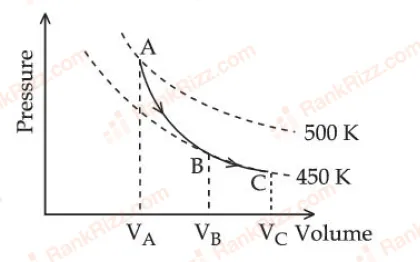
A poly-atomic molecule (CV=3R, CP=4RC_V = 3R,\, C_P = 4R, where R is gas constant) goes from phase space point A (PA=105 Pa, VA=4×10⁻⁶ mA\ (P_A = 10^5\,\text{Pa},\ V_A = 4 \times 10^{-6}\,\text{m} to point B (PB=5×10⁴ Pa, VB=6×10⁻⁶ m3)B\ (P_B = 5 \times 10^4\,\text{Pa},\ V_B = 6 \times 10^{-6}\,\text{m}^3) to point C (PC=104 Pa,  VC=8×10⁻⁶ m3).C\,(P_C = 10^4\,\text{Pa},\; V_C = 8 \times 10^{-6}\,\text{m}^3). A to B is an adiabatic path B and C to is an isothermal path. The net heat absorbed per unit mole by the system is :

  1. A

    500R(ln 3 + ln 4)

  2. B

    450R(ln 4 − ln 3)

  3. C

    500R ln 2

  4. D

    400R ln 4

JEE MAIN 2025 · 24 JAN S2Isothermal and adiabatic processesTRANSCRIBED

Given below are two statements. One is labelled as Assertion (A) and the other is labelled as Reason (R). Assertion (A) : In an insulated container, a gas is adiabatically shrunk to half of its initial volume. The temperature of the gas decreases. Reason (R): Free expansion of an ideal gas is an irreversible and an adiabatic process. In the light of the above statements, choose the correct answer from the options given below :

  1. A

    Both (A) and (R) are true but (R) is NOT the correct explanation of (A)

  2. B

    (A) is false but (R) is true

  3. C

    (A) is true but (R) is false

  4. D

    Both (A) and (R) are true and (R) is the correct explanation of (A)

JEE MAIN 2025 · 23 JAN S1Isothermal and adiabatic processesTRANSCRIBED

An ideal gas initially at 0∘0^{\circ}C temperature, is compressed suddenly to one fourth of its volume. If the ratio of specific heat at constant pressure to that at constant volume is 3/2, the change in temperature due to the thermodynamic process is _____ K.

JEE MAIN 2024 · 27 JAN S2Isothermal and adiabatic processesTRANSCRIBED

During an adiabatic process, the pressure of a gas is found to be proportional to the cube of its absolute temperature. The ratio of CpCv\frac{C_p}{C_v} for the gas is :

  1. A

    53\frac{5}{3}

  2. B

    32\frac{3}{2}

  3. C

    75\frac{7}{5}

  4. D

    97\frac{9}{7}

JEE MAIN 2024 · 30 JAN S2Isothermal and adiabatic processesTRANSCRIBED


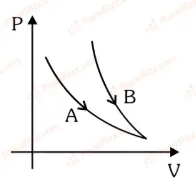
Choose the correct statement for processes AA & BB shown in figure.

Figure for JEE Main 2024 Physics question on Isothermal and adiabatic processes
  1. A

    PVγ=kPV^{\gamma} = k for process BB and PV=kPV = k for process AA

  2. B

    PV=kPV = k for process BB and AA

  3. C

    Pγ−1Tγ=k\frac{P^{\gamma-1}}{T^{\gamma}} = k for process BB and T=kT = k for process AA

  4. D

    TγPγ−1=k\frac{T^{\gamma}}{P^{\gamma-1}} = k for process AA and PV=kPV = k for process BB

JEE MAIN 2024 · 04 APR S2Isothermal and adiabatic processesTRANSCRIBED

A sample of gas at temperature TT is adiabatically expanded to double its volume. Adiabatic constant for the gas is γ=3/2\gamma = 3/2. The work done by the gas in the process is: (μ=1\mu = 1 mole)

  1. A

    RT[1−22]RT[1 - 2\sqrt{2}]

  2. B

    RT[2−2]RT[\sqrt{2} - 2]

  3. C

    RT[2−2]RT[2 - \sqrt{2}]

  4. D

    RT[22−1]RT[2\sqrt{2} - 1]

JEE MAIN 2024 · 05 APR S2Isothermal and adiabatic processesTRANSCRIBED

During an adiabatic process, if the pressure of a gas is found to be proportional to the cube of its absolute temperature, then the ratio of CPCV\frac{C_P}{C_V} for the gas is :

  1. A

    53\frac{5}{3}

  2. B

    97\frac{9}{7}

  3. C

    32\frac{3}{2}

  4. D

    75\frac{7}{5}

JEE MAIN 2024 · 09 APR S1Isothermal and adiabatic processesTRANSCRIBED

A sample of 1 mole gas at temperature T is adiabatically expanded to double its volume. If adiabatic constant for the gas is γ=32\gamma = \frac{3}{2}, then the work done by the gas in the process is:

  1. A

    RT[2−2]\frac{R}{T}[2 - \sqrt{2}]

  2. B

    TR[2+2]\frac{T}{R}[2 + \sqrt{2}]

  3. C

    RT[2−2]RT[2 - \sqrt{2}]

  4. D

    RT[2+2]RT[2 + \sqrt{2}]

JEE MAIN 2024 · 08 APR S1Isothermal and adiabatic processesTRANSCRIBED

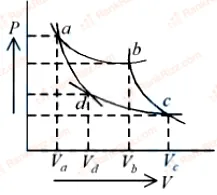
Two different adiabatic paths for the same gas intersect two isothermal curves as shown in P-V diagram. The relation between the ratio VaVd\frac{V_a}{V_d} and the ratio VbVc\frac{V_b}{V_c} is:

Figure for JEE Main 2024 Physics question on Isothermal and adiabatic processes
  1. A

    VaVd≠VbVc\frac{V_a}{V_d} \neq \frac{V_b}{V_c}

  2. B

    VaVd=VbVc\frac{V_a}{V_d} = \frac{V_b}{V_c}

  3. C

    VaVd=(VbVc)−1\frac{V_a}{V_d} = \left(\frac{V_b}{V_c}\right)^{-1}

  4. D

    VaVd=(VbVc)2\frac{V_a}{V_d} = \left(\frac{V_b}{V_c}\right)^2