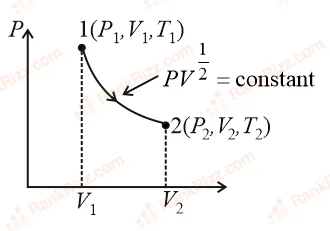
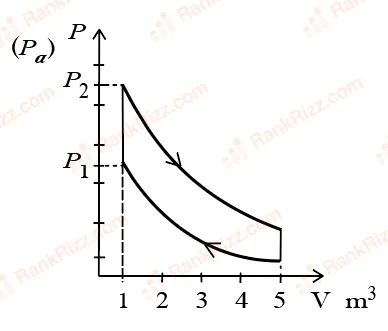
10 mole of an ideal gas is undergoing the process showu in the figure. The heat involved in the process from to is Joule(P_{1}= 21.7Pa and Pa, ) The value of is _________.
- A
28
- B
15
- C
24
- D
21
Every JEE Main question on Isobaric, isochoric and polytropic processes, one of the ideas inside Thermodynamics: 23 questions from 2014–2026, 12 of them in the last five years. Newest first, answer key on every one. Free to read.
Questions
23
Years asked
9
Since
2014
Of the chapter
12%
Questions on Isobaric, isochoric and polytropic processes in each year it was asked.
1–20 OF 23 · NEWEST FIRST
10 mole of an ideal gas is undergoing the process showu in the figure. The heat involved in the process from to is Joule(P_{1}= 21.7Pa and Pa, ) The value of is _________.

28
15
24
21
An ideal gas at pressure and temperature is expanding such that . The coefficient of volume expansion of the gas is :
An ideal gas undergoes a process maintaining relation between pressure and volume as , where and are constants. If two samples A and B (two moles each) with initial volumes and respectively undergo above mentioned process and attain same pressure, then the difference of the temperatures of these samples, is :
(R = gas constant)
An ideal gas goes from an initial state to final state. During the process, the pressure of gas increases linearly with temperature.
A. The work done by gas during the process is zero.
B. The heat added to gas is different from change in its internal energy.
C. The volume of the gas is increased.
D. The internal energy of the gas is increased.
E. The process is isochoric (constant volume process) Choose the correct answer from the options given below:
E Only
A, B, C, D Only
A, D, E Only
A, C Only
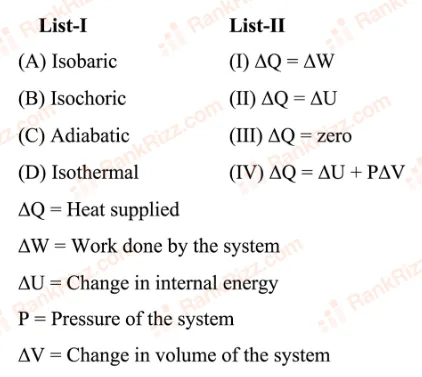
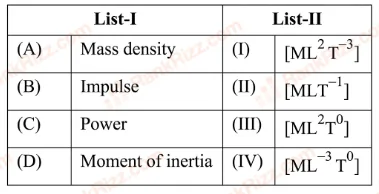
Match List-I with List-II.
Choose the correct answer from the options given below :
(A)-(IV), (B)-(II), (C)-(III), (D)-(I)
(A)-(I), (B)-(III), (C)-(IV), (D)-(II)
(A)-(IV), (B)-(II), (C)-(I), (D)-(III)
(A)-(II), (B)-(III), (C)-(IV), (D)-(I)
Match List-I with List-II.

Choose the correct answer from the options given below :
(A)-(IV), (B)-(III), (C)-(II), (D)-(I)
(A)-(IV), (B)-(I), (C)-(III), (D)-(II)
(A)-(IV), (B)-(II), (C)-(III), (D)-(I)
(A)-(II), (B)-(IV), (C)-(III), (D)-(I)
The pressure and volume of an ideal gas are related as (Constant). The work done when the gas is taken from state to state is :
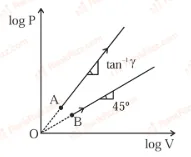
Two thermodynamical processes are shown in the figure. The molar heat capacity for process and are and . The molar heat capacity at constant pressure and constant volume are represented by and , respectively. Choose the correct statement.

and
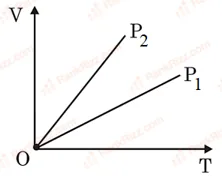
The given figure represents two isobaric processes for the same mass of an ideal gas, then

Match List I with List II:
A. Isothermal Process I. Work done by the gas decreases internal energy
B. Adiabatic Process II. No change in internal energy
C. Isochoric Process III. The heat absorbed goes partly to increase internal energy and partly to do work
D. Isobaric Process IV. No work is done on or by the gas
Choose the correct answer from the options below:
A-II, B-I, C-III, D-IV
A-II, B-I, C-IV, D-III
A-I, B-II, C-IV, D-III
A-I, B-II, C-III, D-IV
mole of certain monoatomic ideal gas undergoes a temperature increase of at constant pressure. The increase in the internal energy of the gas in this process is (Given )
A monoatomic gas performs a work of where is the heat supplied to it. The molar heat capacity of the gas will be ______ .
Where is the gas constant.
Thermodynamic process is shown below on a diagram for one mole of an ideal gas. If , then the ratio of temperature is:

2
Match List I with List II.
| List I | List II |
|---|---|
| (a) Isothermal | (i) Pressure constant |
| (b) Isochoric | (ii) Temperature constant |
| (c) Adiabatic | (iii) Volume constant |
| (d) Isobaric | (iv) Heat content is constant |
Choose the correct answer from the options given below:
(a)(ii), (b)(iii), (c)(iv), (d)(i)
(a)(iii), (b)(ii), (c)(i), (d)(iv)
(a)(i), (b)(iii), (c)(ii), (d)(iv)
(a)(ii), (b)(iv), (c)(iii), (d)(i)
For an ideal gas the instantaneous change in pressure with volume is given by the equation . If at is the given boundary condition, then the maximum temperature one mole of gas can attain is: (Here is the gas constant)
infinity
0°C
In a certain thermodynamical process, the pressure of a gas depends on its volume as . The work done when the temperature changes from 100°C to 300°C will be where denotes number of moles of a gas, find .
The volume of a given mass of monoatomic gas changes with temperature according to the relation . The workdone when temperature changes by 90 K will be . The value of is [R universal gas constant]
The temperature of 3.00 mol of an ideal diatomic gas is increased by 40.0°C without changing the pressure of the gas. The molecules in the gas rotate but do not oscillate. If the ratio of change in internal energy of the gas to the amount of workdone by the gas is . Then the value of (round off to the nearest integer) is _________.
(Given R = 8.31 J )
Half mole of an ideal monoatomic gas is heated at a constant pressure of 1 atm from 20C to 90C. Work done by the gas is
73 J
581 J
291 J
146 J
In a process, temperature and volume of one mole of an ideal monoatomic gas are varied according to the relation VT = K, where K is a constant. In this process the temperature of the gas is increased by . The amount of heat absorbed by gas is (R is gas constant):