RankRizz

Second law, heat engines, refrigerators and reversibility — JEE Main Previous Year Questions

Every JEE Main question on Second law, heat engines, refrigerators and reversibility, one of the ideas inside Thermodynamics: 12 questions from 2005–2025, 2 of them in the last five years. Newest first, answer key on every one. Free to read.

Questions

12

Years asked

10

Since

2005

Of the chapter

6%

When JEE Main asked it

Questions on Second law, heat engines, refrigerators and reversibility in each year it was asked.

20251
20211
20202
20171
20151
20131
20122
20101
20071
20051

Every Second law, heat engines, refrigerators and reversibility question

1–12 OF 12 · NEWEST FIRST

JEE MAIN 2025 · 23 JAN S2Second law, heat engines, refrigerators and reversibilityTRANSCRIBED

Water of mass m gram is slowly heated to increase the temperature from T1T_{1} to T2T_{2} The change in entropy of the water, given specific heat of water is 1Jkg−1K−11Jkg^{-1}K^{-1}, is :

  1. A

    mln(T2T1)mln(\frac{T_{2}}{T_{1}})

  2. B

    zero

  3. C

    mln(T1T2)mln(\frac{T_{1}}{T_{2}})

  4. D

    m(T2−T1)m(T_{2}-T_{1})

JEE MAIN 2021 · 18 MAR S2Second law, heat engines, refrigerators and reversibilityTRANSCRIBED

An ideal gas in a cylinder is separated by a piston in such a way that the entropy of one part is S1S_1 and that of the other part is S2S_2. Given that S1>S2S_1 > S_2. If the piston is removed then the total entropy of the system will be:

  1. A

    S1×S2S_1 \times S_2

  2. B

    S1−S2S_1 - S_2

  3. C

    S1S2\frac{S_1}{S_2}

  4. D

    S1+S2S_1 + S_2

JEE MAIN 2020 · 02 SEP S2Second law, heat engines, refrigerators and reversibilityTRANSCRIBED

A heat engine is involved with exchange of heat of 1915 J, −40-40 J, +125+125 J and −Q-Q J, during one cycle achieving and efficiency of 50.0%. The value of Q is:

  1. A

    640 J

  2. B

    40 J

  3. C

    980 J

  4. D

    400 J

JEE MAIN 2020 · 06 SEP S2Second law, heat engines, refrigerators and reversibilityTRANSCRIBED

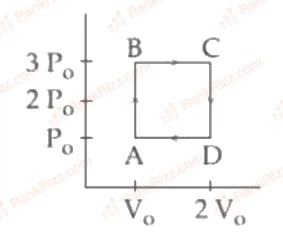
An engine operates by taking a monatomic ideal gas through the cycle shown in the figure. The percentage efficiency of the engine is close to___

Figure for JEE Main 2020 Physics question on Second law, heat engines, refrigerators and reversibility
JEE MAIN 2017 · 08 APR ONLINESecond law, heat engines, refrigerators and reversibilityTRANSCRIBED

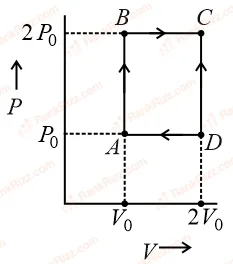
An engine operates by taking nn moles of an ideal gas through the cycle ABCDAABCDA shown in figure. The thermal efficiency of the engine is: (Take Cv=1.5RC_v = 1.5R, where RR is gas constant)

Figure for JEE Main 2017 Physics question on Second law, heat engines, refrigerators and reversibility
  1. A

    0.24

  2. B

    0.15

  3. C

    0.32

  4. D

    0.08

JEE MAIN 2015 · 04 APR OFFLINESecond law, heat engines, refrigerators and reversibilityTRANSCRIBED

A solid body of constant heat capacity 1 J (∘^\circC)−1^{-1} is being heated by keeping it in contact with reservoirs in two ways: (i) Sequentially keeping in contact with 2 reservoirs such that each reservoir supplies the same amount of heat. (ii) Sequentially keeping in contact with 8 reservoirs such that each reservoir supplies the same amount of heat. In both cases the body is brought from initial temperature 100 K to final temperature 200 K. Entropy change of the body in the two cases respectively is: Note: This question was awarded as a bonus since temperatures were given in centigrade instead of in Kelvin. Proper corrections are made in the question to avoid it.

  1. A

    2ln⁡2, 8ln⁡22\ln 2,\ 8\ln 2

  2. B

    ln⁡2, 4ln⁡2\ln 2,\ 4\ln 2

  3. C

    ln⁡2, ln⁡2\ln 2,\ \ln 2

  4. D

    ln⁡2, 2ln⁡2\ln 2,\ 2\ln 2

JEE MAIN 2013 · 07 APR ONLINESecond law, heat engines, refrigerators and reversibilityTRANSCRIBED

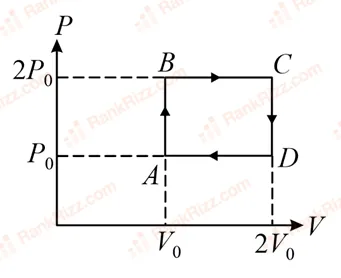
The below P-V diagram represents the thermodynamic cycle of an engine, operating with an ideal mono-atomic gas. The amount of heat, extracted from the source in a single cycle, is:

Figure for JEE Main 2013 Physics question on Second law, heat engines, refrigerators and reversibility
  1. A

    (112)P0V0\left(\frac{11}{2}\right)P_0V_0

  2. B

    4P0V04P_0V_0

  3. C

    P0V0P_0V_0

  4. D

    (132)P0V0\left(\frac{13}{2}\right)P_0V_0

JEE MAIN 2012Second law, heat engines, refrigerators and reversibilityTRANSCRIBED

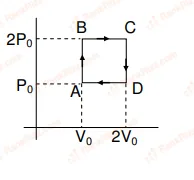
Helium gas goes through a cycle ABCDAABCDA (consisting of two isochoric and two isobaric lines) as shown in figure. Efficiency of this cycle is nearly: (Assume the gas to be close to ideal gas)Figure for JEE Main 2012 Physics question on Second law, heat engines, refrigerators and reversibility

  1. A

    15.4%15.4\%

  2. B

    9.1%9.1\%

  3. C

    10.5%10.5\%

  4. D

    12.5%12.5\%

JEE MAIN 2012Second law, heat engines, refrigerators and reversibilityTRANSCRIBED

The door of a working refrigerator is left open in a well insulated room. The temperature of air in the room will

  1. A

    decrease

  2. B

    increase in winters and decrease in summers

  3. C

    remain the same

  4. D

    increase

JEE MAIN 2010Second law, heat engines, refrigerators and reversibilityTRANSCRIBED

A diatomic ideal gas is used in a Car engine as the working substance. If during the adiabatic expansion part of the cycle, volume of the gas increases from VV to 32V32V the efficiency of the engine is

  1. A

    0.5

  2. B

    0.75

  3. C

    0.99

  4. D

    0.25

JEE MAIN 2007Second law, heat engines, refrigerators and reversibilityTRANSCRIBED

A Carnot engine, having an efficiency of η=1/10\eta = 1/10 as heat engine, is used as a refrigerator. If the work done on the system is 10 J, the amount of energy absorbed from the reservoir at lower temperature is

  1. A

    99 J

  2. B

    90 J

  3. C

    1 J

  4. D

    100 J

JEE MAIN 2005Second law, heat engines, refrigerators and reversibilityTRANSCRIBED

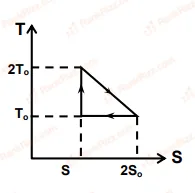
The temperature-entropy diagram of a reversible engine cycle is given in the figure. Its efficiency is Figure for JEE Main 2005 Physics question on Second law, heat engines, refrigerators and reversibility

  1. A

    1/21/2

  2. B

    1/41/4

  3. C

    1/31/3

  4. D

    2/32/3