JEE Main 2020 Physics question — Work done in thermodynamic processes and P-V diagrams
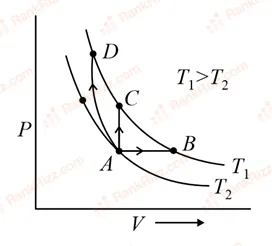
Three different processes that can occur in an ideal monoatomic gas are shown in the vs diagram. The paths are labelled as , and . The change in internal energies during these processes are taken as , and and the work done as , and . The correct relation between these parameters are:
SOLUTION
We are dealing with an ideal mono-atomic gas. For such a gas the internal energy is a pure function of temperature alone and is given by the well-known expression
Consequently, the change in internal energy between any two states depends only on the initial and final temperatures:
In the diagram all three processes start from the common state and terminate at the three distinct points . A careful inspection of the diagram shows that the points lie on the same isothermal curve that passes through none of the other points. Algebraically that statement reads
Using the ideal-gas equation this instantly gives
where is some temperature (which may or may not equal ). Because all three final temperatures are equal, the change in internal energy from the common initial state to any of the three final states is identical:
Hence
Next we examine the work done, remembering the definition
Sign conventions to keep in mind:
• When the gas expands, so (positive work done by the gas).
• When the gas undergoes an isochoric (constant-volume) change, so (no work).
• When the gas is compressed, so (negative work, work done on the gas).
Looking again at the geometry of the three paths:
• Along the curve clearly moves to a larger volume: . Therefore W_{AB}>0.$</p> <p>• AlongA\to CV_C=V_AW_{AC}=0.$
• Along the path proceeds to a smaller volume: . Consequently W_{AD}<0.$</p> <p>Collecting all the deductions we have</p> <p>E_{AB}=E_{AC}=E_{AD},\qquad W_{AB}>0,\qquad W_{AC}=0,\qquad W_{AD}<0.$$
This set of equalities and inequalities is exactly the one listed in Option B of the question.
Hence, the correct answer is Option B.
Tagged Work done in thermodynamic processes and P-V diagrams. Machine-assigned, so read it as a strong shortlist rather than a verdict.