JEE Main 2022 Physics question — Work done in thermodynamic processes and P-V diagrams
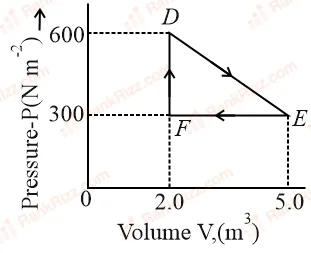
A thermodynamic system is taken from an original state D to an intermediate state E by the linear process shown in the figure. Its volume is then reduced to the original volume from E to F by an isobaric process. The total work done by the gas from D to E to F will be
SOLUTION
We need to find the total work done by the gas during the thermodynamic process from .
The total work done () is the sum of the work done in each individual stage of the path:
Step 1: Work Done during the Linear Process ()
The work done during any process on a Pressure-Volume () diagram is equal to the area under the curve projected onto the Volume axis.
- The region under the straight line path forms a trapezium bounded between and .
- The formula for the area of a trapezium is:
- Parallel sides (Pressures): and
- Distance between them (Change in Volume):
Calculating :
Note: The work is positive because the gas is expanding from to .
Step 2: Work Done during the Isobaric Process ()
The process from is an isobaric compression path carried out at a constant pressure.
- Constant Pressure ():
- Initial Volume ():
- Final Volume ():
Calculating :
Note: The work is negative because the gas is undergoing compression.
Step 3: Calculate Total Work Done
Combining the work computed from both segments gives:
Therefore, the total work done by the gas from D to E to F is 450 J, which corresponds to Option B.
Tagged Work done in thermodynamic processes and P-V diagrams. Machine-assigned, so read it as a strong shortlist rather than a verdict.