JEE Main 2016 Physics question — Electric flux and Gauss's law
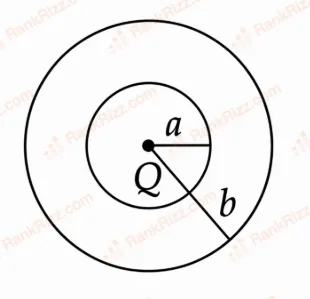
The region between two concentric spheres of radii 'a' and 'b', respectively (see figure), has volume charge density , where A is a constant and r is the distance from the centre. At the centre of the spheres is a point charge Q. The value of A such that the electric field in the region between the spheres will be constant, is:
SOLUTION
First, let us identify the geometry. We have two concentric spheres with radii and satisfying . The shell lying between these two radii is filled with a volume charge whose density varies as , while the very centre (at ) carries a point charge .
We wish to make the electric field anywhere in the region the same for all values of , that is, independent of . To obtain the required value of we use Gauss’s law.
Gauss’s law in integral form states
For spherical symmetry, we choose a Gaussian surface that is itself a sphere of radius (with ). On this surface the magnitude is the same everywhere and the flux becomes
So
Now we calculate the total charge enclosed inside radius , namely
The point charge contributes simply
For the shell portion (from out to ) we integrate the given volume charge density. The differential charge in a thin spherical shell of radius and thickness is
Integrating from to gives
Hence
Substituting this into the earlier result for we obtain
We now enforce the requirement that must not depend on . For that to happen, the numerator must be directly proportional to so that the in the denominator cancels out and leaves a constant.
Let us write the numerator in the desired proportional form:
where is some constant (its exact value is immaterial—only the absence of any other -dependence matters).
Comparing coefficients of like powers of on both sides, we see:
• For the terms:
• For the terms independent of :
The second equality immediately gives us the needed value of :
This is a unique choice; any other value would leave residual -dependence in the field.
Hence, the correct answer is Option C.
Tagged Electric flux and Gauss's law. Machine-assigned, so read it as a strong shortlist rather than a verdict.