JEE Main 2012 Physics question — Electric flux and Gauss's law
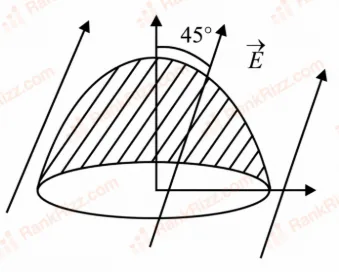
The flat base of a hemisphere of radius with no charge inside it lies in a horizontal plane. A uniform electric field is applied at an angle with the vertical direction. The electric flux through the curved surface of the hemisphere is
SOLUTION
Let the hemisphere of radius form a closed surface by adding its flat circular base. Since no charge is enclosed, Gauss’s law gives
Hence
The base is a circle of area lying in the horizontal plane. Its outward normal is vertical and directed downwards (away from the interior of the hemisphere).
The uniform electric field makes an angle with the vertical. Therefore, the angle between and the outward normal to the base is also .
Flux through the base:
Substituting this value in equation (1):
The minus sign only indicates that the flux through the curved surface is opposite in sense to that through the base. Its magnitude—the quantity usually asked for—is
Thus the required electric flux through the curved surface of the hemisphere corresponds to Option B.
Tagged Electric flux and Gauss's law. Machine-assigned, so read it as a strong shortlist rather than a verdict.