RankRizz

Electric potential and potential energy — JEE Main Previous Year Questions

Every JEE Main question on Electric potential and potential energy, one of the ideas inside Electrostatics: 62 questions from 2004–2026, 28 of them in the last five years. Newest first, answer key on every one. Free to read.

Questions

62

Years asked

17

Since

2004

Of the chapter

21%

Every Electric potential and potential energy question

41–60 OF 62 · NEWEST FIRST

JEE MAIN 2019 · 11 JAN S1Electric potential and potential energyTRANSCRIBED

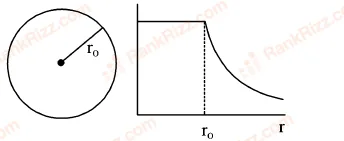
The given graph shows variation (with distance r from centre) of:

Figure for JEE Main 2019 Physics question on Electric potential and potential energy
  1. A

    Electric field of a uniformly charged sphere

  2. B

    Potential of a uniformly charged spherical shell

  3. C

    Potential of a uniformly charged sphere

  4. D

    Electric field of a uniformly charged spherical shell

JEE MAIN 2019 · 08 APR S2Electric potential and potential energyTRANSCRIBED

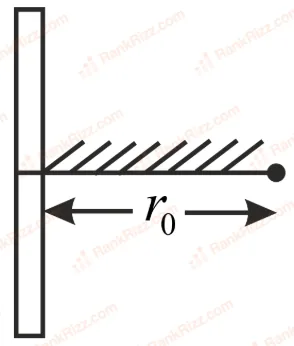
A positive point charge is released from rest at a distance r0r_0 from a positive line charge with uniform charge density. The speed (v) of the point charge, as a function of instantaneous distance r from line charge, is proportional to:

Figure for JEE Main 2019 Physics question on Electric potential and potential energy
  1. A

    v∝rr0v \propto \frac{r}{r_0}

  2. B

    v∝ln⁡rr0v \propto \sqrt{\ln\frac{r}{r_0}}

  3. C

    v∝ln⁡rr0v \propto \ln\frac{r}{r_0}

  4. D

    v∝e+r/r0v \propto e^{+r/r_0}

JEE MAIN 2019 · 12 JAN S1Electric potential and potential energyTRANSCRIBED

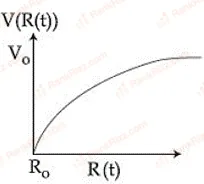
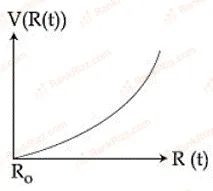
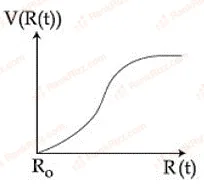
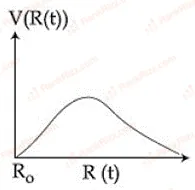
There is a uniform spherically symmetric surface charge density at a distance R0R_0 from the origin. The charge distribution is initially at rest and starts expanding because of mutual repulsion. The figure that represents best the speed V(R(t))V(R(t)) of the distribution as a function of its instantaneous radius R(t)R(t) is:

  1. A
    Figure for JEE Main 2019 Physics question on Electric potential and potential energy
  2. B
    Figure for JEE Main 2019 Physics question on Electric potential and potential energy
  3. C
    Figure for JEE Main 2019 Physics question on Electric potential and potential energy
  4. D
    Figure for JEE Main 2019 Physics question on Electric potential and potential energy
JEE MAIN 2019 · 08 APR S1Electric potential and potential energyTRANSCRIBED

A solid conducting sphere, having a charge Q, is surrounded by an uncharged conducting hollow spherical shell. Let the potential difference between the surface of the solid sphere and that of the outer surface of the hollow shell be V. If the shell is now given a charge of -4Q, the new potential difference between the same two surfaces is:

  1. A

    -2V

  2. B

    2 V

  3. C

    V

  4. D

    4 V

JEE MAIN 2019 · 11 JAN S1Electric potential and potential energyTRANSCRIBED

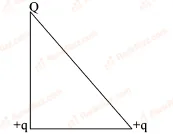
Three charges QQ, +q+q and +q+q are placed at the vertices of a right-angle isosceles triangle as shown below. The net electrostatic energy of the configuration is zero, if the value of Q is:

Figure for JEE Main 2019 Physics question on Electric potential and potential energy
  1. A

    +q+q

  2. B

    −2q2+1\frac{-\sqrt{2}q}{\sqrt{2}+1}

  3. C

    −q1+2\frac{-q}{1+\sqrt{2}}

  4. D

    −2q-2q

JEE MAIN 2019 · 10 JAN S1Electric potential and potential energyTRANSCRIBED

A charge QQ is distributed over three concentric spherical shells of radii aa, bb, cc (a<b<ca < b < c) such that their surface charge densities are equal to one another. The total potential at a point at distance rr from their common centre, where r<ar < a, would be:

  1. A

    Q4πε0(a+b+c)\frac{Q}{4\pi\varepsilon_0(a+b+c)}

  2. B

    Q(a2+b2+c2)4πε0(a3+b3+c3)\frac{Q(a^2+b^2+c^2)}{4\pi\varepsilon_0(a^3+b^3+c^3)}

  3. C

    Q12πε0⋅ab+bc+caabc\frac{Q}{12\pi\varepsilon_0} \cdot \frac{ab+bc+ca}{abc}

  4. D

    Q(a+b+c)4πε0(a2+b2+c2)\frac{Q(a+b+c)}{4\pi\varepsilon_0(a^2+b^2+c^2)}

JEE MAIN 2019 · 08 APR S2Electric potential and potential energyTRANSCRIBED

The electric field in a region is given by E⃗=(Ax+B)i^\vec{E} = (Ax + B)\hat{i}, where E is in NC−1^{-1} and xx is in metres. The values of constants are A = 20 SI unit and B = 10 SI unit. If the potential at x=1x = 1 is V1V_1 and that at x=−5x = -5 is V2V_2, then V1−V2V_1 - V_2 is:

  1. A

    320 V

  2. B

    -520 V

  3. C

    180 V

  4. D

    -48 V

JEE MAIN 2019 · 09 APR S1Electric potential and potential energyTRANSCRIBED

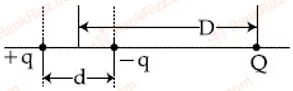
A system of three charges are placed as shown in the figure:

Figure for JEE Main 2019 Physics question on Electric potential and potential energy


If D>>dD >> d, the potential energy of the system is best given by:

  1. A

    14πε0[−q2d−qQdD2]\frac{1}{4\pi\varepsilon_0}\left[-\frac{q^2}{d} - \frac{qQd}{D^2}\right]

  2. B

    14πε0[+q2d+qQdD2]\frac{1}{4\pi\varepsilon_0}\left[+\frac{q^2}{d} + \frac{qQd}{D^2}\right]

  3. C

    14πε0[−q2d−qQd2D2]\frac{1}{4\pi\varepsilon_0}\left[-\frac{q^2}{d} - \frac{qQd}{2D^2}\right]

  4. D

    14πε0[−q2d+2qQdD2]\frac{1}{4\pi\varepsilon_0}\left[-\frac{q^2}{d} + \frac{2qQd}{D^2}\right]

JEE MAIN 2019 · 10 JAN S2Electric potential and potential energyTRANSCRIBED

Four equal point charges QQ each are placed in the xyxy plane at (0,2)(0, 2), (4,2)(4, 2), (4,−2)(4, -2) and (0,−2)(0, -2). The work required to put a fifth charge QQ at the origin of the coordinate system will be:

  1. A

    Q24πε0\frac{Q^2}{4\pi\varepsilon_0}

  2. B

    Q222πε0\frac{Q^2}{2\sqrt{2}\pi\varepsilon_0}

  3. C

    Q24πε0(1+15)\frac{Q^2}{4\pi\varepsilon_0}\left(1 + \frac{1}{\sqrt{5}}\right)

  4. D

    Q24πε0(1+13)\frac{Q^2}{4\pi\varepsilon_0}\left(1 + \frac{1}{\sqrt{3}}\right)

JEE MAIN 2019 · 10 APR S2Electric potential and potential energyTRANSCRIBED

In free space, a particle A of charge 1 μC is held fixed at point P. Another particle B of the same charge and mass 4 μg is kept at a distance of 1 mm from P. If B is released, then its velocity at a distance of 9 mm from P is:
[Take 14πε0=9×10⁹\frac{1}{4\pi\varepsilon_0} = 9 \times 10^9 N m2^2 C−2^{-2}]

  1. A

    1.0 m s−1^{-1}

  2. B

    1.5×1021.5 \times 10^2 m s−1^{-1}

  3. C

    2.0×1032.0 \times 10^3 m s−1^{-1}

  4. D

    3.0×1043.0 \times 10^4 m s−1^{-1}

JEE MAIN 2017 · 08 APR ONLINEElectric potential and potential energyTRANSCRIBED

There is a uniform electrostatic field in a region. The potential at various points on a small sphere centred at PP, in the region, is found to vary between the limits 589.0 V to 589.8 V. What is the potential at a point on the sphere whose radius vector makes an angle of 60° with the direction of the field?

  1. A

    589.4 V

  2. B

    589.5 V

  3. C

    589.2 V

  4. D

    589.6 V

JEE MAIN 2015 · 04 APR OFFLINEElectric potential and potential energyTRANSCRIBED

A uniformly charged solid sphere of radius R has potential V0V_0 (measured with respect to ∞\infty) on its surface. For this sphere the equipotential surfaces with potential 3V02\frac{3V_0}{2}, 5V04\frac{5V_0}{4}, 3V04\frac{3V_0}{4} and V04\frac{V_0}{4} have radius R1R_1, R2R_2, R3R_3 and R4R_4 respectively. Then
Note: This question had two options correct at the time of examination. Proper corrections are made in the question to avoid it.

  1. A

    2R>R42R > R_4

  2. B

    R1=0R_1 = 0 and R2>(R4−R3)R_2 > (R_4 - R_3)

  3. C

    R1≠0R_1 \neq 0 and (R2−R1)>(R4−R3)(R_2 - R_1) > (R_4 - R_3)

  4. D

    R1=0R_1 = 0 and R2<(R4−R3)R_2 < (R_4 - R_3)

JEE MAIN 2015 · 11 APR ONLINEElectric potential and potential energyTRANSCRIBED

An electric field E⃗=(25i^+30j^)\vec{E} = \left(25\hat{i} + 30\hat{j}\right) N C−1^{-1} exists in a region of space. If the potential at the origin is taken to be zero then the potential at x=2x = 2 m, y=2y = 2 m is:

  1. A

    −110-110 J C−1^{-1}

  2. B

    −140-140 J C−1^{-1}

  3. C

    −130-130 J C−1^{-1}

  4. D

    −120-120 J C−1^{-1}

JEE MAIN 2014 · 06 APR OFFLINEElectric potential and potential energyTRANSCRIBED

Assume that an electric field E⃗=30x2i^\vec{E} = 30x^2\hat{i} exists in space. Then the potential difference VA−VOV_A - V_O, where VOV_O is the potential at the origin and VAV_A the potential at x = 2 m is:

  1. A

    120 J C−1^{-1}

  2. B

    −120-120 J C−1^{-1}

  3. C

    −80-80 J C−1^{-1}

  4. D

    80 J C−1^{-1}

JEE MAIN 2013 · 25 APR ONLINEElectric potential and potential energyTRANSCRIBED

This question has Statement-1 and Statement-2. Of the four choices given after the Statements, choose the one that best describes the two Statements.
Statement 1: No work is required to be done to move a test charge between any two points on an equipotential surface.
Statement 2: Electric lines of force at the equipotential surfaces are mutually perpendicular to each other.

  1. A

    Statement 1 is true, Statement 2 is true, Statement 2 is the correct explanation of Statement 1.

  2. B

    Statement 1 is true, Statement 2 is true, Statement 2 is not the correct explanation of Statement 1.

  3. C

    Statement 1 is true, Statement 2 is false.

  4. D

    Statement 1 is false, Statement 2 is true.

JEE MAIN 2013 · 07 APR ONLINEElectric potential and potential energyTRANSCRIBED

A charge Q is uniformly distributed over a long rod AB of length L as shown in the figure. The electric potential at the point O lying at a distance L from the end A is :

Figure for JEE Main 2013 Physics question on Electric potential and potential energy
  1. A

    Q4πϵ0Lln⁡2\frac{Q}{4\pi\epsilon_0 L} \ln 2

  2. B

    Qln⁡24πϵ0L\frac{Q \ln 2}{4\pi\epsilon_0 L}

  3. C

    Q8πϵ0L\frac{Q}{8\pi\epsilon_0 L}

  4. D

    3Q4πϵ0L\frac{3Q}{4\pi\epsilon_0 L}

JEE MAIN 2012Electric potential and potential energyTRANSCRIBED

This question has statement 1 and statement 2. Of the four choices given after the statements, choose the one that best describes the two statements. 

An insulating solid sphere of radius RR has a uniformly positive charge density ρ\rho. As a result of this uniform charge distribution there is a finite value of electric potential at the centre of the sphere, at the surface of the sphere and also at a point out side the sphere. The electric potential at infinity is zero. 

Statement 1: When a charge qq is taken from the centre to the surface of the sphere, its potential energy changes by qP3ε0\frac{qP}{3\varepsilon_0}. 

Statement 2: The electric field at a distance r (r<R)r\ (r < R) from the centre of the sphere is  ρr3ε0\frac{\rho r}{3\varepsilon_0}

  1. A

    Statement 1 is true, Statement 2 is true, Statement 2 is not the correct explanation for statement 1.

  2. B

    Statement 1 is true, Statement 2 is false

  3. C

    Statement 1 is false, Statement 2 is true

  4. D

    Statement 1 is true, Statement 2 is the correct explanation for statement 1

JEE MAIN 2009Electric potential and potential energyTRANSCRIBED

This question contains Statement-1 and Statement-2. Of the four choices given after the statements, choose the one that best describes the two statements. Statement - 1: For a charged particle moving from point PP to point QQ, the net work done by an electrostatic field on the particle is independent of the path connecting point PP to point QQ. Statement-2: The net work done by a conservative force on an object moving along a closed loop is zero

  1. A

    Statement-1 is true, Statement-2 is false

  2. B

    Statement-1 is true, Statement-2 is true; Statement-2 is the correct explanation of Statement-1.

  3. C

    Statement-1 is true, Statement-2 is true; Statement-2 is not the correct explanation of Statement-1.

  4. D

    Statement-1 is false, Statement-2 is true

JEE MAIN 2009Electric potential and potential energyTRANSCRIBED

Two points PP and QQ are maintained at the potentials of 1010 V and −4-4 V respectively. The work done in moving 100100 electrons from PP to QQ is

  1. A

    −19×10−17-19 \times 10^{-17} J

  2. B

    9.60×10−179.60 \times 10^{-17} J

  3. C

    −2.24×10⁻¹⁶-2.24 \times 10^{-16} J

  4. D

    2.24×10−162.24 \times 10^{-16} J

JEE MAIN 2007Electric potential and potential energyTRANSCRIBED

An electric charge 10−3μC10^{-3} \mu C is placed at the origin (0,0)(0, 0) of X−YX-Y co-ordinate system. Two points AA and BB are situated at (2,2)(\sqrt{2}, \sqrt{2}) and (2,0)(2, 0) respectively. The potential difference between the points AA and BB will be

  1. A

    9 volt

  2. B

    zero

  3. C

    2 volt

  4. D

    4.5 volt