JEE MAIN 2023 · 24 JAN S2Electric potential and potential energyTRANSCRIBED
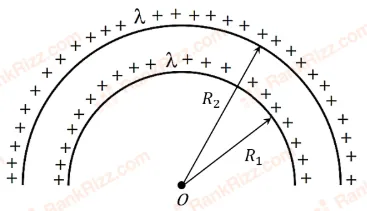
The electric potential at the centre of two concentric half rings of radii and , having same linear charge density is
- A
- B
- C
- D
Every JEE Main question on Electric potential and potential energy, one of the ideas inside Electrostatics: 62 questions from 2004–2026, 28 of them in the last five years. Newest first, answer key on every one. Free to read.
Questions
62
Years asked
17
Since
2004
Of the chapter
21%
21–40 OF 62 · NEWEST FIRST
The electric potential at the centre of two concentric half rings of radii and , having same linear charge density is
For a uniformly charged thin spherical shell, the electric potential radially away from the centre of shell can be graphically represented as
(1)
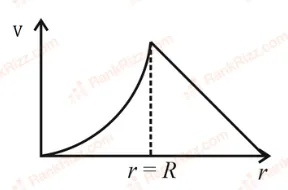
(2)
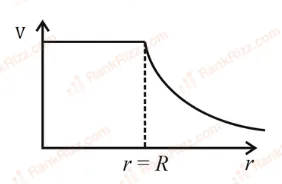
(3)
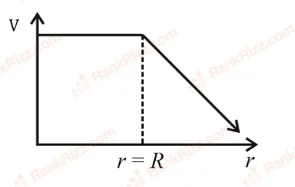
(4)
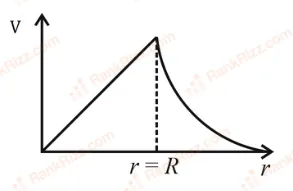
Graph (1)
Graph (2)
Graph (3)
Graph (4)
Electric potential at a point due to a point charge of C is 50 V. The distance of from the point charge is:
(Assume, N m C)
9 cm
3 cm
0.9 cm
90 cm
64 identical drops each charged upto potential of mV are combined to form a bigger drop. The potential of the bigger drop will be _____ mV.
For a charged spherical ball, electrostatic potential inside the ball varies with as . Here, and are constant and is the distance from the center. The volume charge density inside the ball is . The value of is ______.
= permittivity of medium.
If the electric potential at any point m in space is given by volt. The electric field at the point m will be:
3 Vm, directed along positive -axis.
3 Vm, directed along negative -axis.
6 Vm, directed along negative -axis.
6 Vm, directed along positive -axis.
Given below are two statements.
Statement I: Electric potential is constant within and at the surface of each conductor.
Statement II: Electric field just outside a charged conductor is perpendicular to the surface of the conductor at every point.
In the light of the above statements, choose the most appropriate answer from the options given below.
Both statement I and statement II are correct
Both statement I and statement II are incorrect
Statement I is correct but statement II is incorrect
Statement I is incorrect but statement II is correct
identical drops are charged at V each. They combine to form a bigger drop. The potential of the bigger drop will be ______ V.
The two thin coaxial rings, each of radius and having charges and respectively are separated by a distance of . The potential difference between the centres of the two rings is:
512 identical drops of mercury are charged to a potential of 2 V each. The drops are joined to form a single drop. The potential of this drop is ______ V in Volt.
27 similar drops of mercury are maintained at 10 V each. All these spherical drops combine into a single big drop. The potential energy of the bigger drop is ______ times that of a smaller drop.
Hydrogen ion and singly ionized helium atom are accelerated, from rest, through the same potential difference. The ratio of final speeds of hydrogen and helium ions is close to:
Two isolated conducting spheres and of radius and have 12 and charges, respectively, and are at a large distance from each other. They are now connected by a conducting wire. A long time after this is done the charges on and are respectively:
of both
and
and
and
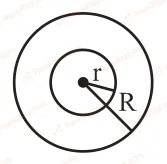
A charge Q is distributed over two concentric conducting thin spherical shells radii r and R (R > r). If the surface charge densities on the two shells are equal, the electric potential at the common centre is:
Ten charges are placed on the circumference of a circle of radius R with constant angular separation between successive charges. Alternate charges 1, 3, 5, 7, 9 have charge each, while 2, 4, 6, 8, 10 have charge each. The potential V and the electric field E at the centre of the circle are respectively: (Take at infinity)
;
,
;
;
Concentric metallic hollow spheres of radii R and 4R hold charges and respectively. Given that surface charge densities of the concentric spheres are equal, the potential difference V(R) - V(4R) is:
A two point charges and are fixed on the -axis at and , respectively. If the third point charge 'q' is taken from the origin to along the semicircle as shown in the figure, the energy of the charge will:
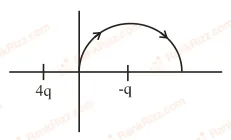
Increase by
Increase by
decrease by
decrease by
Consider two charged metallic spheres and of radii and , respectively. The electric fields (on ) and (on ) on their surfaces are such that . Then the ratio (on )/ (on ) of the electrostatic potentials on each sphere is:
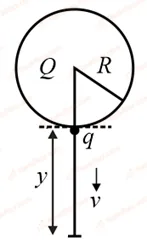
A solid sphere of radius carries a charge distributed uniformly over its volume. A very small point like piece of it of mass gets detached from the bottom of the sphere and falls down vertically under gravity. This piece carries charge . If it acquires a speed when it has fallen through a vertical height (see figure), then (assume the remaining portion to be spherical)
A uniformly charged ring of radius 3a and total charge q is placed in x-y plane centred at origin. A point charge q is moving towards the ring along the z-axis and has speed v at z = 4a. The minimum value of v such that it crosses the origin is:
RELATED ELECTROSTATICS TOPICS