RankRizz
JEE MAIN 2019 · 09 APR S1+4 / −1MEDIUMTRANSCRIBED

JEE Main 2019 Physics question — Electric potential and potential energy

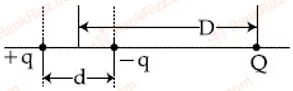
A system of three charges are placed as shown in the figure:

Figure for JEE Main 2019 Physics question on Electric potential and potential energy


If D>>dD >> d, the potential energy of the system is best given by:

SOLUTION

Problem Statement

A system of three charges is placed as shown in the figure. If D≫dD \gg d, the potential energy of the system is best given by:

  • (1) 14πϵ0[+q2d+qQdD2]\frac{1}{4\pi \epsilon_0} \left[ +\frac{q^2}{d} + \frac{qQd}{D^2} \right]
  • (2) 14πϵ0[−q2d−qQdD2]\frac{1}{4\pi \epsilon_0} \left[ -\frac{q^2}{d} - \frac{qQd}{D^2} \right]
  • (3) 14πϵ0[−q2d+2qQdD2]\frac{1}{4\pi \epsilon_0} \left[ -\frac{q^2}{d} + \frac{2qQd}{D^2} \right]
  • (4) 14πϵ0[−q2d−qQd2D2]\frac{1}{4\pi \epsilon_0} \left[ -\frac{q^2}{d} - \frac{qQd}{2D^2} \right]
  • The distance between +q+q and −q-q is dd. Therefore, +q+q is at x=−d2x = -\frac{d}{2} and −q-q is at x=+d2x = +\frac{d}{2}.
  • The distance DD is measured from the midpoint of the dipole to the charge QQ. Therefore, the charge QQ is located at x=Dx = D.
  • Between +q+q and −q-q: r12=dr_{12} = d
  • Between +q+q and QQ: r13=D−(−d2)=D+d2r_{13} = D - \left(-\frac{d}{2}\right) = D + \frac{d}{2}
  • Between −q-q and QQ: r23=D−d2r_{23} = D - \frac{d}{2}

Step-by-Step Solution

1. Identify the Exact Positions of the Charges

Let the midpoint between the charges +q+q and −q-q be the origin (x=0x = 0).

The distances between the pairs of interacting charges are:

2. Set Up the Total Electrostatic Potential Energy Equation

The total potential energy UU of a three-charge system is the sum of the potential energies of all unique pairs:

U=14πϵ0[(+q)(−q)r12+(+q)(Q)r13+(−q)(Q)r23]U = \frac{1}{4\pi\epsilon_0} \left[ \frac{(+q)(-q)}{r_{12}} + \frac{(+q)(Q)}{r_{13}} + \frac{(-q)(Q)}{r_{23}} \right]

Substitute the distances into the equation:

U=14πϵ0[−q2d+qQD+d2−qQD−d2]U = \frac{1}{4\pi\epsilon_0} \left[ -\frac{q^2}{d} + \frac{qQ}{D + \frac{d}{2}} - \frac{qQ}{D - \frac{d}{2}} \right]

3. Simplify using Binomial Approximation

Take out DD from the denominators of the second and third terms to utilize the condition D≫dD \gg d:

U=14πϵ0[−q2d+qQD(1+d2D)−1−qQD(1−d2D)−1]U = \frac{1}{4\pi\epsilon_0} \left[ -\frac{q^2}{d} + \frac{qQ}{D}\left(1 + \frac{d}{2D}\right)^{-1} - \frac{qQ}{D}\left(1 - \frac{d}{2D}\right)^{-1} \right]

Since d2D≪1\frac{d}{2D} \ll 1, we apply the binomial expansion (1±x)−1≈1∓x(1 \pm x)^{-1} \approx 1 \mp x:

U≈14πϵ0[−q2d+qQD(1−d2D)−qQD(1+d2D)]U \approx \frac{1}{4\pi\epsilon_0} \left[ -\frac{q^2}{d} + \frac{qQ}{D}\left(1 - \frac{d}{2D}\right) - \frac{qQ}{D}\left(1 + \frac{d}{2D}\right) \right]

Expand the terms inside the bracket:

U≈14πϵ0[−q2d+qQD−qQd2D2−qQD−qQd2D2]U \approx \frac{1}{4\pi\epsilon_0} \left[ -\frac{q^2}{d} + \frac{qQ}{D} - \frac{qQd}{2D^2} - \frac{qQ}{D} - \frac{qQd}{2D^2} \right]

The qQD\frac{qQ}{D} and −qQD-\frac{qQ}{D} terms cancel each other out:

U≈14πϵ0[−q2d−2qQd2D2]U \approx \frac{1}{4\pi\epsilon_0} \left[ -\frac{q^2}{d} - \frac{2qQd}{2D^2} \right]

U≈14πϵ0[−q2d−qQdD2]U \approx \frac{1}{4\pi\epsilon_0} \left[ -\frac{q^2}{d} - \frac{qQd}{D^2} \right]

Correct Answer

The correct option is (1).
Tagged Electric potential and potential energy. Machine-assigned, so read it as a strong shortlist rather than a verdict.

SubjectPhysics
TopicElectric potential and potential energy
TypeMultiple choice