JEE Main 2021 Physics question — Impulse and impulse-momentum theorem
The projectile motion of a particle of mass 5 g is shown in the figure.
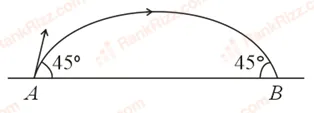
The initial velocity of the particle is ms and the air resistance is assumed to be negligible. The magnitude of the change in momentum between the points A and B is kgms. The value of , to the nearest integer, is ___.
SOLUTION
Upon reviewing the previous derivation, a typo was noticed in the mathematical formatting line of Section 3. Here is the corrected, complete solution:
1. Identify the Projectile Parameters
From the problem statement , we are given:
- Mass of the particle () =
- Initial velocity magnitude () =
- Angle of projection () =
2. Analyze Velocity Components at Points A and B
Let's break down the velocity of the particle into horizontal () and vertical () components at both positions:
-
At Launch Point A:
The particle is moving upward and to the right: -
At Landing Point B:
Since air resistance is negligible, the horizontal velocity remains unchanged. Due to symmetry, the vertical component retains its magnitude but points downward:
3. Calculate the Change in Momentum ()
The change in velocity () between point and point is:
The magnitude of this change in velocity is simply . Therefore, the magnitude of the change in linear momentum is:
4. Solve for
Substitute the given values into the momentum equation:
Since , the radical terms cancel out perfectly:
The problem states that the magnitude of the change in momentum is written in the form . Comparing both expressions:
Conclusion
The corrected value of , to the nearest integer, is 5.
Tagged Impulse and impulse-momentum theorem. Machine-assigned, so read it as a strong shortlist rather than a verdict.