JEE Main 2021 Physics question — Impulse and impulse-momentum theorem
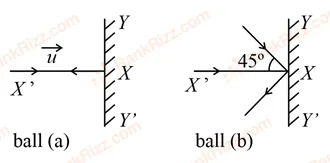
Two billiard balls of equal mass 30 g strike a rigid wall with same speed of 108 kmph (as shown) but at different angles. If the balls get reflected with the same speed, then the ratio of the magnitude of impulses imparted to ball a and ball b by the wall along X direction is:
SOLUTION
We need to determine the ratio of the magnitude of impulses imparted to ball a and ball b along the X-direction by a rigid wall.
1. Understand the Relationship Between Impulse and Momentum
According to the impulse-momentum theorem, the impulse () imparted to an object is equal to its change in linear momentum ():
Since the question specifically asks for the impulse along the X-direction, we only need to look at the change in the horizontal component of velocity for each ball (). Let the initial speed of both balls be .
2. Calculate the Impulse for Ball (a)
From the diagram:
- Ball (a) moves horizontally straight toward the wall along the positive X-direction:
- It rebounds directly backward with the same speed along the negative X-direction:
The change in velocity along the X-axis is:
The magnitude of the impulse for ball (a) is:
3. Calculate the Impulse for Ball (b)
From the diagram for ball (b):
- The ball approaches the wall at an angle of with the horizontal line (). The initial velocity component directed into the wall is .
- It rebounds elastically at an angle of , moving away from the wall with a horizontal component of .
The change in velocity along the X-axis is:
The magnitude of the impulse for ball (b) is:
4. Determine the Ratio
Now, we take the ratio of the two horizontal impulse magnitudes:
Conclusion
The ratio of the magnitude of impulses along the X-direction is , which corresponds exactly to Option B.
Tagged Impulse and impulse-momentum theorem. Machine-assigned, so read it as a strong shortlist rather than a verdict.