JEE MAIN 2024 · 31 JAN S2First law: work, heat and internal energyTRANSCRIBED
If 5 moles of an ideal gas expands from 10 L to a volume of 100 L at 300 K under isothermal and reversible condition then work, , is J. The value of is (Given J K mol)
Every Chemical Thermodynamics question JEE Main has set, grouped by the idea it tests rather than the order of the syllabus. 229 questions across 6 distinct ideas. Free to read, answer key on every one.
Questions
229
Distinct ideas
6
Share of marks
4.6%
Difficulty
MEDIUM
A chapter is not one subject — it is a handful of procedures the examiner reuses. These are the ones Chemical Thermodynamics questions actually test.
61–80 OF 229 · NEWEST FIRST
If 5 moles of an ideal gas expands from 10 L to a volume of 100 L at 300 K under isothermal and reversible condition then work, , is J. The value of is (Given J K mol)
Three moles of an ideal gas are compressed isothermally from L to L using constant pressure of atm. Heat exchange for the compression is ______ Lit. atm.
Combustion of 1 mole of benzene is expressed at . The standard enthalpy of combustion of 2 mol of benzene is kJ. ______ Given: 1. Standard enthalpy of formation of 1 mol of , for the reaction is . 2. Standard enthalpy of formation of 1 mol of , for the reaction is . 3. Standard enthalpy of formation of 1 mol of , for the reaction is .
An ideal gas, , is expanded adiabatically against a constant pressure of 1 atm until it doubles in volume. If the initial temperature and pressure is and , respectively then the final temperature is _______ K (nearest integer). [ is the molar heat capacity at constant volume]
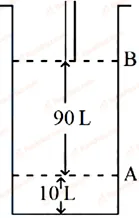
Consider the figure provided. 1 mol of an ideal gas is kept in a cylinder, fitted with a piston, at the position A, at . If the piston is moved to position B, keeping the temperature unchanged, then '' L atm work is done in this reversible process. ______ L atm. (nearest integer) [Given: Absolute temperature , ]
for water is at 1 bar and . Change in internal energy for this vapourisation under same condition is _____ . (Given )
When equal volume of M HCl and M are separately neutralised by excess volume of M NaOH solution. and kJ of heat is liberated respectively. The value of is _______
When and , then the temperature of vapour, at one atmosphere is ______ K.
If three moles of an ideal gas at K expand isothermally from to against a constant opposing pressure of kPa, then the amount of heat transferred is _________ J.
Standard enthalpy of vapourisation for is kJ mol. Heat required for vapourisation of g of at constant temperature is ______ kJ. (Given molar mass in g mol; C = 12, Cl = 35.5)
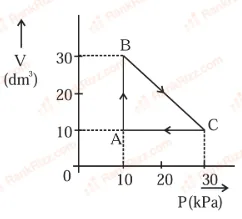
An ideal gas undergoes a cyclic transformation starting from the point and coming back to the same point by tracing the path as shown in the diagram. The total work done in the process is _____ J.
Consider the following reaction at 298 K. , . for the reaction is _________ kJ. (Given ) Round off your answer to the nearest integer.
The heat of combustion of solid benzoic acid at constant volume is at . The heat of combustion at constant pressure is , the value of is ______.
For the reaction at , . and . The reaction will become spontaneous above ___________ K.
The heat of solution of anhydrous and are kJ mol and kJ mol respectively. The heat of hydration of to is kJ. The value of is ______ (nearest integer).
For a certain thermochemical reaction at K, kJ mol, J K, log equilibrium constant () is _____ .
Which of the following relations are correct?
(A)
(B)
(C)
(D)
Choose the most appropriate answer from the options given below:
C and D only
B and C only
A and B only
B and D only
What happens when methane undergoes combustion in systems A and B respectively?
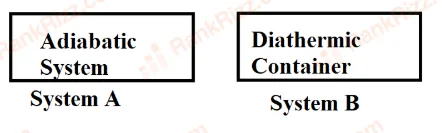
System A: Temperature rises; System B: Temperature remains same
System A: Temperature remains same; System B: Temperature rises
System A: Temperature falls; System B: Temperature remains same
System A: Temperature falls; System B: Temperature rises
Given
(A) , kJ mol
(B) , kJ mol
The for the reaction is
For complete combustion of ethene,
the amount of heat produced as measured in bomb calorimeter is 1406 kJ mol at 300 K. The minimum value of TS needed to reach equilibrium is () kJ. (Nearest integer)
Given: R = 8.3 J K mol
OTHER CHEMISTRY CHAPTERS