Given (i) 2FeO(s) 4Fe(s) + 3O(g); = +1487.0 kJ mol
(ii) 2CO(g) + O(g) 2CO(g); = -514.4 kJ mol
Free energy change, for the reaction 2FeO(s) + 6CO(g) 4Fe(s) + 6CO(g) will be:
- A
-112.4 kJ mol
- B
-56.2 kJ mol
- C
-208.0 kJ mol
- D
-168.2 kJ mol
Every Chemical Thermodynamics question JEE Main has set, grouped by the idea it tests rather than the order of the syllabus. 229 questions across 6 distinct ideas. Free to read, answer key on every one.
Questions
229
Distinct ideas
6
Share of marks
4.6%
Difficulty
MEDIUM
A chapter is not one subject — it is a handful of procedures the examiner reuses. These are the ones Chemical Thermodynamics questions actually test.
181–200 OF 229 · NEWEST FIRST
Given (i) 2FeO(s) 4Fe(s) + 3O(g); = +1487.0 kJ mol
(ii) 2CO(g) + O(g) 2CO(g); = -514.4 kJ mol
Free energy change, for the reaction 2FeO(s) + 6CO(g) 4Fe(s) + 6CO(g) will be:
-112.4 kJ mol
-56.2 kJ mol
-208.0 kJ mol
-168.2 kJ mol
For which of the following processes, is negative?
C (diamond) C (graphite)
N(g, 1 atm) N(g, 5 atm)
N(g, 273K) N(g, 300K)
H(g) 2H(g)
For which of the following reactions, is equal to ?
N(g) + 3H(g) 2NH(g)
2HI(g) H(g) + I(g)
2SO(g) + O(g) 2SO(g)
2NO(g) NO(g)
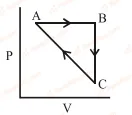
An ideal gas undergoes a cyclic process as shown in Figure.
kJ mol, kJ mol
kJ mol, kJ mol
Heat absorbed by the system during process CA is:
-5 kJ mol
+5 kJ mol
18 kJ mol
-18 kJ mol
Given:
C(graphite) + O(g) CO(g); H° = -393.5 kJ mol
H(g) + O(g) HO(l); H° = -285.8 kJ mol
CO(g) + 2HO(l) CH(g) + 2O(g); H° = +890.3 kJ mol
Based on the above thermochemical equations, the value of H° at 298 K for the reaction
C(graphite) + 2H(g) CH(g) will be:
+144.0 kJ mol
-74.8 kJ mol
-144.0 kJ mol
+74.8 kJ mol
The enthalpy change on freezing of 1 mol of water at 5°C to ice at °C is: (Given kJ mol at 0°C, J mol K, J mol K)
6.00 kJ mol
5.81 kJ mol
5.44 kJ mol
6.56 kJ mol
is equal to:
Isobaric work
Adiabatic work
Isothermal work
Isochoric work
For a reaction, ; . The correct statement for the reaction is:
|\Delta H| < |\Delta U|
|\Delta H| > |\Delta U|
An ideal gas undergoes isothermal expansion at constant pressure. During the process:
Enthalpy remains constant but entropy increases
Enthalpy decreases but entropy increases
Enthalpy increases but entropy decreases
Both enthalpy and entropy remain constant
A gas undergoes change from state A to state B. In this process, the heat absorbed and work done by the gas is 5 J and 8 J, respectively. Now gas is brought back to A by another process during which 3 J of heat is evolved. In this reverse process of B to A.
6 J of the work will be done by the gas
6 J of the work will be done by the surroundings on gas
10 J of the work will be done by the surroundings on gas
10 J of the work will be done by the gas on gas
If 100 mole of decompose at 1 bar and 300 K, the work is done (kJ) by one mole of as it expands against 1 bar pressure is:
J K mol
124.50
249.00
498.00
62.25
The heats of combustion of carbon and carbon monoxide are and kJ mol, respectively. The heat of formation (in kJ) of carbon monoxide per mole is:
110.5
676.5
For the reaction,
, and are, respectively, kJ mol and kJ K mol at 298 K. The equilibrium constant for the reaction at 298 K is:
10
1
A reaction at 1 bar is non-spontaneous at low temperature but becomes spontaneous at high temperature. Identify the correct statement about the reaction among the following:
is negative while is positive
Both and are negative
is positive while is negative
Both and are positive
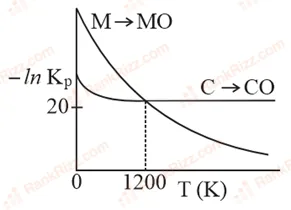
The plot shows the variation of versus temperature for the two reactions.
and
Identify the correct statement:
At T < 1200 K, oxidation of carbon is unfavourable
Oxidation of carbon is favourable at all temperatures
At T < 1200 K, the reaction is spontaneous
At T > 1200 K, carbon will reduce to .
The following reaction is performed at 298 K.
The standard free energy of the formation of is 86.6 kJ mol at 298 K. What is the standard free energy of the formation of at 298 K?
The heat of atomization of methane and ethane are 360 kJ mol and 620 kJ mol, respectively. The longest wavelength of light capable of breaking the C - C bond is (Avogadro's number = , h = J s)
nm
nm
nm
nm
For complete combustion of ethanol, , the amount of heat produced as measured in bomb calorimeter, is 1364.47 kJ mol at 25°C. Assuming ideality the Enthalpy of combustion, , for the reaction will be: ( kJ mol)
kJ mol
kJ mol
kJ mol
kJ mol
The (S°) of the following substances are: CH(g) 186.2 JK mol, O(g) 205.2 JK mol, CO(g) 213.6 JK mol, HO(g) 69.9 JK mol. The entropy change () for the reaction CH(g) + 2O(g) CO(g) + 2HO(l) is:
J K mol
JK mol
JK mol
J K mol
The standard enthalpy of formation of NH is kJ/mol. If bond enthalpy of H is kJ/mol and that of N is kJ/mol, the average bond enthalpy of NH bond in NH is:
kJ/mol
kJ/mol
kJ/mol
kJ/mol
OTHER CHEMISTRY CHAPTERS