JEE MAIN 2020 · 05 SEP S2Colour and magnetic behaviour of complexes from CFTTRANSCRIBED
Considering that , the magnetic moment (in BM) of would be
Every JEE Main question on Colour and magnetic behaviour of complexes from CFT, one of the ideas inside Coordination Compounds: 145 questions from 2004–2026, 102 of them in the last five years. Newest first, answer key on every one. Free to read.
Questions
145
Years asked
17
Since
2004
Of the chapter
39%
121–140 OF 145 · NEWEST FIRST
Considering that , the magnetic moment (in BM) of would be
Homoleptic octahedral complexes of a metal ion with three monodentate ligands , and absorb wavelengths in the region of green, blue and red respectively. The increasing order of the ligand strength is:
The pair of metal ions that can give a spin only magnetic moment of 3.9 BM for the complex , is:
and
and
and
and
The correct order of the spin-only magnetic moment of metal ions in the following low-spin complexes, [V(CN)], [Fe(CN)], [Ru(NH)] and [Cr(NH)], is:
Three complexes,
[CoCl(NH)](I), [Co(NH)HO](II) and [Co(NH)](III)
absorb light in the visible region. The correct order of the wavelength of light absorbed by them is:
(II) > (I) > (III)
(III) > (II) > (I)
(I) > (II) > (III)
(III) > (I) > (II)
The complex that has highest crystal field splitting energy , is:
Two complexes (A) and (B) are violet and yellow coloured, respectively. The incorrect statement regarding them is:
Both are paramagnetic with three unpaired electrons
value of A is less than that of B
values of A and B are calculated from the energies violet and yellow light, respectively.
Both absorb energies corresponding to their complementary colors.
The incorrect statement is.
The spin-only magnetic moments of [FeHO] and [CrHO] are nearly similar.
The spin-only magnetic moment of [NiNHHO is 2.83 BM.
The gemstone, ruby, has Cr ions occupying the octahedral sites of beryl.
The color of [CoClNH] is violet as it absorbs the yellow light.
The degenerate orbitals of [Cr(HO)] are:
and
and
and
and
The complex ion that will lose its crystal field stabilization energy upon oxidation of metal to +3 state is:
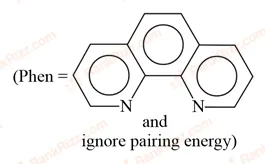
(Phen = phenanthroline, ignore pairing energy)
[Ni(phen)]
[Fe(phen)]
[Co(phen)]
[Zn(phen)]
The crystal field stabilization energy (CFSE) of [FeHO]Cl and K[NiCl], respectively, are:
and
and
and
and
Complete removal of both the axial ligands (along the z-axis) from an octahedral complex leads to which of the following splitting patterns? (relative orbital energies not on scale).
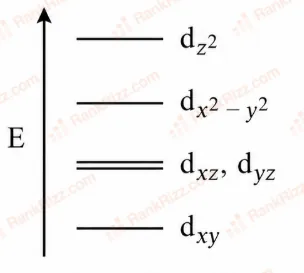
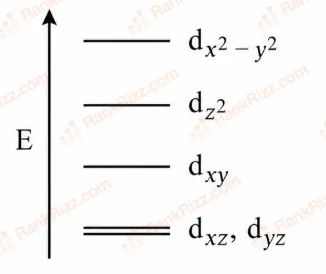
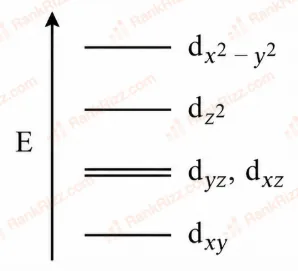
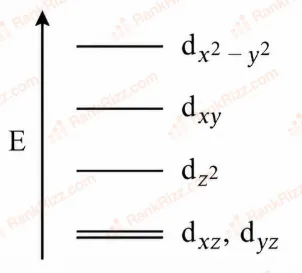
Identify the correct trend given below:
(Atomic No. = Ti : 22, Cr : 24 and Mo : 42)
of and of
of and of
of and of
of and of
Which one of the following compounds is not a yellow colored compound?
Which of the following complex ions has electrons that are symmetrically filled in both and orbitals?
The octahedral complex of a metal ion with four monodentate ligands , , and absorb wavelengths in the region of red, green, yellow and blue, respectively. The increasing order of ligand strength of the four ligands is:
Among the following species the one which causes the highest CFSE, as a ligand is:
CN
NH
F
CO
Which one of the following complexes will most likely absorb visible light? (At. nos. Sc = 21, Ti = 22, V = 23, Zn = 30)
[Sc(HO)]
[Ti(NH)]
[V(NH)]
[Zn(NH)]
In which of the following octahedral complex species the magnitude of will be maximum?
The -electron configurations of and are and respectively. Which one of the following will exhibit the lowest paramagnetic behaviour? (Atomic no. Cr = 24, Mn = 25, Fe = 26, Co = 27).
RELATED COORDINATION COMPOUNDS TOPICS