RankRizz
JEE MAIN 2019 · 12 APR S1+4 / −1MEDIUMTRANSCRIBED

JEE Main 2019 Chemistry question — Colour and magnetic behaviour of complexes from CFT

The complex ion that will lose its crystal field stabilization energy upon oxidation of metal to +3 state is:

Figure for JEE Main 2019 Chemistry question on Colour and magnetic behaviour of complexes from CFT

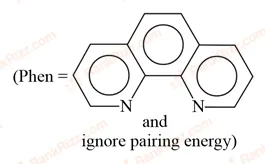
(Phen = phenanthroline, ignore pairing energy)

SOLUTION

CFSE for Strong Field Complexes

Phenanthroline (phen\text{phen}) is a strong field bidentate ligand. In an octahedral crystal field, it forces electrons to pair up in the lower-energy t2gt_{2g} orbitals before filling the higher-energy ege_g orbitals (low-spin complexes). The CFSE formula for an octahedral complex (ignoring pairing energy) is:

CFSE=[(−0.4×nt2g)+(0.6×neg)]Δo\text{CFSE} = [(-0.4 \times n_{t2g}) + (0.6 \times n_{eg})]\Delta_o


Step-by-Step Analysis of Each Complex Ion:

  • 1. [Ni(phen)3]2+→[Ni(phen)3]3+\mathbf{[Ni(phen)_3]^{2+}}\rightarrow\mathbf{[Ni(phen)_3]^{3+}}

    • Ni2+\text{Ni}^{2+} (s0d8s^0 d^8) configuration: t2g6eg2  ⟹  CFSE=[6(−0.4)+2(0.6)]Δo=−1.2Δot_{2g}^6 e_g^2 \implies \text{CFSE} = [6(-0.4) + 2(0.6)]\Delta_o = -1.2\Delta_o
    • Ni3+\text{Ni}^{3+} (s0d7s^0 d^7) configuration: t2g6eg1  ⟹  CFSE=[6(−0.4)+1(0.6)]Δo=−1.8Δot_{2g}^6 e_g^1 \implies \text{CFSE} = [6(-0.4) + 1(0.6)]\Delta_o = -1.8\Delta_o
    • Result: CFSE increases in magnitude (gains stabilization energy).


  • 2. [Fe(phen)3]2+→[Fe(phen)3]3+\mathbf{[Fe(phen)_3]^{2+}}\rightarrow\mathbf{[Fe(phen)_3]^{3+}}

    • Fe2+\text{Fe}^{2+} is a d6d^6 system. In a strong field, its configuration is t2g6eg0t_{2g}^6 e_g^0.
      CFSE=[6×(−0.4)+0×0.6]Δo=−2.4Δo\text{CFSE} = [6 \times (-0.4) + 0 \times 0.6]\Delta_o = -2.4\Delta_o
    • Fe3+\text{Fe}^{3+} is a d5d^5 system. In a strong field, its configuration is t2g5eg0t_{2g}^5 e_g^0.
      CFSE=[5×(−0.4)+0×0.6]Δo=−2.0Δo\text{CFSE} = [5 \times (-0.4) + 0 \times 0.6]\Delta_o = -2.0\Delta_o
    • Result: The CFSE magnitude drops from −2.4Δo-2.4\Delta_o to −2.0Δo-2.0\Delta_o (it loses stabilization energy).
  • 3. [Co(phen)3]2+→[Co(phen)3]3+\mathbf{[Co(phen)_3]^{2+}} \rightarrow \mathbf{[Co(phen)_3]^{3+}}

    • Co2+\text{Co}^{2+} (s0d7s^0 d^7) configuration: t2g6eg1  ⟹  CFSE=[6(−0.4)+1(0.6)]Δo=−1.8Δot_{2g}^6 e_g^1 \implies \text{CFSE} = [6(-0.4) + 1(0.6)]\Delta_o = -1.8\Delta_o
    • Co3+\text{Co}^{3+} (s0d6s^0 d^6) configuration: t2g6eg0  ⟹  CFSE=[6(−0.4)+0(0.6)]Δo=−2.4Δot_{2g}^6 e_g^0 \implies \text{CFSE} = [6(-0.4) + 0(0.6)]\Delta_o = -2.4\Delta_o
    • Result: CFSE increases in magnitude (gains stabilization energy).

  • 4. [Zn(phen)3]2+→[Zn(phen)3]3+\mathbf{[Zn(phen)_3]^{2+}} \rightarrow \mathbf{[Zn(phen)_3]^{3+}}

    • Zn2+\text{Zn}^{2+} (s0d10s^0 d^{10}) configuration: t2g6eg4  ⟹  CFSE=[6(−0.4)+4(0.6)]Δo=0Δot_{2g}^6 e_g^4 \implies \text{CFSE} = [6(-0.4) + 4(0.6)]\Delta_o = 0\Delta_o
    • Zn3+\text{Zn}^{3+} (s0d9s^0 d^9) configuration: t2g6eg3  ⟹  CFSE=[6(−0.4)+3(0.6)]Δo=−0.6Δot_{2g}^6 e_g^3 \implies \text{CFSE} = [6(-0.4) + 3(0.6)]\Delta_o = -0.6\Delta_o
    • Result: CFSE increases in magnitude (gains stabilization energy).

Conclusion:

Only the iron complex undergoes a decrease in its crystal field stabilization energy upon oxidation from +2+2 to +3+3.

Answer: Option B — [Fe(phen)₃]²⁺

Tagged Colour and magnetic behaviour of complexes from CFT. Machine-assigned, so read it as a strong shortlist rather than a verdict.

SubjectChemistry
TopicColour and magnetic behaviour of complexes from CFT
TypeMultiple choice