If absorbs a light of wavelength nm for d-d transition, then the value of octahedral crystal field splitting energy for will be ______ J [Nearest integer]
(Given : Js and ms)
Every JEE Main question on Colour and magnetic behaviour of complexes from CFT, one of the ideas inside Coordination Compounds: 145 questions from 2004–2026, 102 of them in the last five years. Newest first, answer key on every one. Free to read.
Questions
145
Years asked
17
Since
2004
Of the chapter
39%
101–120 OF 145 · NEWEST FIRST
If absorbs a light of wavelength nm for d-d transition, then the value of octahedral crystal field splitting energy for will be ______ J [Nearest integer]
(Given : Js and ms)
Reaction of with excess ammonia and in the presence of oxygen results into a diamagnetic product. Number of electrons present in -orbitals of the product is ______
The calculated magnetic moments (spin only value) for species , and respectively are:
4.90, 0 and 1.73 BM
4.90, 0 and 2.83 BM
5.82, 0 and 0 BM
5.92, 4.90 and 0 BM
The correct order of intensity of colors of the compounds is:
The Crystal Field Stabilization Energy (CFSE) and magnetic moment (spin-only) of an octahedral aqua complex of a metal ion M are and 3.87 BM, respectively. Identify M:
V
Co
Cr
Mn
Arrange the following Cobalt complexes in the order of increasing Crystal Field Stabilization Energy (CFSE) value.
Complexes:
Choose the correct option:
B < C < D < A
B < A < C < D
A < B < C < D
C < D < B < A
absorbs light of wavelength 498 nm during a d-d transition. The octahedral splitting energy for the above complex is ________ J. (Round off to the Nearest Integer).
Js; ms.
The total number of unpaired electrons present in [Co(NH)]Cl and [Co(NH)]Cl is ___.
The d-electron configuration of , and respectively are:
and
and
and
and
The correct order of the spin-only magnetic moments of the following complexes is:
(I)
(II)
(III)
(IV)
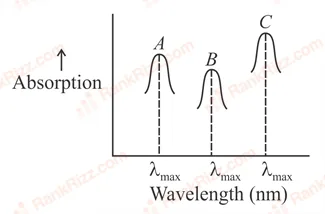
Simplified absorption spectra of three complexes ((i) and (ii) and (iii)) of ion are provided below; their values are marked as A, B and C respectively. The correct match between the complexes and their values is:
(i)
(ii)
(iii)
A-(iii), (B)-(i), C-(ii)
A-(ii), (B)-(i), C-(iii)
A-(ii), (B)-(iii), C-(i)
A-(i), (B)-(ii), C-(iii)
The Crystal Field Stabilization Energy (CFSE) of is:
The values of the crystal field stabilization energies for a high spin metal ion in octahedral and tetrahedral fields, respectively, are:
and
and
and
and
Among the statements (a) - (d), the incorrect ones are:
(a) Octahedral Co(III) complexes with strong field ligands have very high magnetic moments
(b) When , the d-electron configuration of Co(III) in an octahedral complex is
(c) Wavelength of light absorbed by [Co(en)] is lower than that of [CoF]
(d) If the for an octahedral complex of Co(III) is 18,000 cm, the for its tetrahedral complex with the same ligand will be 16,000 cm.
(a) and (d) only
(c) and (d) only
(a) and (b) only
(b) and (c) only
For a metal ion in an octahedral field, the correct electronic configuration is:
when
when
when
when
The one that can exhibit highest paramagnetic behaviour among the following is: gly = glycinato; bpy = 2, 2'-bipyridine
The theory that can completely/properly explain the nature of bonding in [Ni(CO)] is:
Werner's theory
Molecular orbital theory
Crystal field theory
Valence bond theory
has number of geometrical isomers. Then, the spin-only magnetic moment and crystal field stabilization energy [CFSE] of , respectively, are:
[Note: Ignore the pairing energy]
2.84 BM and
5.92 BM and 0
1.73 BM and
0 BM and
The electronic spectrum of shows a single broad peak with a maximum at 20,300 cm. The crystal field stabilization energy (CFSE) of the complex ion, in kJ mol, is: (1 kJ mol = 83.7 cm)
145.5
242.5
83.7
97
Consider that metal ion forms a complex with aqua ligands, and the spin only magnetic moment of the complex is 4.90 BM. The geometry and the crystal field stabilization energy of the complex is:
octahedral and
tetrahedral and
octahedral and
tetrahedral and
RELATED COORDINATION COMPOUNDS TOPICS