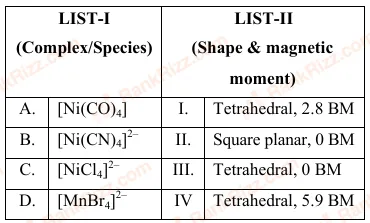
Match the LIST-I with LIST-II
Choose the correct answer from the options given below :
- A
A-III, B-IV, C-II, D-I
- B
A-I, B-III, C-I, D-IV
- C
A-III, B-II, C-I, D-IV
- D
A-IV, B-I, C-III, D-II
Every JEE Main question on Colour and magnetic behaviour of complexes from CFT, one of the ideas inside Coordination Compounds: 145 questions from 2004–2026, 102 of them in the last five years. Newest first, answer key on every one. Free to read.
Questions
145
Years asked
17
Since
2004
Of the chapter
39%
41–60 OF 145 · NEWEST FIRST
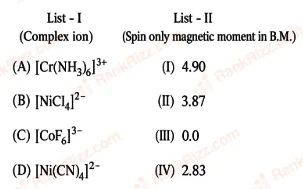
Match the LIST-I with LIST-II
Choose the correct answer from the options given below :
A-III, B-IV, C-II, D-I
A-I, B-III, C-I, D-IV
A-III, B-II, C-I, D-IV
A-IV, B-I, C-III, D-II
From the magnetic behaviour of (diamagnetic), choose the correct geometry and oxidation state.
The correct increasing order of stability of the complexes based on value is: I. II. III. IV.
IV < III < II < I
I < II < IV < III
III < II < IV < I
II < III < I < IV
A transition metal among and has the highest standard electrode potential (). It forms a metal complex of the type . The number of electrons present in the orbital of the complex is ______.
Consider the following low-spin complexes , , , The sum of the spin-only magnetic moment values of
complexes having yellow colour is. _____ B.M. (answer in nearest integer)
The spin-only magnetic moment value of ion formed among Ni, Zn, Mn and Cu that has the least enthalpy of atomisation is _________. (in nearest integer)
Here n is equal to the number of diamagnetic complexes among , , and
Number of complexes from the following with even number of unpaired "d" electrons is: , , , , . [Given atomic numbers: V=23, Cr=24, Fe=26, Ni=28, Cu=29]
Select the option with correct property:
and both diamagnetic
and both paramagnetic
diamagnetic, paramagnetic
Number of Complexes with even number of electrons in orbitals is - , , , ,
2
3
1
5
The correct sequence of ligands in the order of decreasing field strength is:
Given below are two statements: Statement (I): A solution of is green in colour. Statement (II): A solution of is colourless. In the light of the above statements, choose the most appropriate answer from the options given below:
Both Statement I and Statement II are incorrect
Both Statement I and Statement II are correct
Statement I is incorrect but Statement II is correct
Statement I is correct but Statement II is incorrect
Which of the following compounds show colour due to d-d transition?
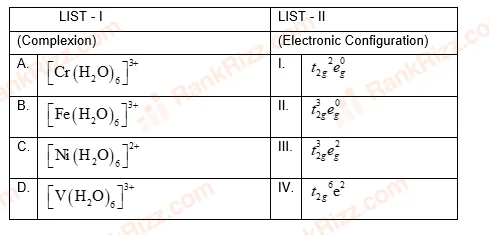
Match List I with List II
Choose the correct answer from the options given below:
A-III, B-II, C-IV, D-I
A-IV, B-I, C-II, D-III
A-IV, B-III, C-I, D-II
A-II, B-III, C-IV, D-I
A first row transition metal in its +2 oxidation state has a spin-only magnetic moment value of BM. The atomic number of the metal is:
26
25
23
22
The number of complexes from the following with no electrons in the orbital is , , , ,
1
4
3
2
Which one of the following complexes will exhibit the least paramagnetic behaviour? [Atomic number, ]
The following complexes (A), (B), (C), (D). The correct order of A, B, C and D in terms of wavenumber of light absorbed is :
C < D < A < B
B < C < A < D
A < C < B < D
D < A < C < B
Match List - I with List - II.
Choose the correct answer from the options given below :
(A)-(II), (B)-(III), (C)-(I), (D)-(IV)
(A)-(II), (B)-(IV), (C)-(I), (D)-(III)
(A)-(I), (B)-(IV), (C)-(II), (D)-(III)
(A)-(IV), (B)-(III), (C)-(I), (D)-(II)
If an iron (III) complex with the formula has no electron in its orbital, then the value of is:
4
5
6
3
The correct order of ligands arranged in increasing field strength.
RELATED COORDINATION COMPOUNDS TOPICS