JEE MAIN 2026 · 24 JAN S2Ionisation enthalpyTRANSCRIBED
The correct order of C, N, 0 and F in terms of second ionisation potential is
- A
C < O < N < F
- B
F < N < C < O
- C
C < N < F < O
- D
C < F < N < O
Every Classification of Elements and Periodicity question JEE Main has set from 2004–2026, grouped by the idea it tests rather than the order of the syllabus. 201 questions across 6 distinct ideas. Free to read, answer key on every one.
Questions
201
Distinct ideas
6
Share of marks
4.2%
Difficulty
EASY
A chapter is not one subject — it is a handful of procedures the examiner reuses. These are the ones Classification of Elements and Periodicity questions actually test.
21–40 OF 201 · NEWEST FIRST
The correct order of C, N, 0 and F in terms of second ionisation potential is
C < O < N < F
F < N < C < O
C < N < F < O
C < F < N < O
First and second ionization enthalpies of lithium are 520 kJ mol and 7297 kJ mol respectively. Energy required to convert 3.5 mg lithium (g) into Li(g) [Li(g) Li(g)] is _______ kJ mol. (nearest integer)
[Molar mass of Li = 7 g mol]
The incorrect relationship in the following pairs in relation to ionisation enthalpies is :
The property/properties that show irregularity in first four elements of group-17 is/are:
(A) Covalent radius
(B) Electron affinity
(C) Ionic radius
(D) First ionization energy
Choose the correct answer from the options given below:
B and D only
A and C only
B only
A, B, C and D
Which of the following electronegativity order is incorrect?
Mg < Be < B < N
S < Cl < O < F
Al < Si < C < N
Al < Mg < B < N
An element 'E'has the ionisation enthalpy value of .'E'reacts with elements A, B, C and D with electron gain enthalpy values of −328, −349, −325 and , respectively. The correct order of the products EA, EB, EC and ED in terms of ionic character is :
ED > EC > EB > EA
EA > EB > EC > ED
EB > EA > EC > ED
ED > EC > EA > EB
The element that does not belong to the same period of the remaining elements (modern periodic table) is:
Iridium
Platinum
Osmium
Palladium
Match the LIST-I with LIST-II.
| LIST-I (Family) | LIST-II (Symbol) | ||
|---|---|---|---|
| A. | Pnicogen (group 15) | I. | Ts |
| B. | Chalcogen | II. | Og |
| C. | Halogen | III. | Lv |
| D. | Noble gas | IV. | Mc |
Choose the correct answer from the options given below :
A-IV, B-I, C-II, D-III
A-IV, B-III, C-I, D-II
A-III, B-I, C-IV, D-II
A-II, B-III, C-IV, D-I
Given below are two statements :
Statement (I) : The first ionization energy of Pb is greater than that of Sn .
Statement (II) : The first ionization energy of Ge is greater than that of Si .
In the light of the above statements, choose the correct answer from the options given below :
Statement I is false but Statement II is true
Statement I is true but Statement II is false
Both Statement I and Statement II are true
Both Statement I and Statement II are false
Choose the incorrect trend in the atomic radii (r) of the elements :
Given below are two statements : Statement (I): The radii of isoelectronic species increases in the order. Statement (II): The magnitude of electron gain enthalpy of halogen decreases in the order. Cl > F > Br > I In the light of the above statements, choose the most appropriate answer from the options given below :
Statement I is incorrect but Statement II is correct
Statement I is correct but Statement II is incorrect
Both Statement I and Statement II are incorrect
Both Statement I and Statement II are correct
The atomic number of the element from the following with lowest 1st ionisation enthalpy is :
32
35
87
19
Which of the following statements are correct?
A. The process of the addition of an electron to a neutral gaseous atom is always exothermic
B. The process of removing an electron from an isolated gaseous atom is always endothermic
C. The 1st ionization energy of the boron is less than that of the beryllium
D. The electronegativity of C is 2.5 in and
E. Li is the most electropositive among elements of group I
Choose the correct answer from the options given below
B and C only
A, C and D only
B and D only
B, C and E only
Consider the following elements In, Tl, Al, Pb, Sn and Ge . The most stable oxidation states of elements with highest and lowest first ionisation enthalpies, respectively, are
+4 and +1
+1 and +4
+4 and +3
+2 and +3
Electronic configuration of four elements A, B, C and D are given below :
(A)
(B)
(C)
(D)
Which of the following is the correct order of increasing electronegativity (Pauling's scale) ?
Match List-I with List-II.
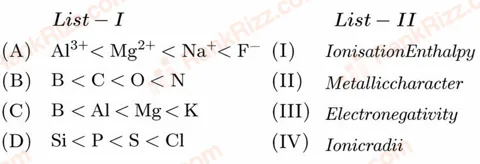
Choose the correct answer from the options given below :
(A)-(IV), (B)-(I), (C)-(II), (D)-(III)
(A)-(IV), (B)-(I), (C)- (III), (D)-(II)
(A)-(III), (B)-(IV), (C)- (II), (D)-(I)
(A)-(II), (B)-(III), (C)-(IV), (D)-(I)
Which of the following statements are NOT true about the periodic table? A. The properties of elements are function of atomic weights. B. The properties of elements are function of atomic numbers. C. Elements having similar outer electronic configurations are arranged in same period. D. An element's location reflects the quantum numbers of the last filled orbital. E. The number of elements in a period is same as the number of atomic orbitals available in energy level that is being filled. Choose the correct answer from the options given below:
A, C and E Only
A and E Only
B, C and E Only
D and E Only
The type of oxide formed by the element among Li, Na, Be, Mg, B and Al that has the least atomic radius is :
AO
Given below are two statements : Statement (I) : An element in the extreme left of the periodic table forms acidic oxides. Statement (II) : Acid is formed during the reaction between water and oxide of a reactive element present in the extreme right of the periodic table. In the light of the above statements, choose the correct answer from the options given below :
Statement I is true but Statement II is false
Both Statement I and Statement II are true
Both Statement I and Statement II are false
Statement I is false but Statement II is true
First ionisation enthalpy values of first four group 15 elements are given below. Choose the correct value for the element that is a main component of apatite family :
1402 kJ
834 kJ
1012 kJ
947 kJ
OTHER CHEMISTRY CHAPTERS