JEE Main 2025 Chemistry question — Modern periodic table and classification of elements
Match List-I with List-II.
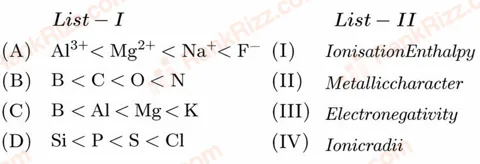
Choose the correct answer from the options given below :
SOLUTION
In periodic-property matching questions, first recall how each property varies and then find the description that matches this trend.
Case A: Second ionisation enthalpy (IE2)
• For an alkali-metal atom the first electron is removed from the subshell, but the second electron must be removed from the stable noble-gas core configuration, making IE2 extraordinarily high.
• Hence the correct description is “exceptionally high when removal produces a noble-gas configuration”.
(A) (IV)
Case B: Electron-gain enthalpy (electron affinity)
• Within a group, added electrons enter the same type of subshell but the atomic size increases, lessening the effective nuclear attraction.
• Therefore the energy released (numerically the negativity of the value) becomes smaller in magnitude; i.e. it becomes “less negative” down the group.
(B) (I)
Case C: Atomic radius
• Across a period the nuclear charge increases while the electrons are added to the same principal shell, pulling the electronic cloud closer to the nucleus.
• Consequently the atomic radius decreases from left to right in a period.
(C) (II)
Case D: Electropositive (metallic) character
• Down any main group the outer electrons experience more shielding and are held less tightly, so the tendency to lose electrons (electropositivity) increases.
(D) (III)
The complete matching is:
(A) - (IV), (B) - ( I), (C) - (II), (D) - (III)
Therefore the correct option is:
Option A which is: (A)-(IV), (B)-(I), (C)-(II), (D)-(III)
Tagged Modern periodic table and classification of elements. Machine-assigned, so read it as a strong shortlist rather than a verdict.