JEE MAIN 2026 · 28 JAN S1Atomic and ionic radii
In period 4 of the periodic table, the elements with highest and lowest atomic radii are respectively.
- A
K & Br
- B
K & Se
- C
Na & Cl
- D
Rb & Br
Atomic and ionic radii has been asked 32 times in JEE Main, in 16 different years between 2004 and 2026, and in all of the last five exam years (2022–2026), 15 questions in all. That is 16% of Classification of Elements and Periodicity. Last asked in JEE Main 28 Jan 2026, Shift 1. All 32 are multiple choice; 19 easy and 9 medium by our difficulty labels. All of them are below, newest first, free to read.
Questions
32
Years asked
16
Since
2004
Of the chapter
16%
Questions on Atomic and ionic radii in every year it was asked, newest first.
| Year | Relative frequency | Questions |
|---|---|---|
| 2026 | 1 | |
| 2025 | 5 | |
| 2024 | 5 | |
| 2023 | 1 | |
| 2022 | 3 | |
| 2021 | 3 | |
| 2020 | 3 | |
| 2019 | 1 | |
| 2018 | 1 | |
| 2015 | 1 | |
| 2014 | 3 | |
| 2013 | 1 | |
| 2012 | 1 | |
| 2010 | 1 | |
| 2009 | 1 | |
| 2004 | 1 | |
| Total | 32 |
1–20 OF 32 · NEWEST FIRST
In period 4 of the periodic table, the elements with highest and lowest atomic radii are respectively.
K & Br
K & Se
Na & Cl
Rb & Br
The property/properties that show irregularity in first four elements of group-17 is/are:
(A) Covalent radius
(B) Electron affinity
(C) Ionic radius
(D) First ionization energy
Choose the correct answer from the options given below:
B and D only
A and C only
B only
A, B, C and D
Choose the incorrect trend in the atomic radii (r) of the elements :
Given below are two statements : Statement (I): The radii of isoelectronic species increases in the order. Statement (II): The magnitude of electron gain enthalpy of halogen decreases in the order. Cl > F > Br > I In the light of the above statements, choose the most appropriate answer from the options given below :
Statement I is incorrect but Statement II is correct
Statement I is correct but Statement II is incorrect
Both Statement I and Statement II are incorrect
Both Statement I and Statement II are correct
Given below are two statements:
Statement (I): The metallic radius of Al is less than that of Ga.
Statement (II): The ionic radius of Al is less than that of Ga.
In the light of the above statements, choose the most appropriate answer from the options given below:
Both Statement I and Statement II are incorrect
Statement I is incorrect but Statement II is correct
Statement I is correct but Statement II is incorrect
Both Statement I and Statement II are correct
The incorrect decreasing order of atomic radii is
Si > P > Cl > F
Be > Mg > Al > Si
Al > B > N > F
Mg > Al > C > O
In case of isoelectronic species the size of , and is affected by:
Principal quantum number
None of the factors because their size is the same
Electron-electron interaction in the outer orbitals
Nuclear charge
Given below are the two statements: one is labeled as Assertion (A) and the other is labeled as Reason (R).
Assertion (A): There is a considerable increase in covalent radius from to . However from to only a small increase in covalent radius is observed.
Reason (R): covalent and ionic radii in a particular oxidation state increases down the group.
In the light of the above statement, choose the most appropriate answer from the options given below:
(A) is false but (R) is true
Both (A) and (R) are true but (R) is not the correct explanation of (A)
(A) is true but (R) is false
Both (A) and (R) are true and (R) is the correct explanation of (A)
Given below are two statements : Statement I : The metallic radius of Na is Å and the ionic radius of is lesser than Å. Statement II : Ions are always smaller in size than the corresponding elements. In the light of the above statements, choose the correct answer from the options given below :
Both Statement I and Statement II are false
Statement I is incorrect but Statement II is true
Both Statement I and Statement II are true
Statement I is correct but Statement II is false
Consider the following elements.
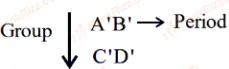
Which of the following is/are true about A', B', C' and D'?
A. Order of atomic radii:
B. Order of metallic character:
C. Size of the element:
D. Order of ionic radii:
Choose the correct answer from the options given below:
A only
A, B and D only
A and B only
B, C and D only
The statement(s) that are correct about the species and . (A) All are isoelectronic (B) All have the same nuclear charge (C) has the largest ionic radii (D) has the smallest ionic radii. Choose the most appropriate answer from the options given below :
(B), (C) and (D) only
(C) and (D) only
(A), (C) and (D) only
(A), (B), (C) and (D)
The correct increasing order of the ionic radii is
Given below are two statements : one is labelled as Assertion and the other is labelled as Reason.
Assertion: The ionic radii of and are same.
Reason: Both and are isoelectronic species.
Both Assertion and Reason are true and Reason is the correct explanation of Assertion.
Both Assertion and Reason are true but Reason is not the correct explanation of Assertion.
Assertion is true but Reason is false.
Assertion is false but Reason is true.
The correct order of ionic size of and is :
Given two statements below:
Statement I: In molecule the covalent radius is double of the atomic radius of chlorine.
Statement II: Radius of anionic species is always greater than their parent atomic radius.
Choose the most appropriate answer from options given below
Both Statement I and Statement II are correct
Both Statement I and Statement II are incorrect
Statement I is correct but Statement II is incorrect
Statement I is incorrect but Statement II is correct
The correct order of ionic radii for the ions, P, S, Ca, K, Cl is:
P > S > Cl > K > Ca
P > S > Cl > Ca > K
Cl > S > P > Ca > K
K > Ca > P > S > Cl
The ionic radii of K, Na, Al and Mg are in the order:
Na < K < Mg < Al
Al < Mg < K < Na
Al < Mg < Na < K
K < Al < Mg < Na
The ionic radii of F and O respectively are 1.33 A and 1.4A, while the covalent radius of N is 0.74A. The correct statement for the ionic radius of N from the following is:
It is smaller than F and N
It is bigger than O and F
It is bigger than F and N, but smaller than O
It is smaller than O and F, but bigger than N
The correct order of the ionic radii of , , , , and is:
The increasing order of the atomic radii of the following elements is:
(a) C
(b) O
(c) F
(d) Cl
(e) Br
(b) < (c) < (d) < (a) < (e)
(d) < (c) < (b) < (a) < (e)
(c) < (b) < (a) < (d) < (e)
(a) < (b) < (c) < (d) < (e)
RELATED CLASSIFICATION OF ELEMENTS AND PERIODICITY TOPICS