JEE Main 2021 Chemistry question — Integrated rate laws and half-life (zero and first order)
For the following graphs,
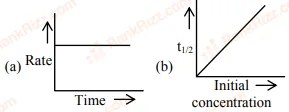
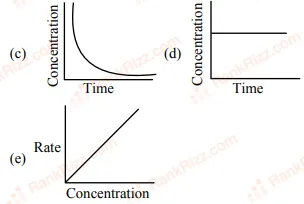
Choose from the options given below, the correct one regarding order of reaction is:
SOLUTION
For a zero-order reaction:
the rate is independent of concentration.
Hence, in graph (a), rate remains constant with time, giving a horizontal line.
For zero-order reactions, half-life is:
Thus:
Therefore, graph (b) gives a straight line passing through the origin and represents zero-order kinetics.
For a first-order reaction:
The integrated rate equation is:
Thus, concentration decreases exponentially with time.
Hence, graph (c) represents first-order kinetics.
For first-order reactions:
Therefore, graph (e), which is a straight line between rate and concentration passing through the origin, also represents first-order kinetics.
Graph (d) shows constant concentration with time.
This means concentration does not decrease and effectively no reaction occurs.
Therefore:
Tagged Integrated rate laws and half-life (zero and first order). Machine-assigned, so read it as a strong shortlist rather than a verdict.