JEE MAIN 2022 · 28 JUL S1VSEPR theory and shapes of molecules and ionsTRANSCRIBED
The number of inter halogens from the following having square pyramidal structure is
Every Chemical Bonding and Molecular Structure question JEE Main has set, grouped by the idea it tests rather than the order of the syllabus. 316 questions across 11 distinct ideas. Free to read, answer key on every one.
Questions
316
Distinct ideas
11
Share of marks
4.8%
Difficulty
MEDIUM
A chapter is not one subject — it is a handful of procedures the examiner reuses. These are the ones Chemical Bonding and Molecular Structure questions actually test.
161–180 OF 316 · NEWEST FIRST
The number of inter halogens from the following having square pyramidal structure is
Given below are two statements: one is labelled as Assertion A and the other is labelled as Reason R:
Assertion A: The H-O-H bond angle in water molecule is 104.5°.
Reason R: The lone pair - lone pair repulsion of electrons is higher than the bond pair - bond pair repulsion.
A is false but R is true
Both A and R are true, but R is not the correct explanation of A
A is true but R is false
Both A and R are true, and R is the correct explanation of A
Which among the following species has unequal bond lengths?
Amongst the following, the linear species is:
NO
ClO
O
N
Number of paramagnetic oxides among the following given oxides is _________.
LiO, CaO, NaO, KO, MgO and KO
1
3
0
2
Which of the following are isostructural pairs?
A. and
B. and
C. and
D. and
A and C only
B and C only
A and B only
C and D only
The correct set from the following in which both pairs are in correct order of melting point is:
LiF > LiCl; NaCl > MgO
LiCl > LiF; MgO > NaCl
LiCl > LiF; NaCl > MgO
LiF > LiCl; MgO > NaCl
A central atom in a molecule has two lone pairs of electrons and forms three single bonds. The shape of this molecule is:
see-saw
planar triangular
T-shaped
trigonal pyramidal
Match List-I with List-II
| (a) SF | (i) spd |
| (b) IF | (ii) dsp |
| (c) NO | (iii) spd |
| (d) NH | (iv) sp |
| (v) sp |
Choose the correct answer from the options given below:
(a)-(i), (b)-(ii), (c)-(v) and (d)-(iii)
(a)-(ii), (b)-(i), (c)-(iv) and (d)-(v)
(a)-(iii), (b)-(i), (c)-(v) and (d)-(iv)
(a)-(iv), (b)-(iii), (c)-(ii) and (d)-(v)
The interaction energy of London forces between two particles is proportional to , where r is the distance between the particles. The value of x is:
6
3
In the following the correct bond order sequence is:
The correct shape and I - I - I bond angles respectively in ion are:
T-shaped; 180° and 90°
Distorted trigonal planar; 135° and 90°
Trigonal planar; 120°
Linear; 180°
According to molecular orbital theory, the species among the following that does not exist is:
The hybridisations of the atomic orbitals of nitrogen in NO, NO and NH respectively are:
sp, sp and sp
sp, sp and sp
sp, sp and sp
sp, sp and sp
The bond order and magnetic behaviour of ion are, respectively:
1.5 and diamagnetic.
1.5 and paramagnetic.
2 and diamagnetic.
1 and paramagnetic
Identify the species having one -bond and maximum number of canonical forms from the following:
Match List-I with List-II.
| List-I (Molecule) | List-II (Bond order) |
|---|---|
| (a) | (i) 1 |
| (b) | (ii) 2 |
| (c) | (iii) 0 |
| (d) | (iv) 3 |
(a)(ii), (b)(i), (c)(iv), (d)(iii)
(a)(iii), (b)(iv), (c)(i), (d)(ii)
(a)(i), (b)(ii), (c)(iii), (d)(iv)
(a)(iv), (b)(iii), (c)(ii), (d)(i)
In the following molecules,
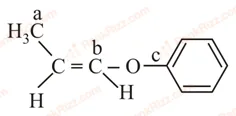
Hybridisation of carbon a, b and c respectively are :
sp, sp, sp
sp, sp, sp
sp, sp, sp
sp, sp, sp
Match List - I with List - II:
List-I (Property) List-II (Example)
(a) Diamagnetism (i) MnO
(b) Ferrimagnetism (ii) O
(c) Paramagnetism (iii) NaCl
(d) Antiferromagnetism (iv) FeO
Choose the most appropriate answer from the options given below:
(a) - (iv), (b) - (ii), (c) - (i), (d) - (iii)
(a) - (ii), (b) - (i), (c) - (iii), (d) - (iv)
(a) - (i), (b) - (iii), (c) - (iv), (d) - (ii)
(a) - (iii), (b) - (iv), (c) - (ii), (d) - (i)
In
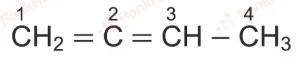
molecule, the hybridization of carbon 1, 2, 3 and 4 respectively, are:
OTHER CHEMISTRY CHAPTERS