JEE MAIN 2023 · 25 JAN S1VSEPR theory and shapes of molecules and ionsTRANSCRIBED
The total number of lone pairs of electrons on oxygen atoms of ozone is
Every Chemical Bonding and Molecular Structure question JEE Main has set, grouped by the idea it tests rather than the order of the syllabus. 316 questions across 11 distinct ideas. Free to read, answer key on every one.
Questions
316
Distinct ideas
11
Share of marks
4.8%
Difficulty
MEDIUM
A chapter is not one subject — it is a handful of procedures the examiner reuses. These are the ones Chemical Bonding and Molecular Structure questions actually test.
121–140 OF 316 · NEWEST FIRST
The total number of lone pairs of electrons on oxygen atoms of ozone is
The number of species having a square planar shape from the following is
XeF, SF, SiF, BF, BrF, [Cu(NH)], [FeCl], [PtCl]
The number of bent-shaped molecule/s from the following is _______ N, NO, I, O, SO
The number of molecules or ions from the following, which do not have odd number of electrons are ______.
(A) NO
(B) ICl
(C) BrF
(D) ClO
(E) NO
(F) NO
Amongst the following, the number of species having the linear shape is
XeF, I, CO, I, CO, SO, BeCl and BCl
In an ice crystal, each water molecule is hydrogen bonded to ______ neighbouring molecules.
The sum of lone pairs present on the central atom of the interhalogen IF and IF is _______.
The number of species from the following which have square pyramidal structure is ______
PF, BrF, IF, BrF, XeOF, ICl
The number of following factors which affect the percent covalent character of the ionic bond is______
A) Polarising power of cation
B) Extent of distortion of anion
C) Polarisability of the anion
D) Polarising power of anion
The number of molecules from the following which contain only two lone pair of electrons is _______
HO, N, CO, XeF, NH, NO, CO, F
The maximum number of lone pairs of electron on the central atom from the following species is _______ ClO, XeF, SF and I
Bonding in which of the following diatomic molecule(s) become(s) stronger, on the basis of MO Theory, by removal of an electron?
(A) NO
(B)
(C)
(D)
(E)
Choose the most appropriate answer from the options given below :
A, B, C only
B, C, E only
A, C only
D only
Based upon VSEPR theory, match the shape (geometry) of the molecules in List-I with the molecules in List-II
| List-I (Shape) | List-II (Molecules) |
|---|---|
| A T-shaped | I. |
| B Trigonal planar | II. |
| C Square planar | III. |
| D See-saw | IV. |
A-(I), B-(II), C-(III), D-(IV)
A-(IV), B-(I), C-(II), D-(III)
A-(II), B-(I), C-(IV), D-(III)
A-(III), B-(IV), C-(I), D-(II)
Identify the incorrect statement for from the following.
In this molecule, orbitals of phosphorous are assumed to undergo hybridization.
The geometry of is trigonal bipyramidal.
has two axial bonds stronger than three equatorial bonds.
The three equatorial bonds of lie in a plane.
Match List I with List II
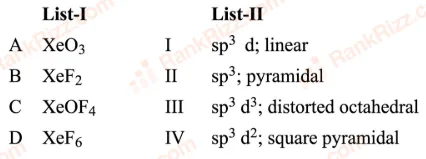
Choose the correct answer from the options given below
A - II, B - IV, C - III, D - I
A - IV, B - II, C - III, D - I
A - II, B - I, C - IV, D - III
A - IV, B - II, C - I, D - III
Match List - I with List - II.
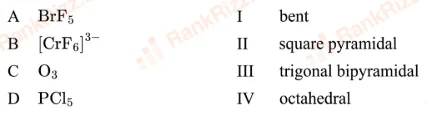
Choose the correct answer from the options given below
A-I, B-II, C-III, D-IV
A-IV, B-III, C-II, D-I
A-II, B-IV, C-I, D-III
A-III, B-IV, C-II, D-I
Number of electron deficient molecules among the following and is
0
1
2
3
Consider the ions/molecule . For increasing bond order the correct option is
O_2^- < O_2^{2-} < O_2 < O_2^+
O_2^- < O_2^{2-} < O_2^+ < O_2
O_2^- < O_2^+ < O_2^{2-} < O_2
O_2^{2-} < O_2^- < O_2 < O_2^+
The correct order of increasing intermolecular hydrogen bond strength is
HCN < H_2O < NH_3
HCN < CH_4 < NH_3
CH_4 < HCN < NH_3
CH_4 < NH_3 < HCN
Arrange the following in increasing order of their covalent character.
(A)
(B)
(C)
(D)
Choose the correct answer from the options given below.
B < A < C < D
A < B < C < D
A < B < D < C
A < C < B < D
OTHER CHEMISTRY CHAPTERS