RankRizz

JEE Main 09 Jan 2019, Shift 1: Chemistry

The 30 Chemistry questions of JEE Main 09 Jan 2019, Shift 1, numbered across the whole paper. Pick an answer on any question to check it against the key. Free to read, nothing to download.

Chemistry

Q31Hydrogen spectrum and spectral seriesTRANSCRIBED

For emission line of atomic hydrogen from ni=8n_i = 8 to nf=nn_f = n, the plot of wave number νˉ\bar{\nu} against 1n2\frac{1}{n^2} will be: (The Rydberg constant, RHR_H is in wave number unit)

  1. A

    Linear with slope −RH-R_H

  2. B

    Non linear

  3. C

    Linear with slope RHR_H

  4. D

    Linear with intercept −RH-R_H

Q32Electronegativity, effective nuclear charge and shieldingTRANSCRIBED

In general, the properties that decrease and increase down a group in the periodic table, respectively, are:

  1. A

    Atomic radius and electronegativity

  2. B

    Electronegativity and atomic radius

  3. C

    Electronegativity and electron gain enthalpy

  4. D

    Electron gain enthalpy and electronegativity

Q33Group 13: general trends and inert pair effectTRANSCRIBED

Aluminium is usually found in +3 oxidation state. In contrast, thallium exists in +1 and +3 oxidation states. This is due to:

  1. A

    Diagonal relationship

  2. B

    Lattice effect

  3. C

    Lanthanoid contraction

  4. D

    Inert pair effect

Q34Molecular orbital theory of diatomic speciesTRANSCRIBED

According to molecular orbital theory, which of the following is true with respect to Li2+Li_2^+ and Li2−Li_2^-?

  1. A

    Li2+Li_2^+ is stable and Li2−Li_2^- is unstable

  2. B

    Both are unstable

  3. C

    Both are stable

  4. D

    Li2+Li_2^+ is unstable and Li2−Li_2^- is stable

Q35Gas laws and ideal gas equationTRANSCRIBED

0.5 moles of gas A and x moles of gas B exert a pressure of 200 Pa in a container of volume 10 m3^3 at 1000 K. Given, R is the gas constant in JK−1^{-1}mol−1^{-1}, x is:

  1. A

    4+R2R\frac{4 + R}{2R}

  2. B

    2R4+R\frac{2R}{4 + R}

  3. C

    4−R2R\frac{4 - R}{2R}

  4. D

    2R4−R\frac{2R}{4 - R}

Q36Heat capacity and calorimetryTRANSCRIBED

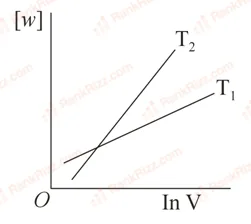
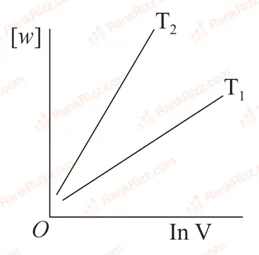
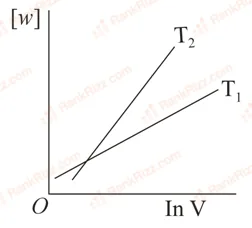
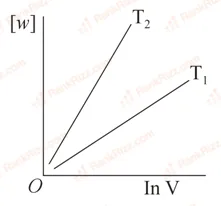
Consider the reversible isothermal expansion of an ideal gas in a closed system at two different temperatures T1T_1 and T2T_2 (T1<T2T_1 < T_2). The correct graphical depiction of the dependence of work done ww vs the final volume VV is:

  1. A
    Figure for JEE Main 2019 Chemistry question on Heat capacity and calorimetry
  2. B
    Figure for JEE Main 2019 Chemistry question on Heat capacity and calorimetry
  3. C
    Figure for JEE Main 2019 Chemistry question on Heat capacity and calorimetry
  4. D
    Figure for JEE Main 2019 Chemistry question on Heat capacity and calorimetry
Q37pH of acids, bases and their mixturesTRANSCRIBED

20 ml of 0.1 M H2SO4H_2SO_4 solution is added to 30 mL of 0.2 M NH4OHNH_4OH solution. The pH of the resultant mixture is: (pKbpK_b of NH4OH=4.7NH_4OH = 4.7)

  1. A

    5.0

  2. B

    5.2

  3. C

    9.4

  4. D

    9.0

Q38Position, isotopes, preparation and properties of dihydrogenTRANSCRIBED

The isotopes of hydrogen are:

  1. A

    Protium, deuterium and tritium

  2. B

    Tritium and protium only

  3. C

    Protium and deuterium only

  4. D

    Deuterium and tritium only

Q39Alkaline earth metals: properties and trendsTRANSCRIBED

The alkaline earth metal nitrate that does not crystallise with molecules is:

  1. A

    Ba(NO3)2Ba(NO_3)_2

  2. B

    Sr(NO3)2Sr(NO_3)_2

  3. C

    Mg(NO3)2Mg(NO_3)_2

  4. D

    Ca(NO3)2Ca(NO_3)_2

Q40Group 14: trends and carbon allotropesTRANSCRIBED

Correct statements among regarding silicones are:
(a) They are polymers with hydrophobic character.
(b) They are biocompatible.
(c) In general, they have high thermal stability and low dielectric strength.
(d) Usually, they are resistant to oxidation and used as greases.

  1. A

    (a), (b) and (c) only

  2. B

    (a) and (b) only

  3. C

    (a), (b), (c) and (d)

  4. D

    (a), (b) and (d) only

Q41Electrophilic substitution of anilineTRANSCRIBED

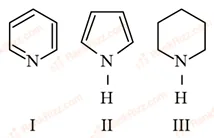
Arrange the following amines in the decreasing order of basicity.

Figure for JEE Main 2019 Chemistry question on Electrophilic substitution of aniline
  1. A

    III > I > II

  2. B

    I > III > II

  3. C

    III > II > I

  4. D

    I > II > III

Q42Acidity and basicity of organic compoundsTRANSCRIBED

Which amongst the following is the strongest acid?

  1. A

    CHCN3CHCN_3

  2. B

    CHI3CHI_3

  3. C

    CHBr3CHBr_3

  4. D

    CHCl3CHCl_3

Q43HaloarenesTRANSCRIBED

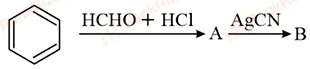
The compounds A and B in the following reaction are, respectively:

Figure for JEE Main 2019 Chemistry question on Haloarenes
  1. A

    A = Benzyl alcohol, B = Benzyl isocyanide

  2. B

    A = Benzyl chloride, B = Benzyl isocyanide

  3. C

    A = Benzyl alcohol, B = Benzyl cyanide

  4. D

    A = Benzyl chloride, B = Benzyl cyanide

Q44Water pollutionTRANSCRIBED

A water sample has ppm level concentration of the following metals: Fe = 0.2; Mn = 5.0; Cu = 3.0; Zn = 5.0. The metal that makes the water sample unsuitable for drinking is:

  1. A

    Zn

  2. B

    Fe

  3. C

    Mn

  4. D

    Cu

Q45Group 14: trends and carbon allotropesTRANSCRIBED

The one that is extensively used as a piezoelectric material is:

  1. A

    Tridymite

  2. B

    Quartz

  3. C

    Amorphous silica

  4. D

    Mica

Q46Concentration terms and their interconversionTRANSCRIBED

A solution of sodium sulphate contains 92 g of Na+^+ ions per kilogram of water. The molality of Na+^+ ions in that solution in mol kg−1^{-1} is:

  1. A

    16

  2. B

    4

  3. C

    12

  4. D

    8

Q47Solubility of gases and Henry's lawTRANSCRIBED

Which one of the following statements regarding Henry's law is not correct?

  1. A

    Different gases have different KHK_H (Henry's law constant) values at the same temperature

  2. B

    The partial pressure of the gas in vapour phase is proportional to the mole fraction of the gas in the solution

  3. C

    Higher the value of KHK_H at a given pressure, higher is the solubility of the gas in the liquids

  4. D

    The value of KHK_H increases with increase of temperature and KHK_H is function of the nature of the gas

Q48Electrolysis and Faraday's lawsTRANSCRIBED

The anodic half-cell of lead-acid battery is recharged using electricity of 0.05 Faraday. The amount of PbSO4PbSO_4 electrolyzed in g during the process is: (Molar mass of PbSO4=303PbSO_4 = 303 g mol−1^{-1})

  1. A

    22.8

  2. B

    15.2

  3. C

    11.4

  4. D

    7.6

Q49Methods to determine order of reactionTRANSCRIBED

The following results were obtained during kinetic studies of the reaction.
2A+B→2A + B \rightarrow product

Experiment I: A = 0.10 mol L−1^{-1}, B = 0.20 mol L−1^{-1}, Rate = 6.93×10−36.93 \times 10^{-3} mol L−1^{-1} min−1^{-1}
Experiment II: A = 0.10 mol L−1^{-1}, B = 0.25 mol L−1^{-1}, Rate = 6.93×10−36.93 \times 10^{-3} mol L−1^{-1} min−1^{-1}
Experiment III: A = 0.20 mol L−1^{-1}, B = 0.30 mol L−1^{-1}, Rate = 1.386×10−21.386 \times 10^{-2} mol L−1^{-1} min−1^{-1}

The time (in minutes) required to consume half of A is:
  1. A

    100

  2. B

    10

  3. C

    5

  4. D

    1

Q50Adsorption and adsorption isothermsTRANSCRIBED

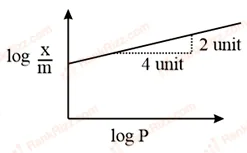
Adsorption of a gas follows Freundlich adsorption isotherm. In the given plot, xx is the mass of the gas adsorbed on mass mm of the adsorbent at pressure P. xm\frac{x}{m} is proportional to:

Figure for JEE Main 2019 Chemistry question on Adsorption and adsorption isotherms
  1. A

    p14p^{\frac{1}{4}}

  2. B

    pp

  3. C

    p2p^2

  4. D

    p12p^{\frac{1}{2}}

Q51Occurrence of metals: minerals and oresTRANSCRIBED

The ore that contains both iron and copper is:

  1. A

    Azurite

  2. B

    Malachite

  3. C

    Dolomite

  4. D

    Copper pyrites

Q52Reactions and tests of aminesTRANSCRIBED

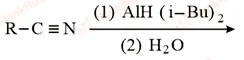
The major product of the following reaction is:

Figure for JEE Main 2019 Chemistry question on Reactions and tests of amines
  1. A

    RCOOHRCOOH

  2. B

    RCHORCHO

  3. C

    RCH2NH2RCH_2NH_2

  4. D

    RCONH2RCONH_2

Q53Colour and magnetic behaviour of complexes from CFTTRANSCRIBED

Two complexes [CrH2O)6]Cl3[CrH_2O)_6]Cl_3 (A) and [Cr(NH3)6]Cl3[Cr(NH_3)_6]Cl_3 (B) are violet and yellow coloured, respectively. The incorrect statement regarding them is:

  1. A

    Both are paramagnetic with three unpaired electrons

  2. B

    Δ0\Delta_0 value of A is less than that of B

  3. C

    Δ0\Delta_0 values of A and B are calculated from the energies violet and yellow light, respectively.

  4. D

    Both absorb energies corresponding to their complementary colors.

Q54HaloarenesTRANSCRIBED

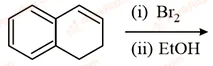
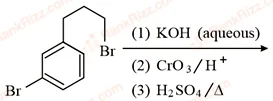
In the reaction given below what will be the major product at the end:

Figure for JEE Main 2019 Chemistry question on Haloarenes


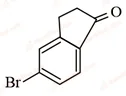
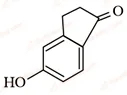
Options:

  1. A
    Figure for JEE Main 2019 Chemistry question on Haloarenes
  2. B
    Figure for JEE Main 2019 Chemistry question on Haloarenes
  3. C
    Figure for JEE Main 2019 Chemistry question on Haloarenes
  4. D
    Figure for JEE Main 2019 Chemistry question on Haloarenes
Q55Classification of polymers and types of polymerisationTRANSCRIBED

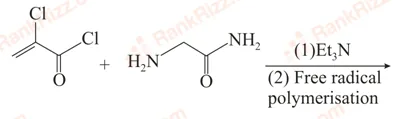
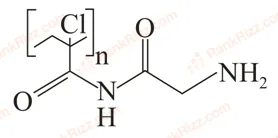
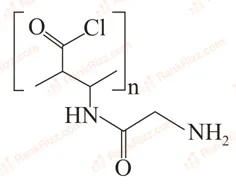
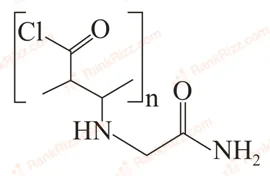
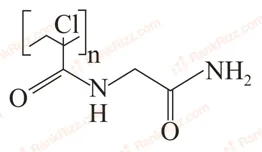
Major product of the given reaction is:

Figure for JEE Main 2019 Chemistry question on Classification of polymers and types of polymerisation


Options:

  1. A
    Figure for JEE Main 2019 Chemistry question on Classification of polymers and types of polymerisation
  2. B
    Figure for JEE Main 2019 Chemistry question on Classification of polymers and types of polymerisation
  3. C
    Figure for JEE Main 2019 Chemistry question on Classification of polymers and types of polymerisation
  4. D
    Figure for JEE Main 2019 Chemistry question on Classification of polymers and types of polymerisation
Q56Valence bond theory of complexesTRANSCRIBED

The highest value of the calculated spin only magnetic moment (in BM) among all the transition metal complexes is:

  1. A

    4.90 BM

  2. B

    3.87 BM

  3. C

    6.93 BM

  4. D

    5.92 BM

Q57Acidity and basicity of organic compoundsTRANSCRIBED

Acid strength given below the correct decreasing order will be:

  1. A

    NO2CH2COOH>FCH2COOH>CNCH2COOH>ClCH2COOHNO_2CH_2COOH > FCH_2COOH > CNCH_2COOH > ClCH_2COOH

  2. B

    FCH2COOH>NCCH2COOH>NO2CH2COOH>ClCH2COOHFCH_2COOH > NCCH_2COOH > NO_2CH_2COOH > ClCH_2COOH

  3. C

    CNCH2COOH>O2NCH2COOH>FCH2COOH>ClCH2COOHCNCH_2COOH > O_2NCH_2COOH > FCH_2COOH > ClCH_2COOH

  4. D

    O2NCH2COOH>FCH2COOH>ClCH2COOH>NCCH2COOHO_2NCH_2COOH > FCH_2COOH > ClCH_2COOH > NCCH_2COOH

Q59Quantitative estimation of elementsTRANSCRIBED

The correct match between column-I and column-II is:
Column-I (drug)              Column-II (test)
(A) Chloroxylenol           (P) Carbylamine test
(B) Norethindrone         (Q) Sodium hydrogen carbonate test
(C) Sulphapyridine        (R) Ferric chloride test
(D) Penicillin                  (S) Baeyer's test

  1. A

    A →\rightarrow R, B →\rightarrow P, C →\rightarrow S, D →\rightarrow Q

  2. B

    A →\rightarrow Q, B →\rightarrow S, C →\rightarrow P, D →\rightarrow R

  3. C

    A →\rightarrow Q, B →\rightarrow P, C →\rightarrow S, D →\rightarrow R

  4. D

    A →\rightarrow R, B →\rightarrow S, C →\rightarrow P, D →\rightarrow Q

Q60Proteins and enzymesTRANSCRIBED

The increasing order of pKa of the following amino acids in aqueous solution is: Glycine, Aspartate, Lysine, Arginine.

  1. A

    Arginine < Lysine < Glycine < Aspartate

  2. B

    Aspartate < Glycine < Arginine < Lysine

  3. C

    Glycine < Aspartate < Arginine < Lysine

  4. D

    Aspartate < Glycine < Lysine < Arginine

NEXT IN THIS PAPER →Maths, Q61 onwards