JEE Main 2019 Chemistry question — Solubility of gases and Henry's law
Which one of the following statements regarding Henry's law is not correct?
SOLUTION
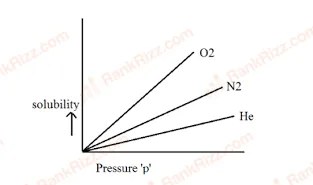
We begin by recalling Henry's law, which establishes a relation between the pressure of a gas above a liquid solution and the mole fraction of that gas dissolved in the liquid. The law is stated mathematically as
where
is the partial pressure of the gas in the vapour phase above the solution,
is the mole fraction of the gas dissolved in the liquid, and
is Henry’s law constant, characteristic of the particular gas-solvent pair at a given temperature.
From the relation we can algebraically solve for the mole fraction to see how it depends on :
Dividing both sides by , we obtain
This expression shows explicitly that, when the pressure is kept the same, the mole fraction (which directly represents the solubility of the gas in the liquid) is inversely proportional to the constant . In simpler words, for a fixed external pressure,
• If is large, the denominator in is large, so the mole fraction becomes small, meaning the gas is less soluble.
• If is small, the denominator is small, so becomes large, meaning the gas is more soluble.
Therefore, a higher value of corresponds to lower solubility of the gas in the liquid.
Now let us analyse each statement in the question one by one using the facts above.
Statement A: “Different gases have different values at the same temperature.”
This is true, because depends on the nature of the gas as well as the solvent.
Statement B: “The partial pressure of the gas in the vapour phase is proportional to the mole fraction of the gas in the solution.”
This is exactly the verbal form of Henry’s law , so it is correct.
Statement C: “Higher the value of at a given pressure, higher is the solubility of the gas in the liquids.”
Using , we found that a higher actually lowers the solubility. Hence this statement is incorrect.
Statement D: “The value of increases with increase of temperature and is function of the nature of the gas.”
Empirically, for most gases, indeed rises with temperature because gases become less soluble as temperature increases; it is also well known that varies with the identity of the gas. Thus this statement is correct.
Only Statement C contradicts the true relationship derived from Henry’s law, so it is the one that is not correct.
Hence, the correct answer is Option C.
Tagged Solubility of gases and Henry's law. Machine-assigned, so read it as a strong shortlist rather than a verdict.