JEE Main 2019 Chemistry question — Reactions and tests of amines
The major product of the following reaction is:
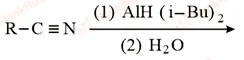
SOLUTION

- Partial Reduction: DIBAL-H is a bulky, sterically hindered reducing agent. At low temperatures, it delivers exactly one equivalent of hydride () to the electrophilic carbon of the nitrile group (). This reduces the triple bond to a double bond, stopping cleanly at an imine intermediate ().
- Hydrolysis: When water () is introduced during the workup step, the imine intermediate undergoes rapid nucleophilic hydrolysis, replacing the nitrogenous group with an oxygen atom to yield an aldehyde ().
Detailed Evaluation of Each Option:
-
Option A: (Carboxylic Acid)
This statement is incorrect. Nitriles can be hydrolyzed to carboxylic acids using strong aqueous acids or bases with prolonged heating, but a hydride reduction with DIBAL-H does not oxidize the carbon to an acid state.
-
Option B: (Aldehyde)
This statement is correct. The primary synthetic application of treating a nitrile with DIBAL-H followed by water is the controlled, selective conversion into an aldehyde.
-
Option C: (Primary Amine)
This statement is incorrect. Complete reduction down to a primary amine requires a much stronger, unhindered reducing agent like lithium aluminum hydride () or catalytic hydrogenation ().
-
Option D: (Primary Amide)
This statement is incorrect. An amide is formed during the partial chemical hydrolysis of a nitrile group, not through a hydride reduction pathway.
Conclusion:
DIBAL-H reduces nitriles selectively to imines, which yield aldehydes upon subsequent aqueous workup.
Answer: Option B —
Tagged Reactions and tests of amines. Machine-assigned, so read it as a strong shortlist rather than a verdict.