JEE MAIN 2019 · 09 JAN S1+4 / −1MEDIUMTRANSCRIBED
JEE Main 2019 Chemistry question — Haloarenes
In the reaction given below what will be the major product at the end:
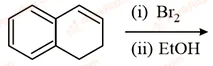
Options:
SOLUTION
Key idea: adds to the alkene via a bromonium ion; in ethanol the benzylic carbon (best able to hold positive charge) is attacked by the solvent.
- Substrate: 1,2-dihydronaphthalene; its C=C (C1=C2) is conjugated with the benzene ring, C1 being benzylic.
- forms a bromonium ion across C1–C2 (or a dibromide whose benzylic C–Br ionises easily).
- The C1–Br bond is weaker/more stretched because C1 can stabilise positive charge by resonance with the ring (benzylic). So the nucleophile EtOH attacks C1.
- Loss of gives the product with OEt on the benzylic carbon and Br on the adjacent carbon:
- Option (C) has the regiochemistry reversed; (A) has no Br; (B) is an elimination product.
Answer: (D)
Tagged Haloarenes. Machine-assigned, so read it as a strong shortlist rather than a verdict.