JEE MAIN 2019 · 09 JAN S1+4 / −1MEDIUMTRANSCRIBED
JEE Main 2019 Chemistry question — Haloarenes
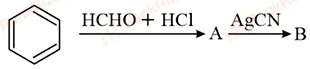
The compounds A and B in the following reaction are, respectively:
SOLUTION
Step 1: Formation of Compound A (Blanc Chloromethylation)
When benzene reacts with formaldehyde (HCHO) and hydrogen chloride (HCl) in the presence of a Lewis acid catalyst like ZnCl2, it undergoes a Blanc chloromethylation reaction.
- Mechanism: Formaldehyde is protonated to form an electrophile, which attacks the benzene ring. The resulting benzyl alcohol intermediate is quickly converted by HCl into a benzyl halide.
- Compound A: Benzyl chloride (C6H5-CH2Cl)
Step 2: Formation of Compound B (Nucleophilic Substitution with AgCN)
When benzyl chloride (A) reacts with silver cyanide (AgCN), a nucleophilic substitution reaction takes place.
- Regioselectivity Rule: Silver cyanide (AgCN) is predominantly covalent in nature. Because the silver-carbon bond is strong, the lone pair on the nitrogen atom acts as the nucleophile rather than the carbon atom.
- Result: This leads to the formation of an isocyanide (isonitrile) rather than a cyanide (nitrile).
- Compound B: Benzyl isocyanide (C6H5-CH2-NC)
Summary of Products
- A: Benzyl chloride (C6H5-CH2Cl)
- B: Benzyl isocyanide (C6H5-CH2-NC)
Tagged Haloarenes. Machine-assigned, so read it as a strong shortlist rather than a verdict.