JEE Main 2019 Chemistry question — Classification of polymers and types of polymerisation
Major product of the given reaction is:
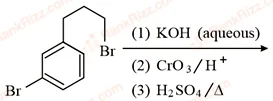
Options:
SOLUTION
Step 1: Nucleophilic Substitution with aqueous KOH
The starting material contains two bromine atoms: an unreactive aryl bromide on the benzene ring and a reactive terminal alkyl bromide. Aqueous KOH selectively undergoes an reaction with the terminal alkyl bromide to replace the group with a hydroxyl group (), forming a primary alcohol side chain.
Step 2: Oxidation (Jones Oxidation)
Chromium trioxide in an acidic medium is a strong oxidizing agent. It oxidizes the newly formed primary alcohol side chain fully into a carboxylic acid group -COOH.
Step 3: Intramolecular Friedel-Crafts Acylation with H2SO4 with Heating
Concentrated sulfuric acid and heat dehydrate the carboxylic acid side chain, generating an electrophilic acylium ion intermediate. This ion undergoes an intramolecular Friedel-Crafts acylation by attacking the benzene ring at the available position ortho to the side chain.
Tagged Classification of polymers and types of polymerisation. Machine-assigned, so read it as a strong shortlist rather than a verdict.