Q31Mole concept, atomic and molar massTRANSCRIBED
An organic compound contains C, H and S. The minimum molecular weight of the compound containing 8% Sulphur is
- A
600 g mol
- B
200 g mol
- C
400 g mol
- D
300 g mol
The 30 Chemistry questions of JEE Main 09 Apr 2016, Online, numbered across the whole paper. Pick an answer on any question to check it against the key. Free to read, nothing to download.
An organic compound contains C, H and S. The minimum molecular weight of the compound containing 8% Sulphur is
600 g mol
200 g mol
400 g mol
300 g mol
The amount of arsenic pentasulphide that can be obtained when 35.5 g arsenic acid is treated with excess in the presence of conc. HCl (assuming 100% conversion) is
0.25 mol
0.50 mol
0.333 mol
0.125 mol
The total number of orbitals associated with the principal quantum number 5 is:
20
25
10
5
The group of molecules having identical shape is:
, ,
, ,
, ,
, ,
At very high pressures, the compressibility factor of one mole of a gas is given by:
Which intermolecular force is most responsible in allowing xenon gas to liquefy?
London forces
Ion-dipole
Ionic
Dipole-dipole
For the reaction,
, and are, respectively, kJ mol and kJ K mol at 298 K. The equilibrium constant for the reaction at 298 K is:
10
1
A reaction at 1 bar is non-spontaneous at low temperature but becomes spontaneous at high temperature. Identify the correct statement about the reaction among the following:
is negative while is positive
Both and are negative
is positive while is negative
Both and are positive
Identify the incorrect statement regarding heavy water:
It reacts with to form deuterated sulphuric acid .
It is used as a coolant in nuclear reactors.
It reacts with to produce and .
It reacts with to produce and .
The correct order of the solubility of alkaline-earth metal sulphates in water is:
Mg > Ca > Sr > Ba
Mg > Sr > Ca > Ba
Mg < Ca < Sr < Ba
Mg < Sr < Ca < Ba
Match the items in Column I with its main use listed in Column II:
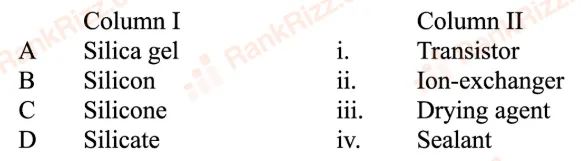
A - iii, B - i, C - iv, D - ii
A - iv, B - i, C - ii, D - iii
A - ii, B - i, C - iv, D - iii
A - ii, B - iv, C - i, D - iii
The hydrocarbon with seven carbon atoms containing a neopentyl and a vinyl group is:
2,2-dimethyl-4-pentene
4,4-dimethylpent-1-ene
Isopropyl-2-butene
2,2-dimethyl-3-pentene
5 L of an alkane requires 25 L of oxygen for its complete combustion. If all volumes are measured at constant temperature and pressure, the alkane is
Isobutane
Ethane
Butane
Propane
BOD stands for:
Bacterial Oxidation Demand
Biological oxygen demand
Biochemical oxygen demand
Both A and B
The solubility of in water at 300 K and 500 torr partial pressure is 0.01 g L. The solubility (in g L) at 750 torr partial pressure is:
0.0075
0.005
0.02
0.015
What will happen when a block of copper metal is dropped into a beaker containing a solution of 1 M ?
The copper metal will dissolve with evolution of oxygen gas.
The copper metal will dissolve with evolution of hydrogen gas.
No reaction will occur.
The copper metal will dissolve and zinc metal will be deposited.
The reaction of ozone with oxygen atoms in the presence of chlorine atoms can occur by a two step process shown below:
...(i)
L mol s
...(ii)
L mol s
The closest rate constant for the overall reaction
is:
L mol s
L mol s
L mol s
L mol s
A particular adsorption process has the following characteristics: (i) It arises due to van der Waals forces and (ii) it is reversible. Identify the correct statement that describes the above adsorption process:
Adsorption is monolayer
Adsorption increases with increase in temperature
Enthalpy of adsorption is greater than 100 kJ mol
Energy of activation is low
The most appropriate method of making egg-albumin sol is:
Break an egg carefully and transfer the transparent part of the content to 100 mL of 5% w/V saline solution and stir well
Keep the egg in boiling water for 10 minutes. After removing the shell, transfer the yellow part of the content to 100 mL of 5% w/V saline solution and homogenize with a mechanical shaker
Keep the egg in boiling water for 10 minutes. After removing the shell, transfer the white part of the content to 100 mL of 5% w/V saline solution and homogenize with a mechanical shaker
Break an egg carefully and transfer only the yellow part of the content to 100 mL of 5% w/V saline solution and stir well
The plot shows the variation of versus temperature for the two reactions.
and
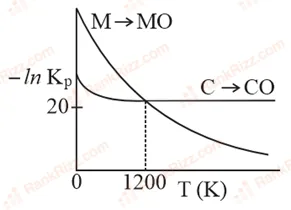
Identify the correct statement:
At T < 1200 K, oxidation of carbon is unfavourable
Oxidation of carbon is favourable at all temperatures
At T < 1200 K, the reaction is spontaneous
At T > 1200 K, carbon will reduce to .
The non-metal that does not exhibit positive oxidation state is:
Chlorine
Iodine
Fluorine
Oxygen
Which one of the following species is stable in aqueous solution?
Which one of the following complexes will consume more equivalents of aqueous solution of ?
Identify the correct trend given below:
(Atomic No. = Ti : 22, Cr : 24 and Mo : 42)
of and of
of and of
of and of
of and of
The gas evolved on heating in methanol is:
Methane
Ethane
Propane
HBr
Bouveault-Blanc reduction reaction involves:
Reduction of an acyl halide with .
Reduction of an anhydride with
Reduction of an ester with .
Reduction of a carbonyl compound with Na/Hg and HCl.
The test to distinguish primary, secondary and tertiary amines is:
Sandmeyer's reaction
Carbylamine reaction
Idoform test
Assertion: Rayon is a semisynthetic polymer whose properties are better than natural cotton.
Reason: Mechanical and aesthetic properties of cellulose can be improved by acetylation.
Both assertion and reason are correct, but the reason is not the correct explanation for the assertion.
Both assertion and reason are correct, and the reason is the correct explanation for the assertion.
Assertion is incorrect statement, but the reason is correct.
Both assertion and reason are incorrect.
The artificial sweetener that has the highest sweetness value in comparison to cane sugar is:
Sucralose
Aspartame
Saccharin
Alitame
Consider the following sequence for aspartic acid:
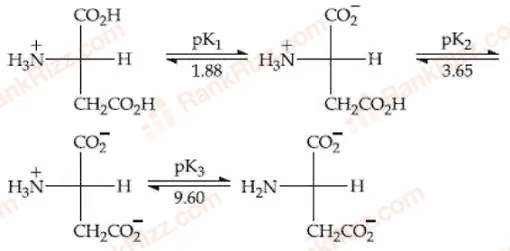
The pH (Isoelectric point) of aspartic acid is:
3.65
2.77
5.74
1.88