All 90 questions of JEE Main 03 Apr 2016, Offline, in the order they were asked. Pick an answer on any question to check it against the key. Free to read, nothing to download.
Questions
90
Chemistry · Mathematics · Physics
Answer key
89
questions with a checked key
Under review
1
key not yet trusted
Price
Free
no sign-up
Chemistry
Q1JEE MAIN 2016 · 03 APR OFFLINEStoichiometry, limiting reagent and percentage yieldTRANSCRIBED
At 300 K and 1 atm, 15 mL of a gaseous hydrocarbon requires 375 mL air containing 20% O2 by volume, for complete combustion. After combustion, the gases occupy 345 mL. Assuming that the water formed is in liquid form and the volumes were measured at the same temperature and pressure, the formula of the hydrocarbon is: (Assume complete combustion of reactant)
Q2JEE MAIN 2016 · 03 APR OFFLINEde Broglie wavelength and Heisenberg uncertainty principleTRANSCRIBED
A stream of electrons from a heat filament was passed between two charge plates kept at a potential difference V esu. If e and m are charge and mass of an electron, respectively, then the value of λh (where λ is wavelength associated with the electron wave) is given by:
Q5JEE MAIN 2016 · 03 APR OFFLINEGas laws and ideal gas equationTRANSCRIBED
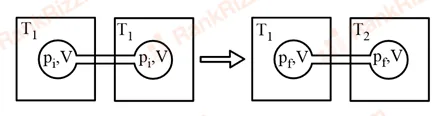
Two closed bulbs of equal volume (V) containing an ideal gas initially at pressure pi and temperature T1 are connected through a narrow tube of negligible volume, as shown in the figure below. The temperature of one of the bulbs is then raised to T2. The final pressure Pf is:
Q6JEE MAIN 2016 · 03 APR OFFLINEEnthalpies of reaction and Hess's lawTRANSCRIBED
The heats of combustion of carbon and carbon monoxide are −393.5 and −283.5 kJ mol−1, respectively. The heat of formation (in kJ) of carbon monoxide per mole is:
Q7JEE MAIN 2016 · 03 APR OFFLINELaw of mass action and equilibrium constants Kc and KpTRANSCRIBED
The equilibrium constant at 298 K for a reaction A+B⇌C+D is 100. If the initial concentration of all the four species were 1 M each, then the equilibrium concentration of D (in mol L−1) will be:
Q13JEE MAIN 2016 · 03 APR OFFLINEWater pollutionTRANSCRIBED
The concentration of fluoride, lead, nitrate and iron in a water sample from an underground lake was found to be 1000 ppb, 40 ppb, 100 ppm and 0.2 ppm, respectively. This water is unsuitable for drinking due to high concentration of:
Q16JEE MAIN 2016 · 03 APR OFFLINEIntegrated rate laws and half-life (zero and first order)TRANSCRIBED
Decomposition of H2O2 follows a first order reaction. In fifty minutes the concentration of H2O2 decreases from 0.5 to 0.125 M in one such decomposition. When the concentration of H2O2 reaches 0.05 M, the rate of formation of O2 will be:
Q33JEE MAIN 2016 · 03 APR OFFLINEPermutations of letters and words, rank in dictionaryTRANSCRIBED
If all the words (with or without meaning) having five letters, formed using the letters of the word SMALL and arranged as in a dictionary; then the position of the word SMALL is
Q34JEE MAIN 2016 · 03 APR OFFLINEGeometric progression and infinite GPTRANSCRIBED
If the 2nd, 5th and 9th terms of a non-constant arithmetic progression are in geometric progression, then the common ratio of this geometric progression is
Q38JEE MAIN 2016 · 03 APR OFFLINEEquations of a line in various formsTRANSCRIBED
Two sides of a rhombus are along the lines, x−y+1=0 and 7x−y−5=0. If its diagonals intersect at (−1,−2), then which one of the following is a vertex of this rhombus?
Q40JEE MAIN 2016 · 03 APR OFFLINEChord with given midpoint and locus of midpointsTRANSCRIBED
If one of the diameters of the circle, given by the equation, x2+y2−4x+6y−12=0, is a chord of a circle S, whose centre is at (−3,2), then the radius of S is
Q41JEE MAIN 2016 · 03 APR OFFLINENormals to a parabolaTRANSCRIBED
Let P be the point on the parabola, y2=8x which is at a minimum distance from the center C of the circle, x2+(y+6)2=1. Then the equation of the circle, passing through C and having its center at P is
Q47JEE MAIN 2016 · 03 APR OFFLINEHeights and distancesTRANSCRIBED
A man is walking towards a vertical pillar in a straight path, at a uniform speed. At a certain point A on the path, he observes that the angle of elevation of the top of the pillar is 30°. After walking for 10 minutes from A in the same direction, at a point B, he observes that the angle of elevation of the top of the pillar is 60°. Then the time taken (in minutes) by him, from B to reach the pillar, is
Q53JEE MAIN 2016 · 03 APR OFFLINELocal maxima and minima and concavityTRANSCRIBED
A wire of length 2 units is cut into two parts which are bent respectively to form a square of side = x units and a circle of radius = r units. If the sum of the areas of the square and the circle so formed is minimum, then
Q60JEE MAIN 2016 · 03 APR OFFLINEConditional probability and multiplication theoremTRANSCRIBED
Let two fair six-faced dice A and B be thrown simultaneously. If E1 is the event that die A shows up four, E2 is the event that die B shows up two and E3 is the event that the sum of numbers on both dice is odd, then which of the following statements is not true?
Q61JEE MAIN 2016 · 03 APR OFFLINEErrors in measurement and significant figuresTRANSCRIBED
A student measures the time period of 100 oscillations of a simple pendulum four times. The data set is 90 s, 91 s, 95 s and 92 s. If the minimum division in the measuring clock is 1 s, then the reported mean time should be:
Q62JEE MAIN 2016 · 03 APR OFFLINEConservation of mechanical energyTRANSCRIBED
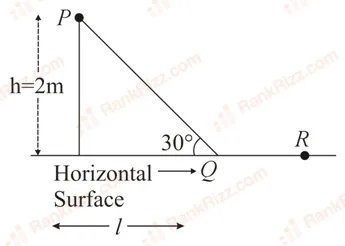
A point particle of mass m, moves along the uniformly rough track PQR as shown in the figure. The coefficient of friction, between the particle and the rough track equals μ. The particle is released, from rest, from the point P and it comes to rest at a point R. The energies, lost by the ball, over the parts, PQ and QR, of the track, are equal to each other, and no energy is lost when particle changes direction from PQ to QR. The values of the coefficient of friction μ and the distance x = (QR), are respectively close to:
Q63JEE MAIN 2016 · 03 APR OFFLINEConservation of mechanical energyTRANSCRIBED
A person trying to lose weight by burning fat lifts a mass of 10 kg upto a height of 1 m 1000 times. Assume that the potential energy lost each time he lowers the mass is dissipated. How much fat will he use up considering the work done only when the weight is lifted up? Fat supplies 3.8×10⁷ J of energy per kg which is converted to mechanical energy with a 20% efficiency rate. Take g=9.8 ms−2:
Q65JEE MAIN 2016 · 03 APR OFFLINETorque and the rotational form of Newton's second lawTRANSCRIBED
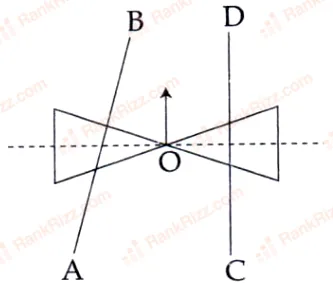
A roller is made by joining together two cones at their vertices O. It is kept on two rails AB and CD which are placed asymmetrically, with its axis perpendicular to CD and its centre O at the centre of line joining AB and CD (see the figure below). It is given a light push so that it starts rolling with its centre O moving parallel to CD in the direction shown. As it moves, the roller will tend to:
Q66JEE MAIN 2016 · 03 APR OFFLINEEscape speedTRANSCRIBED
A satellite is revolving in a circular orbit at a height h from the earth's surface (radius of earth R; h << R). The minimum increase in its orbital velocity required, so that the satellite could escape from the earth's gravitational field, is close to (Neglect the effect of atmosphere.)
Q67JEE MAIN 2016 · 03 APR OFFLINETemperature scales and thermal expansionTRANSCRIBED
A pendulum clock loses 12 s a day if the temperature is 40°C and gains 4 s a day if the temperature is 20°C. The temperature at which the clock will show correct time, and the co-efficient of linear expansion (α) of the metal of the pendulum shaft are respectively:
Q69JEE MAIN 2016 · 03 APR OFFLINEIsobaric, isochoric and polytropic processesTRANSCRIBED
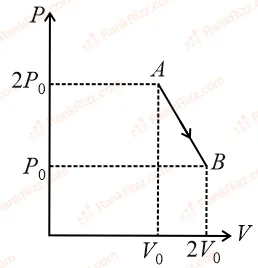
An ideal gas undergoes a quasi-static, reversible process in which its molar heat capacity C remains constant. If during this process the relation of pressure P and volume V is given by PVn = constant, then n is given by (Here CP and CV are molar specific heat at constant pressure and constant volume, respectively):
Q70JEE MAIN 2016 · 03 APR OFFLINESHM: equation, phase, velocity and accelerationTRANSCRIBED
A particle performs simple harmonic motion with amplitude A. Its speed is tripled at the instant that it is at a distance 32A from equilibrium position. The new amplitude of the motion is:
Q71JEE MAIN 2016 · 03 APR OFFLINESuperposition, interference and beatsTRANSCRIBED
A pipe open at both ends has a fundamental frequency f in air. The pipe is dipped vertically in water so that half of it is in water. The fundamental frequency of the air column is now:
Q72JEE MAIN 2016 · 03 APR OFFLINEProgressive waves: wave equation, phase and intensityTRANSCRIBED
A uniform string of length 20 m is suspended from a rigid support. A short wave pulse is introduced at its lowest end. It starts moving up the string. The time taken to reach the support is (Take, g=10 m s−2)
Q73JEE MAIN 2016 · 03 APR OFFLINEElectric flux and Gauss's lawTRANSCRIBED
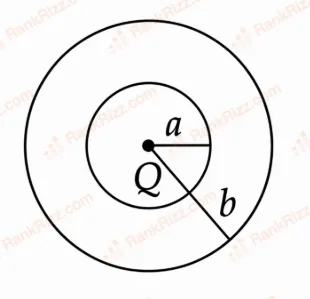
The region between two concentric spheres of radii 'a' and 'b', respectively (see figure), has volume charge density ρ=rA, where A is a constant and r is the distance from the centre. At the centre of the spheres is a point charge Q. The value of A such that the electric field in the region between the spheres will be constant, is:
Q74JEE MAIN 2016 · 03 APR OFFLINECapacitors in DC circuits (steady state)TRANSCRIBED
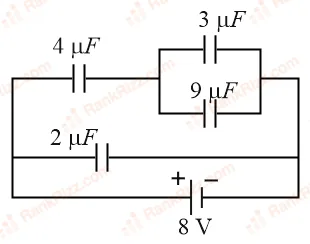
A combination of capacitors is set up as shown in the figure. The magnitude of the electric field, due to a point charge Q (having a charge equal to the sum of the charges on the 4 μF and 9 μF capacitors), at a point distant 30 m from it, would equal:
Q75JEE MAIN 2016 · 03 APR OFFLINEGalvanometer conversion to ammeter and voltmeterTRANSCRIBED
A galvanometer having a coil resistance of 100 Ω gives a full scale deflection, when a current of 1 mA is passed through it. The value of the resistance, which can convert this galvanometer into ammeter giving a full scale deflection for a current of 10 A, is:
Q77JEE MAIN 2016 · 03 APR OFFLINEBiot-Savart law: straight wires and moving chargesTRANSCRIBED
Two identical wires A and B, each of length l, carry the same current I. Wire A is bent into a circle of radius R and wire B is bent to form a square of side a. If BA and BB are the values of magnetic field at the centres of the circle and square respectively, then the ratio BBBA is
Q78JEE MAIN 2016 · 03 APR OFFLINESeries LCR circuits: impedance and phaseTRANSCRIBED
An arc lamp requires a direct current of 10 A at 80 V to function. If it is connected to a 220 V (rms), 50 Hz AC supply, the series inductor needed for it to work is close to:
Q81JEE MAIN 2016 · 03 APR OFFLINERefraction at plane surfaces, Snell's law and apparent depthTRANSCRIBED
In an experiment for determination of refractive index of glass of a prism by i v/s δ plot, it was found that a ray incident at angle 35°, suffers a deviation of 40° and that it emerges at angle 79°. In that case which of the following is closest to the maximum possible value of the refractive index?
Q82JEE MAIN 2016 · 03 APR OFFLINESingle slit diffractionTRANSCRIBED
The box of a pin hole camera, of length L, has a hole of radius a. It is assumed that when the hole is illuminated by a parallel beam of light of wavelength λ the spread of the spot (obtained on the opposite wall of the camera) is the sum of its geometrical spread and the spread due to diffraction. The spot would then have its minimum size (say bmin) when:
Q83JEE MAIN 2016 · 03 APR OFFLINEPhotoelectric effect and Einstein's equationTRANSCRIBED
Radiation of wavelength λ is incident on a photocell. The fastest emitted photoelectron has a speed v. If the wavelength is changed to 43λ, the speed of the fastest emitted photoelectron will be:
Q84JEE MAIN 2016 · 03 APR OFFLINERadioactivity: decay law, half-life and decay modesTRANSCRIBED
Half-lives of two radioactive elements A and B are 20 minutes and 40 minutes, respectively. Initially, the samples have an equal number of nuclei. After 80 minutes, the ratio of decayed numbers of A and B nuclei will be:
Q90JEE MAIN 2016 · 03 APR OFFLINEScrew gauge: pitch, least count and zero errorTRANSCRIBED
A screw gauge with a pitch of 0.5 mm and a circular scale with 50 divisions is used to measure the thickness of a thin sheet of aluminium. Before starting the measurement, it is found that when the two jaws of the screw gauge are brought in contact, the 45th division coincides with the main scale line and that the zero of the main scale is barely visible. What is the thickness of the sheet if the main scale reading is 0.5 mm and the 25th division coincides with the main scale line?