Mechanical Properties of Fluids: 226 past questions, 9 ideas
Every idea JEE has asked in Mechanical Properties of Fluids, one past question each — the most recently set — with how many times the examiner has come back to it. Do these 9; where one goes wrong, practise every question on that idea.
An idea here is one syllabus topic — the finest tag our past questions carry. A topic can hold more than one technique, so treat each question as the door into an idea, not the whole of it. Every topic in Mechanical Properties of Fluids has at least one past question, so none is missing from this sheet.
The 9 ideas, most asked first
01
Surface tension and surface energy
ASKED 38× · 2007–2026, 18 DIFFERENT YEARS · 28 MAIN, 10 ADVANCED
set 38×
JEE MAIN 2026 · 05 APR S2MOST RECENTLY SETTRANSCRIBED
Eight mercury drops, each of radius r coalesce to form a bigger drop. The surface energy released in this process is_________ . ( S is the surface tension of mercury).
JEE MAIN 2026 · 08 APR S2MOST RECENTLY SETTRANSCRIBED
A spherical liquid drop of radius R acquires the terminal velocity v1 when falls through a gas of viscosity η. Now the drop is broken into 64 identical droplets and each droplet acquires terminal velocity v2 falling through the same gas. The ratio of terminal velocities v1/v2 is __________.
Fluid pressure, Pascal's law and accelerated/rotating liquids
ASKED 32× · 2011–2026, 14 DIFFERENT YEARS · 24 MAIN, 8 ADVANCED
set 32×
JEE MAIN 2026 · 23 JAN S2MOST RECENTLY SETTRANSCRIBED
An air bubble of volume 2.9 cm3 rises from the bottom of a swimming pool of 5 m deep. At the bottom of the pool water temperature is 17oC. The volume of the bubble when it reaches the surface, where the water temperature is 27oC, is ______cm3. (g=10m/s2, density of water = 103kg/m3, and 1 atm pressure is 105 Pa)
ASKED 32× · 2008–2026, 14 DIFFERENT YEARS · 20 MAIN, 12 ADVANCED
set 32×
JEE ADVANCED 2026 · PAPER 2MOST RECENTLY SETTRANSCRIBED
Question Stem for Question Nos. 15 and 16
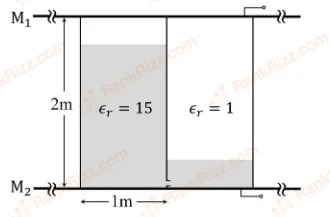
A container of height 2m, length 2m and breadth 1m is made of insulating vertical walls and two large area horizontal metal plates (M1 and M2) which extend far beyond the vertical walls in all directions. The container is partitioned into two equal chambers with a thin insulating vertical wall. The partition wall contains a small hole of cross-sectional area 10cm2 near its bottom edge. Initially the hole is closed and the left chamber of the container is completely filled with a liquid of dielectric constant ϵr=15 and the right chamber is empty (ϵr=1). At time t=0, the hole is opened and the liquid flows from the left chamber to the right chamber. In both the chambers, the space above the liquid has ϵr=1 and is maintained at atmospheric pressure. The schematic of the container at a time t>0 is shown in the figure.
[Given: acceleration due to gravity is 10ms−2.]
The height (in m) of the liquid in left chamber at t=500s is:
Speed of efflux and applications of Bernoulli's theorem
ASKED 21× · 2012–2026, 11 DIFFERENT YEARS
set 21×
JEE MAIN 2026 · 06 APR S2MOST RECENTLY SETTRANSCRIBED
A cylindrical vessel of 40 cm radius is completely filled with water and its capacity is 528 dm3 (dm : decimeter). The vessel is placed on a solid block of exactly same height as vessel. If a small hole is made at 70 cm below the top of water level, then horizontal range of water falling on the ground in the beginning is __________ cm.
ASKED 21× · 2005–2026, 12 DIFFERENT YEARS · 19 MAIN, 2 ADVANCED
set 21×
JEE MAIN 2026 · 22 JAN S2MOST RECENTLY SETTRANSCRIBED
When a part of a straight capillary tube is placed vertically in a liquid, the liquid raises up to certain height h. If the inner radius of the capillary tube, density of the liquid and surface tension of the liquid decrease by 1 % each, then the height of the liquid in the tube will change by __ %.
JEE MAIN 2025 · 03 APR S2MOST RECENTLY SETTRANSCRIBED
The excess pressure inside a soap bubble A in air is half the excess pressure inside another soap bubble B in air. If the volume of the bubble A is n times the volume of the bubble B, then the value of n is ________.
ASKED 17× · 2008–2026, 8 DIFFERENT YEARS · 16 MAIN, 1 ADVANCED
set 17×
JEE MAIN 2026MOST RECENTLY SETTRANSCRIBED
A wooden block is floating in a liquid, 40\ \%\ of its volume is inside the liquid when the vessel is stationary. Percentage of volume immersed when the vessel moves upwards with an acceleration a=5m.s−2 is
Viscosity, Poiseuille's equation and Reynolds number
ASKED 11× · 2014–2025, 8 DIFFERENT YEARS
set 11×
JEE MAIN 2025 · 28 JAN S1MOST RECENTLY SETTRANSCRIBED
Consider following statements: A. Surface tension arises due to extra energy of the molecules at the interior as compared to the molecules at the surface, of a liquid. B. As the temperature of liquid rises, the coefficient of viscosity increases. C. As the temperature of gas increases, the coefficient of viscosity increases D. The onset of turbulence is determined by Reynold's number. E. In a steady flow two stream lines never intersect. Choose the correct answer from the options given below: