RankRizz
UNIQUE CONCEPTS · PHYSICS

Thermal Properties of Matter: 138 past questions, 6 ideas

Every idea JEE has asked in Thermal Properties of Matter, one past question each — the most recently set — with how many times the examiner has come back to it. Do these 6; where one goes wrong, practise every question on that idea.

Past questions

138

Ideas

6

Set again later

0

Years

2004–26

Download PDFEvery Thermal Properties of Matter question

How these ideas are grouped

An idea here is one syllabus topic — the finest tag our past questions carry. A topic can hold more than one technique, so treat each question as the door into an idea, not the whole of it. Every topic in Thermal Properties of Matter has at least one past question, so none is missing from this sheet.

The 6 ideas, most asked first

01

Calorimetry and specific heat capacity

ASKED 30× · 2004–2026, 18 DIFFERENT YEARS · 23 MAIN, 7 ADVANCED

set 30×
JEE MAIN 2026 · 21 JAN S1MOST RECENTLY SETTRANSCRIBED

A gas based geyser heats water flowing at the rate of 5.0 litres per minute from 27°C to 87°C. The rate of consumption of the gas is ___ g/s. (take heat of combustion of gas=5.0×10⁴J/ggas=5.0\times10^{4}J/g) specific heat capacity of water =4200 J/ kg.°C

  1. A

    0.42

  2. B

    0.21

  3. C

    2.1

  4. D

    4.2

02

Temperature scales and thermal expansion

ASKED 28× · 2007–2026, 12 DIFFERENT YEARS · 25 MAIN, 3 ADVANCED

set 28×
JEE MAIN 2026 · 04 APR S2MOST RECENTLY SETTRANSCRIBED

The temperature of a metal strip having coefficient of linear expansion α\alpha is increased from T1T_1 to T2T_2 resulting in increase of its length by ΔL1\Delta L_1. The temperature is further increased from T2T_2 to T3T_3 such that the increase in its length is ΔL2\Delta L_2. Given T3+T1=2T2T_3 + T_1 = 2T_2 and T2−T1=ΔTT_2 - T_1 = \Delta T, the value of ΔL2\Delta L_2 is ______.

  1. A

    ΔL1[1+2α2(ΔT)2]\Delta L_1[1 + 2\alpha^2(\Delta T)^2]

  2. B

    ΔL1[1+α2(ΔT)2]\Delta L_1[1 + \alpha^2(\Delta T)^2]

  3. C

    ΔL1[1+2αΔT]\Delta L_1[1 + 2\alpha\Delta T]

  4. D

    ΔL1[1+αΔT]\Delta L_1[1 + \alpha\Delta T]

03

Heat conduction and thermal resistance

ASKED 23× · 2004–2026, 13 DIFFERENT YEARS

set 23×
JEE MAIN 2026 · 22 JAN S1MOST RECENTLY SETTRANSCRIBED

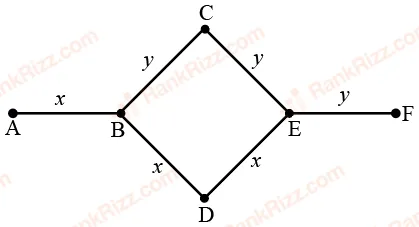
Rods xx and yy of equal dimensions but of different materials are joined as shown in figure. Temperatures of end points AA and FF are maintained at 100oC100 ^{o}C and 40oC40 ^{o}C respectively. Given the thermal conductivity of rod xx is three times of that of rod yy, the temperature at junction points BB and EE are (close to):

Screenshot_41
  1. A

    60oC60 ^{o}C and 45oC45 ^{o}C respectively

  2. B

    80oC80 ^{o}C and 60oC60 ^{o}C respectively

  3. C

    89oC89 ^{o}C and 73oC73 ^{o}C respectively

  4. D

    80oC80 ^{o}C and 70oC70 ^{o}C respectively

04

Change of state and latent heat

ASKED 20× · 2013–2026, 9 DIFFERENT YEARS

set 20×
JEE MAIN 2026 · 05 APR S2MOST RECENTLY SETTRANSCRIBED

The heat extracted out of x gram of water initialy at  50°50°C to  cool it down to 0°0°C is sufficient to evaporate  (1000−x)(1000 - x) gram  of water also initialy at 50°50°C. The value of xx (closest integer) is_______.  (Take Latent heat of water  L=2256L = 2256 kJ/kg K, specific heat capacity of water c=4200c = 4200 J/kg·K)

NUMERICAL ANSWER · CHECK IT ON THE QUESTION PAGE

05

Thermal radiation: Stefan's law, Wien's law and Kirchhoff's law

ASKED 19× · 2004–2025, 15 DIFFERENT YEARS · 6 MAIN, 13 ADVANCED

set 19×
JEE MAIN 2025 · 07 APR S1MOST RECENTLY SETTRANSCRIBED

A wire of length 10 cm and diameter 0.5 mm is used in a bulb. The temperature of the wire is 1727 degrees C and power radiated by the wire is 94.2 W. Its emissivity is x8\frac{x}{8} where x = ______.
(Given σ=6.0×10⁻⁸\sigma = 6.0 \times 10^{-8} W m−2^{-2} K−4^{-4}, π=3.14\pi = 3.14 and assume that the emissivity of wire material is same at all wavelength. )

NUMERICAL ANSWER · CHECK IT ON THE QUESTION PAGE

06

Newton's law of cooling

ASKED 18× · 2012–2025, 10 DIFFERENT YEARS

set 18×
JEE MAIN 2025 · 29 JAN S2MOST RECENTLY SETTRANSCRIBED

A cup of coffee cools from 90∘90^{\circ} to 80∘80^{\circ} in t minutes when the room temperature is 20∘20^{\circ}. The time taken by the similar cup of coffee to cool from 80∘80^{\circ} to 60∘60^{\circ} at the same room temperature is :

  1. A

    1310t\frac{13}{10}t

  2. B

    1013t\frac{10}{13}t

  3. C

    513t\frac{5}{13}t

  4. D

    135t\frac{13}{5}t

Got one wrong? Practise that idea, graded.

A free account opens every past question on an idea with the answer checked as you go, and files your mistakes by idea.

Not ready? Get new sheets by email

A note when a chapter’s sheet changes or a new one is added. No account, no spam, one click to leave.

OTHER PHYSICS SHEETS