RankRizz
UNIQUE CONCEPTS · PHYSICS

Wave Optics: 218 past questions, 6 ideas

Every idea JEE has asked in Wave Optics, one past question each — the most recently set — with how many times the examiner has come back to it. Do these 6; where one goes wrong, practise every question on that idea.

Past questions

218

Ideas

6

Set again later

1

Years

2004–26

Download PDFEvery Wave Optics question

How these ideas are grouped

An idea here is one syllabus topic — the finest tag our past questions carry. A topic can hold more than one technique, so treat each question as the door into an idea, not the whole of it. Every topic in Wave Optics has at least one past question, so none is missing from this sheet.

The 6 ideas, most asked first

01

Young's double slit experiment: fringe width and intensity

ASKED 85× · 2004–2026, 20 DIFFERENT YEARS · 68 MAIN, 17 ADVANCED

set 85×
JEE MAIN 2026 · 06 APR S2MOST RECENTLY SETTRANSCRIBED

In a Young double slit experiment, the wavelength of incident light is 6000 Å. The separation between slits S1S_1 and S2S_2 is 5 cm and the distance between slits plane and screen is 50 cm, as shown in the figure below. If the resultant intensity at P is equal to the intensity due to individual slits, the path difference between interfering waves is __________ Å.
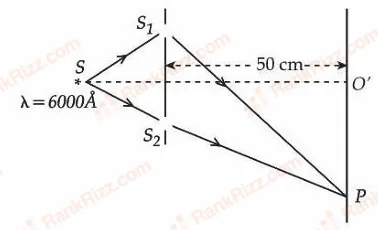
Figure for JEE Main 2026 Physics question on Young's double slit experiment: fringe width and intensity
  1. A

    4000

  2. B

    3000

  3. C

    2000

  4. D

    1000

02

Wavefronts and Huygens' principle

ASKED 51× · 2010–2026, 9 DIFFERENT YEARS · 50 MAIN, 1 ADVANCED

set 51×
JEE MAIN 2026 · 28 JAN S1MOST RECENTLY SETTRANSCRIBED

Given below are two statements:
Statement I: A plane wave after passing through prism remains as plane wave but passing through small pin hole may become spherical wave.
Statement II: The curvature of a spherical wave emerging from a slit will increase for increasing slit wridth
In the light of the above statements, choose the correct answer from the options given below

  1. A

    Both Statement I and Statement II are true

  2. B

    Statement I is false but Statement II is true

  3. C

    Statement I is true but Statement II is false

  4. D

    Both Statement I and Statement II are false

03

Polarisation: Malus's law and Brewster's law

ASKED 40× · 2004–2026, 15 DIFFERENT YEARS · 37 MAIN, 3 ADVANCED

set 40×
JEE ADVANCED 2026 · PAPER 2MOST RECENTLY SETTRANSCRIBED

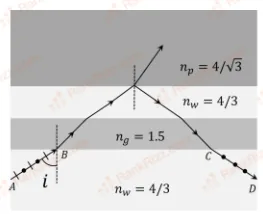
As shown in the figure, a ray ABAB of unpolarized light enters from water of refractive index nw=4/3n_w=4/3 into a medium of refractive index np=4/3n_p=4/\sqrt{3} after passing through a glass plate of refractive index ng=1.5n_g=1.5 and a layer of water. At a particular incident angle ii the reflected ray CDCD is polarized in the direction as shown in the figure. The value of ii (in degrees) is:

Figure for JEE Advanced 2026 Physics question on Polarisation: Malus's law and Brewster's law

NUMERICAL ANSWER · CHECK IT ON THE QUESTION PAGE

04

Single slit diffraction

ASKED 29× · 2005–2026, 15 DIFFERENT YEARS

set 29×
JEE MAIN 2026 · 04 APR S1MOST RECENTLY SETTRANSCRIBED

A slit of width aa is illuminated by light of wavelength λ\lambda. The linear separation between 1st and 3rd minima in the diffraction pattern produced on a screen placed at a distance DD from the slit system is :

  1. A

    Dλa\frac{D\lambda}{a}

  2. B

    1.5Dλa1.5\frac{D\lambda}{a}

  3. C

    2Dλa2\frac{D\lambda}{a}

  4. D

    3Dλa3\frac{D\lambda}{a}

05

Resolving power of microscopes and telescopes

ASKED 12× · 2005–2026, 8 DIFFERENT YEARS

set 12×
JEE MAIN 2026 · 08 APR S2MOST RECENTLY SETTRANSCRIBED

Some distant star is to be observed by some telescope of diameter of objective lens aa, at an angular resolution of 3.0×10−73.0 \times 10^{-7} radian. If the wavelength of light from the star reaching the telescope is 500 nm, the minimum diameter of the objective lens of the telescope is __________ cm. (nearest integer)

NUMERICAL ANSWER · CHECK IT ON THE QUESTION PAGE

06

YDSE with slabs, white light and modified setups

ASKED 1× · 2012

set 1×
JEE MAIN 2012MOST RECENTLY SETTRANSCRIBED

In a Young's double slit experiment with light of wavelength λ\lambda, fringe pattern on the screen has fringe width β\beta. When two thin transparent glass (refractive index μ\mu) plates of thickness t1t_1 and t2t_2 (t1>t2t_1 > t_2) are placed in the path of the two beams respectively, the fringe pattern will shift by a distance

  1. A

    β(μ−1)λ(t1t2)\dfrac{\beta(\mu-1)}{\lambda}\left(\dfrac{t_1}{t_2}\right)

  2. B

    μβλt1t2\dfrac{\mu \beta}{\lambda}\dfrac{t_1}{t_2}

  3. C

    β(μ−1)λ(t1−t2)\dfrac{\beta(\mu-1)}{\lambda}(t_1 - t_2)

  4. D

    (μ−1λβ)(t1+t2)\left(\mu - 1\dfrac{\lambda}{\beta}\right)(t_1 + t_2)

Got one wrong? Practise that idea, graded.

A free account opens every past question on an idea with the answer checked as you go, and files your mistakes by idea.

Not ready? Get new sheets by email

A note when a chapter’s sheet changes or a new one is added. No account, no spam, one click to leave.

OTHER PHYSICS SHEETS