RankRizz
UNIQUE CONCEPTS · PHYSICS

Centre of Mass, Momentum & Collisions: 147 past questions, 8 ideas

Every idea JEE has asked in Centre of Mass, Momentum & Collisions, one past question each — the most recently set — with how many times the examiner has come back to it. Do these 8; where one goes wrong, practise every question on that idea.

Past questions

147

Ideas

8

Set again later

0

Years

2004–26

Download PDFEvery Centre of Mass, Momentum & Collisions question

How these ideas are grouped

An idea here is one syllabus topic — the finest tag our past questions carry. A topic can hold more than one technique, so treat each question as the door into an idea, not the whole of it. Every topic in Centre of Mass, Momentum & Collisions has at least one past question, so none is missing from this sheet.

The 8 ideas, most asked first

01

Head-on collisions and coefficient of restitution

ASKED 49× · 2008–2026, 16 DIFFERENT YEARS · 48 MAIN, 1 ADVANCED

set 49×
JEE MAIN 2026 · 23 JAN S1MOST RECENTLY SETTRANSCRIBED

A small bob A of mass m is attached to a massless rigid rod of length 1 m pivoted at point P and kept at an angle of 60° with vertical as shown in figure. At distance of 1 m below point P, an identical bob B is kept at rest on a smooth horizontal surface that extends to a circular track of radius R as shown in figure. If bob B just manages to complete the circular path of radius R upto a point Q after being hit elastically by bob A, then radius R is ____ m.
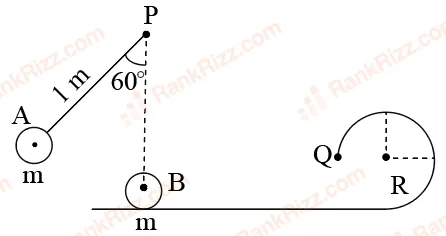
Figure for JEE Main 2026 Physics question on Head-on collisions and coefficient of restitution
  1. A

    2+35\frac{2+\sqrt{3}}{5}

  2. B

    2−35\frac{2-\sqrt{3}}{5}

  3. C

    35\frac{3}{5}

  4. D

    15\frac{1}{5}

02

Motion of centre of mass, momentum conservation and explosions

ASKED 31× · 2005–2026, 17 DIFFERENT YEARS · 23 MAIN, 8 ADVANCED

set 31×
JEE MAIN 2026 · 06 APR S2MOST RECENTLY SETTRANSCRIBED

Two identical bodies A and B of equal masses have initial velocities v1⃗=4i^\vec{v_1} = 4\hat{i} m/s and v2⃗=4j^\vec{v_2} = 4\hat{j} m/s respectively. The body A has acceleration a1⃗=6i^+6j^\vec{a_1} = 6\hat{i} + 6\hat{j} m/s2^2 while the acceleration of the other body B is zero. The centre of mass of the two bodies moves in __________ path.

  1. A

    circular

  2. B

    parabolic

  3. C

    straight line

  4. D

    elliptical

03

Impulse and impulse-momentum theorem

ASKED 26× · 2004–2024, 12 DIFFERENT YEARS · 24 MAIN, 2 ADVANCED

set 26×
JEE MAIN 2024 · 27 JAN S1MOST RECENTLY SETTRANSCRIBED

A body of mass 10001000 kg is moving horizontally with a velocity 6 m s−16 \text{ m s}^{-1}. If 200200 kg extra mass is added, the final velocity (in m s−1\text{m s}^{-1}) is:

  1. A

    6

  2. B

    2

  3. C

    3

  4. D

    5

04

Centre of mass of continuous bodies and cavities

ASKED 22× · 2005–2025, 13 DIFFERENT YEARS · 21 MAIN, 1 ADVANCED

set 22×
JEE MAIN 2025 · 07 APR S1MOST RECENTLY SETTRANSCRIBED

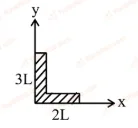
A rod of length 5L is bent right angle keeping one side length as 2L.

Figure for JEE Main 2025 Physics question on Centre of mass of continuous bodies and cavities

The position of the centre of mass of the system: (Consider L = 10 cm)

  1. A

    2i^+3j^2\hat{i} + 3\hat{j}

  2. B

    3i^+7j^3\hat{i} + 7\hat{j}

  3. C

    5i^+8j^5\hat{i} + 8\hat{j}

  4. D

    4i^+9j^4\hat{i} + 9\hat{j}

05

Centre of mass of a system of particles

ASKED 10× · 2006–2026, 6 DIFFERENT YEARS

set 10×
JEE MAIN 2026 · 06 APR S1MOST RECENTLY SETTRANSCRIBED

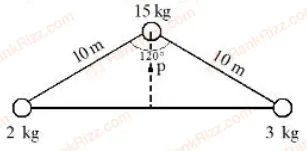
The position of center of mass of three masses 2 kg, 3 kg and 15 kg placed with respect to mid point (p) of normal bisector, as shown in the figure is _______.

Figure for JEE Main 2026 Physics question on Centre of mass of a system of particles
  1. A

    (34,1.25)\left(\frac{\sqrt{3}}{4}, 1.25\right)

  2. B

    (34,1.0)\left(\frac{\sqrt{3}}{4}, 1.0\right)

  3. C

    (0,0)(0, 0)

  4. D

    (1.25,0)(1.25, 0)

06

Variable mass systems and rockets

ASKED 4× · 2012, 2020, 2021

set 4×
JEE MAIN 2021 · 26 AUG S1MOST RECENTLY SETTRANSCRIBED

The initial mass of a rocket is 1000 kg. Calculate at what rate the fuel should be burnt so that the rocket is given an acceleration of 20 m s−2^{-2}. The gases come out at a relative speed of 500 m s−1^{-1}, with respect to the rocket: [Use g=10g = 10 m s−2^{-2}]

  1. A

    10 kg s−1^{-1}

  2. B

    60 kg s−1^{-1}

  3. C

    500 kg s−1^{-1}

  4. D

    6.0×1026.0 \times 10^2 kg s−1^{-1}

07

Two-body systems connected by springs

ASKED 4× · 2012, 2021, 2022, 2025

set 4×
JEE MAIN 2025 · 03 APR S2MOST RECENTLY SETTRANSCRIBED
Figure for JEE Main 2025 Physics question on Two-body systems connected by springs

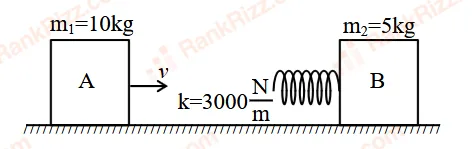
Consider two blocks A and B of masses m1=10m_1 = 10 kg and m2=5m_2 = 5 kg that are placed on a frictionless table. The block A moves with a constant speed v=3v = 3 m/s towards the block B kept at rest. A spring with spring constant k=3000k = 3000 N/m is attached with the block B as shown in the figure. After the collision, suppose that the blocks A and B, along with the spring in constant compression state, move together, then the compression in the spring is, (Neglect the mass of the spring)

  1. A

    0.2 m

  2. B

    0.4 m

  3. C

    0.1 m

  4. D

    0.3 m

08

Oblique collisions in two dimensions

ASKED 1× · 2005

set 1×
JEE MAIN 2005MOST RECENTLY SETTRANSCRIBED

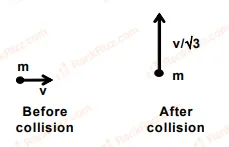
A mass 'mm' moves with a velocity vv and collides inelastically with another identical mass. After collision the 1st1^{st} mass moves with velocity v/3v/\sqrt{3} in a direction perpendicular to the initial direction of motion. Find the speed of the 2nd2^{nd} mass after collision Figure for JEE Main 2005 Physics question on Oblique collisions in two dimensions

  1. A

    vv

  2. B

    3v\sqrt{3}v

  3. C

    2v/32v/\sqrt{3}

  4. D

    v/3v/\sqrt{3}

Got one wrong? Practise that idea, graded.

A free account opens every past question on an idea with the answer checked as you go, and files your mistakes by idea.

Not ready? Get new sheets by email

A note when a chapter’s sheet changes or a new one is added. No account, no spam, one click to leave.

OTHER PHYSICS SHEETS