RankRizz
UNIQUE CONCEPTS · PHYSICS

Electrostatics: 353 past questions, 9 ideas

Every idea JEE has asked in Electrostatics, one past question each — the most recently set — with how many times the examiner has come back to it. Do these 9; where one goes wrong, practise every question on that idea.

Past questions

353

Ideas

9

Set again later

0

Years

2004–26

Download PDFEvery Electrostatics question

How these ideas are grouped

An idea here is one syllabus topic — the finest tag our past questions carry. A topic can hold more than one technique, so treat each question as the door into an idea, not the whole of it. Every topic in Electrostatics has at least one past question, so none is missing from this sheet.

The 9 ideas, most asked first

01

Electric flux and Gauss's law

ASKED 74× · 2007–2026, 20 DIFFERENT YEARS · 53 MAIN, 21 ADVANCED

set 74×
JEE MAIN 2026 · 02 APR S2MOST RECENTLY SETTRANSCRIBED

Two point charges 8 μ8\,\muC and −2 μ-2\,\muC are located at x=2x = 2 cm and x=4x = 4 cm, respectively on the x-axis. The ratio of electric flux due to these charges through two spheres of radii 3 cm and 5 cm with their centers at the origin is _______.

  1. A

    4:14 : 1

  2. B

    3:43 : 4

  3. C

    4:34 : 3

  4. D

    4:54 : 5

02

Electric potential and potential energy

ASKED 63× · 2004–2026, 17 DIFFERENT YEARS · 62 MAIN, 1 ADVANCED

set 63×
JEE ADVANCED 2026 · PAPER 2MOST RECENTLY SETTRANSCRIBED

Two charges Q1=qQ_1=q and Q2=mqQ_2=mq are placed at the points P1(a,b)P_1(a,b) and P2(ma,mb)P_2(ma,mb), respectively, in the XYXY plane, where a,b≠0a,b\neq 0 and m≠0,1m\neq 0,1. If V1V_1 is the potential at a point in the XYXY plane due to charge Q1Q_1 and V2V_2 is the potential at that point due to charge Q2Q_2. Correct statement(s) for the points at which ∣V1∣=∣V2∣|V_1|=|V_2| is/are:

  1. A

    For m=−1m=-1, locus of these points is ax+by=0ax+by=0.

  2. B

    For m=2m=2, the locus of these points is a circle of radius 23a2+b2\dfrac{2}{3}\sqrt{a^2+b^2} centered at (23a,23b)\left(\dfrac{2}{3}a,\dfrac{2}{3}b\right).

  3. C

    For m=−2m=-2, the locus of these points is a circle of radius 2a2+b22\sqrt{a^2+b^2} centered at (2a,2b)(2a,2b).

  4. D

    For m=−3m=-3, locus of these points is 3bx+3ay=03bx+3ay=0.

03

Electric field of continuous charge distributions

ASKED 57× · 2008–2026, 17 DIFFERENT YEARS · 41 MAIN, 16 ADVANCED

set 57×
JEE MAIN 2026 · 06 APR S1MOST RECENTLY SETTRANSCRIBED

A thin half ring of radius 35 cm is uniformly charged with a total charge of QQ coulomb. If the magnitude of the electric field at centre of the half ring is 100 V/m, then the value of QQ is _______ nC.
(ε0=8.85×10⁻¹²(\varepsilon_0 = 8.85 \times 10^{-12} C2^2/Nm2^2 and π=3.14)\pi = 3.14)

  1. A

    2.14

  2. B

    2.44

  3. C

    3.25

  4. D

    0.7

04

Electric charge and Coulomb's law

ASKED 47× · 2004–2026, 16 DIFFERENT YEARS · 41 MAIN, 6 ADVANCED

set 47×
JEE MAIN 2026 · 08 APR S2MOST RECENTLY SETTRANSCRIBED

Two point charges q1=3 μCq_1 = 3 \, \mu C and q2=−4 μCq_2 = -4 \, \mu C are placed at points (2i^+3j^+3k^)(2\hat{i} + 3\hat{j} + 3\hat{k}) and (i^+j^+k^)(\hat{i} + \hat{j} + \hat{k}) respectively. Force on charge q2q_2 is __________ N. (Take 14πϵ0=9×10⁹ SI Units)\left(\text{Take } \frac{1}{4\pi\epsilon_0} = 9 \times 10^9 \text{ SI Units}\right)

  1. A

    (12i^+24j^+24k^)×10−3(12\hat{i} + 24\hat{j} + 24\hat{k}) \times 10^{-3}

  2. B

    (4i^+8j^+8k^)×10−3(4\hat{i} + 8\hat{j} + 8\hat{k}) \times 10^{-3}

  3. C

    (3i^+6j^+6k^)×10−3(3\hat{i} + 6\hat{j} + 6\hat{k}) \times 10^{-3}

  4. D

    (−4i^−8j^−8k^)×10−3(-4\hat{i} - 8\hat{j} - 8\hat{k}) \times 10^{-3}

05

Electric dipole and dipole in external field

ASKED 46× · 2006–2026, 11 DIFFERENT YEARS · 39 MAIN, 7 ADVANCED

set 46×
JEE ADVANCED 2026 · PAPER 2MOST RECENTLY SETTRANSCRIBED

Consider an electric dipole comprising two charges +q+q and −q-q each with mass mm, separated by a fixed distance dd and initially at rest with its dipole moment pointing along i^\hat{i}. A uniform electric field Ej^E\hat{j} is turned on at time t=0t=0 and it is turned off at t=tft=t_f, when the dipole moment makes an angle θf\theta_f with i^\hat{i}. Neglecting any sources of energy loss, correct option(s) is/are:

  1. A

    The center of mass of the dipole is deflected towards j^\hat{j} in the presence of the field.

  2. B

    If the magnitude of the final angular velocity ωf=2qEmd\omega_f=\sqrt{\dfrac{2qE}{md}}, then θf=π6\theta_f=\dfrac{\pi}{6}.

  3. C

    If θf=π/3\theta_f=\pi/3, then the change in kinetic energy of the dipole is given by 23 qEd2\sqrt{3}\,qEd.

  4. D

    For θf=π/4\theta_f=\pi/4, the dipole rotates around its center of mass with a constant angular velocity after t>tft>t_f.

06

Electric field due to point charges and superposition

ASKED 25× · 2005–2026, 10 DIFFERENT YEARS

set 25×
JEE MAIN 2026 · 22 JAN S1MOST RECENTLY SETTRANSCRIBED

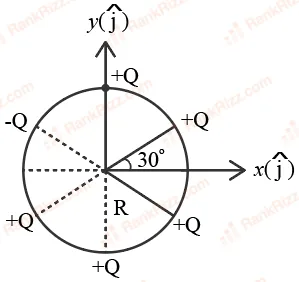
Six point charges are kept 60o60^{o} apart from each other on the circumference of a
circle of radius RR as shown in figure . The net electric field at the center of the circle is______.
( ϵo\epsilon_{o} is permittivity of free space)

Screenshot_34
  1. A

    −Q4πϵoR2(3i^−j^)-\frac{Q}{4\pi\epsilon_{o}R^{2}}\left(\sqrt{3}\widehat{i}- \widehat{j} \right)

  2. B

    −5Q8πϵoR2(i^+3j^)-\frac{5Q}{8\pi\epsilon_{o}R^{2}}\left(\widehat{i}+ \sqrt{3}\widehat{j} \right)

  3. C

    −(5Q8πϵoR2)(i^−3j^)-\left(\frac{5Q}{8\pi\epsilon_{o}R^{2}}\right)\left(\widehat{i}- \sqrt{3}\widehat{j} \right)

  4. D

    Q4πϵoR2(3i^−j^)\frac{Q}{4\pi\epsilon_{o}R^{2}}\left(\sqrt{3}\widehat{i}- \widehat{j} \right)

07

Relation between field and potential, equipotential surfaces

ASKED 23× · 2007–2026, 10 DIFFERENT YEARS · 13 MAIN, 10 ADVANCED

set 23×
JEE MAIN 2026 · 06 APR S2MOST RECENTLY SETTRANSCRIBED

The electric potential as a function of x,yx, y is given by V=5(x2−y2)V = 5(x^2 - y^2) V. The electric field at a point (2,3)(2, 3) m is __________ V/m.

  1. A

    (−20i^+30j^)(-20\hat{i} + 30\hat{j})

  2. B

    (20i^−30j^)(20\hat{i} - 30\hat{j})

  3. C

    (20i^+45j^)(20\hat{i} + 45\hat{j})

  4. D

    (−4i^+6j^)(-4\hat{i} + 6\hat{j})

08

Conductors, concentric shells and earthing

ASKED 11× · 2006–2026, 9 DIFFERENT YEARS

set 11×
JEE MAIN 2026 · 04 APR S2MOST RECENTLY SETTRANSCRIBED

Given below are two statements: one is labelled as Assertion A and the other is labelled as Reason R

Assertion A: In electrostatics, a conductor does not store any net charge inside.

Reason R: Inside the capacitor (with no dielectric medium), the free charge carriers, if placed between the plates of capacitor, experience force and drift.
Choose the correct answer from the options given below:

  1. A

    Both A and R are true, and R is the correct explanation of A

  2. B

    Both A and R are true, but R is NOT the correct explanation of A

  3. C

    A is true but R is false

  4. D

    A is false but R is true

09

Motion and equilibrium of charged bodies in electric fields

ASKED 7× · 2004–2025, 6 DIFFERENT YEARS

set 7×
JEE MAIN 2025 · 28 JAN S1MOST RECENTLY SETTRANSCRIBED

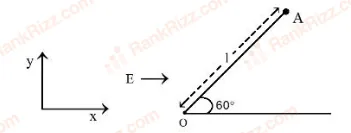
A particle of mass 'm' and charge 'q'is fastened to one end 'A' of a massless string having equilibrium length l, whose other end is fixed at point 'O'. The whole system is placed on a frictionless horizontal plane and is initially at rest. If uniform electric field is switched on along the direction as shown in figure, then the speed of the particle when it crosses the x -axis is

page4_img2
  1. A

    qEl2m\sqrt{\frac{qEl}{2m}}

  2. B

    qElm\sqrt{\frac{qEl}{m}}

  3. C

    qEl4m\sqrt{\frac{qEl}{4m}}

  4. D

    2qElm\sqrt{\frac{2qEl}{m}}

Got one wrong? Practise that idea, graded.

A free account opens every past question on an idea with the answer checked as you go, and files your mistakes by idea.

Not ready? Get new sheets by email

A note when a chapter’s sheet changes or a new one is added. No account, no spam, one click to leave.

OTHER PHYSICS SHEETS