RankRizz
UNIQUE CONCEPTS · PHYSICS

Moving Charges & Magnetism: 285 past questions, 8 ideas

Every idea JEE has asked in Moving Charges & Magnetism, one past question each — the most recently set — with how many times the examiner has come back to it. Do these 8; where one goes wrong, practise every question on that idea.

Past questions

285

Ideas

8

Set again later

0

Years

2004–26

Download PDFEvery Moving Charges & Magnetism question

How these ideas are grouped

An idea here is one syllabus topic — the finest tag our past questions carry. A topic can hold more than one technique, so treat each question as the door into an idea, not the whole of it. Every topic in Moving Charges & Magnetism has at least one past question, so none is missing from this sheet.

The 8 ideas, most asked first

01

Motion of charged particles in a magnetic field

ASKED 84× · 2005–2026, 18 DIFFERENT YEARS · 69 MAIN, 15 ADVANCED

set 84×
JEE ADVANCED 2026 · PAPER 2MOST RECENTLY SETTRANSCRIBED

In a vacuum chamber, a particle of charge 1 μC1\,\mu\mathrm{C} and mass 1 mg1\,\mathrm{mg} is projected with a velocity (i^+2j^) ms−1(\hat{i}+2\hat{j})\,\mathrm{ms^{-1}} from the XZXZ plane at time t=0t=0 in an electric field of 1i^ Vm−11\hat{i}\,\mathrm{Vm^{-1}}. At t=0.2 st=0.2\,\mathrm{s}, the electric field is switched off and a magnetic field of 6j^ T6\hat{j}\,\mathrm{T} is switched on. The acceleration due to gravity is −10j^ ms−2-10\hat{j}\,\mathrm{ms^{-2}}. Correct option(s) is/are:

  1. A

    The vertical distance of the particle from the XZXZ plane at t=0.3 st=0.3\,\mathrm{s} is 15 cm15\,\mathrm{cm}.

  2. B

    The vertical distance of the particle from the XZXZ plane at t=0.4 st=0.4\,\mathrm{s} is 10 cm10\,\mathrm{cm}.

  3. C

    The radius of the trajectory of the particle for t>0.2 st>0.2\,\mathrm{s} is 20 cm20\,\mathrm{cm}.

  4. D

    The particle will be in the XZXZ plane at t=0.35 st=0.35\,\mathrm{s}.

02

Biot-Savart law: straight wires and moving charges

ASKED 75× · 2007–2026, 16 DIFFERENT YEARS · 74 MAIN, 1 ADVANCED

set 75×
JEE MAIN 2026MOST RECENTLY SETTRANSCRIBED

Two protons move parallel to each other, keeping distance rr between them, both moving with same velocity vv. Then the ratio of the electric and magnetic force of interaction between them is

  1. A

    c2v2\frac{c^2}{v^2}

  2. B

    c22v2\frac{c^2}{2v^2}

  3. C

    2c2v2\frac{2c^2}{v^2}

  4. D

    11

03

Magnetic dipole moment of current loops and torque on loops

ASKED 65× · 2012–2026, 15 DIFFERENT YEARS · 60 MAIN, 5 ADVANCED

set 65×
JEE ADVANCED 2026 · PAPER 1MOST RECENTLY SETTRANSCRIBED

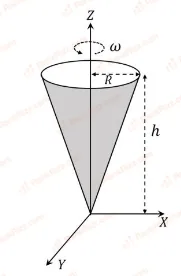
A hollow, right circular cone of base radius RR and height hh, with its tip at the origin is rotating about the ZZ-axis with an angular velocity ω\omega, as shown in the figure. The cone carries a total charge QQ uniformly distributed on its curved surface. The magnitude of magnetic field at a point (0,0,z)(0,0,z), where z≫Rz\gg R and z≫hz\gg h, is nμ04πQR2ωz3\dfrac{n\mu_0}{4\pi}\dfrac{QR^2\omega}{z^3}. The value of nn is:

Figure for JEE Advanced 2026 Physics question on Magnetic dipole moment of current loops and torque on loops

NUMERICAL ANSWER · CHECK IT ON THE QUESTION PAGE

04

Ampere's circuital law: cylinders, solenoids and toroids

ASKED 23× · 2004–2026, 13 DIFFERENT YEARS · 19 MAIN, 4 ADVANCED

set 23×
JEE MAIN 2026 · 28 JAN S2MOST RECENTLY SETTRANSCRIBED

A long cylindrical conductor with large cross section carries an electric current distributed uniformly over its cross-section. Magnetic field due to this current is:
A. maximum at either ends of the conductor and minimum at the midpoint
B. maximum at the axis of the conductor
C. minimum at the surface of the conductor
D. minimum at the axis of the conductor
E. same at all points in the cross-section of the conductor
Choose the correct answer from the options given below :

  1. A

    E Only

  2. B

    B, C Only

  3. C

    D Only

  4. D

    A, D Only

05

Magnetic field of circular loops, arcs and coils

ASKED 12× · 2004–2026, 11 DIFFERENT YEARS · 5 MAIN, 7 ADVANCED

set 12×
JEE MAIN 2026MOST RECENTLY SETTRANSCRIBED

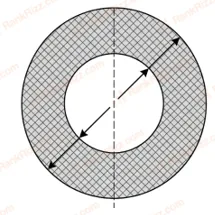
An annular disc of inner radius RR and outer radius 2R2R has uniform charge density σ\sigma. It is rotating about the axis passing through the center and perpendicular to its plane with angular velocity ω\omega. If the magnetic field at the center of the ring is μ0σωRn,\frac{\mu_0\sigma\omega R}{n}, then find nn.  

Magnetism

NUMERICAL ANSWER · CHECK IT ON THE QUESTION PAGE

06

Moving coil galvanometer

ASKED 11× · 2008–2025, 7 DIFFERENT YEARS · 10 MAIN, 1 ADVANCED

set 11×
JEE MAIN 2025 · 02 APR S2MOST RECENTLY SETTRANSCRIBED

In a moving coil galvanometer, two moving coils M1M_1 and M2M_2 have the following particulars :
R1=5 ΩR_1 = 5\,\Omega, N1=15N_1 = 15, A1=3.6×10⁻³ m2A_1 = 3.6 \times 10^{-3}\,\text{m}^2, B1=0.25 TB_1 = 0.25\,\text{T}
R2=7 ΩR_2 = 7\,\Omega, N2=21N_2 = 21, A2=1.8×10⁻³ m2A_2 = 1.8 \times 10^{-3}\,\text{m}^2, B2=0.50 TB_2 = 0.50\,\text{T}
Assuming that torsional constant of the springs are same for both coils, what will be the ratio of voltage sensitivity of M1M_1 and M2M_2 ?

  1. A

    1:11 : 1

  2. B

    1:41 : 4

  3. C

    1:31 : 3

  4. D

    1:21 : 2

07

Force on current-carrying conductors and between parallel wires

ASKED 9× · 2004–2022, 8 DIFFERENT YEARS · 4 MAIN, 5 ADVANCED

set 9×
JEE ADVANCED 2022 · PAPER 1MOST RECENTLY SETTRANSCRIBED

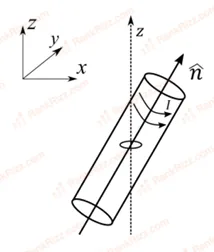
A small circular loop of area AA and resistance RR is fixed on a horizontal xyxy-plane with the center of the loop always on the axis n^\hat{n} of a long solenoid. The solenoid has mm turns per unit length and carries current II counterclockwise as shown in the figure. The magnetic field due to the solenoid is in n^\hat{n} direction. List-I gives time dependences of n^\hat{n} in terms of a constant angular frequency ω\omega.

List-II gives the torques experienced by the circular loop at time t=π6ωt = \frac{\pi}{6\omega}. Let α=A2μ02m2I2ω2R\alpha = \frac{A^2 \mu_0^2 m^2 I^2 \omega}{2R}.

Figure for JEE Advanced 2022 Physics question on Force on current-carrying conductors and between parallel wires
List-IList-II
(I) 12(sin⁡ωt j^+cos⁡ωt k^)\frac{1}{\sqrt{2}}(\sin \omega t \, \hat{j} + \cos \omega t \, \hat{k})(P) 0
(II) 12(sin⁡ωt i^+cos⁡ωt j^)\frac{1}{\sqrt{2}}(\sin \omega t \, \hat{i} + \cos \omega t \, \hat{j})(Q) −α4i^-\frac{\alpha}{4}\hat{i}
(III) 12(sin⁡ωt i^+cos⁡ωt k^)\frac{1}{\sqrt{2}}(\sin \omega t \, \hat{i} + \cos \omega t \, \hat{k})(R) 3α4i^\frac{3\alpha}{4}\hat{i}
(IV) 12(cos⁡ωt i^+sin⁡ωt k^)\frac{1}{\sqrt{2}}(\cos \omega t \, \hat{i} + \sin \omega t \, \hat{k})(S) α4j^\frac{\alpha}{4}\hat{j}
Which one of the following options is correct?(T) −3α4i^-\frac{3\alpha}{4}\hat{i}
  1. A

    I →\to Q, II →\to P, III →\to S, IV →\to T

  2. B

    I →\to S, II →\to T, III →\to Q, IV →\to P

  3. C

    I →\to Q, II →\to P, III →\to S, IV →\to R

  4. D

    I →\to T, II →\to Q, III →\to P, IV →\to R

08

Charged particles in combined electric and magnetic fields

ASKED 6× · 2005–2026, 6 DIFFERENT YEARS

set 6×
JEE MAIN 2026 · 05 APR S2MOST RECENTLY SETTRANSCRIBED

A particle of charge qq and mass mm is projected  from origin with an initial velocity has v⃗=v02x^+v02y^\vec{v} = \frac{v_0}{\sqrt{2}}\hat{x} + \frac{v_0}{\sqrt{2}}\hat{y}. There exists a uniform magnetic field B⃗=B0z^\vec{B} = B_0\hat{z} and a space varying electric field E⃗=E0e−λxx^\vec{E} = E_0 e^{-\lambda x}\hat{x} within the region 0≤x≤L0 \leq x \leq L. After travelling a distance such that x-coordinate has changed from x=0x=0 to x=Lx=L, the change in the kinetic energy  is_________.

  1. A

    qE0λ\frac{qE_0}{\lambda} [1−e−λL][1 - e^{-\lambda L}]

  2. B

    v0qB02λ(2−e−2λL)\frac{v_0 qB_0}{2\lambda}(2 - e^{-2\lambda L})

  3. C

    qE0λ\frac{qE_0}{\lambda} [1+e−λL][1 + e^{-\lambda L}]

  4. D

    q(E0+v0B0λ)q\left(\frac{E_0 + v_0 B_0}{\lambda}\right) [1−e−λL/2][1 - e^{-\lambda L/2}]

Got one wrong? Practise that idea, graded.

A free account opens every past question on an idea with the answer checked as you go, and files your mistakes by idea.

Not ready? Get new sheets by email

A note when a chapter’s sheet changes or a new one is added. No account, no spam, one click to leave.

OTHER PHYSICS SHEETS