RankRizz

Carnot engine and Carnot cycle — JEE Main Previous Year Questions

Every JEE Main question on Carnot engine and Carnot cycle, one of the ideas inside Thermodynamics: 37 questions from 2011–2025, 23 of them in the last five years. Newest first, answer key on every one. Free to read.

Questions

37

Years asked

11

Since

2011

Of the chapter

19%

Every Carnot engine and Carnot cycle question

21–37 OF 37 · NEWEST FIRST

JEE MAIN 2021 · 27 AUG S2Carnot engine and Carnot cycleTRANSCRIBED

A heat engine operates between a cold reservoir at temperature T2=400T_2 = 400 K and a hot reservoir at temperature T1T_1. It takes 300 J of heat from the hot reservoir and delivers 240 J of heat to the cold reservoir in a cycle. The minimum temperature of the hot reservoir has to be _________.
JEE MAIN 2021 · 25 FEB S2Carnot engine and Carnot cycleTRANSCRIBED

A reversible heat engine converts one-fourth of the heat input into work. When the temperature of the sink is reduced by 52 K, its efficiency is doubled. The temperature in Kelvin of the source will be ______.

JEE MAIN 2021 · 16 MAR S2Carnot engine and Carnot cycleTRANSCRIBED

For an ideal heat engine, the temperature of the source is 127°C. In order to have 60% efficiency the temperature of the sink should be ________°C. (Round off to the nearest integer)

JEE MAIN 2020 · 07 JAN S2Carnot engine and Carnot cycleTRANSCRIBED

Two ideal Carnot engines operate in cascade (all heat given up by one engine is used by the other engine to produce work) between temperatures, T1_1 and T2_2. The temperature of the hot reservoir of the first engine is T1_1 and the temperature of the cold reservoir of the second engine is T2_2. T is temperature of the sink of first engine which is also the source for the second engine. How is T related to T1_1 and T2_2, if both the engines perform equal amount of work?

  1. A

    T=2T1T2T1+T2T = \frac{2T_1 T_2}{T_1 + T_2}

  2. B

    T=T1+T22T = \frac{T_1 + T_2}{2}

  3. C

    T=T1T2T = \sqrt{T_1 T_2}

  4. D

    T=0T = 0

JEE MAIN 2020 · 08 JAN S2Carnot engine and Carnot cycleTRANSCRIBED

A Carnot engine having an efficiency of 110\frac{1}{10} is being used as a refrigerator. If the work done on the refrigerator is 10 J, the amount of heat absorbed from the reservoir at a lower temperature is

  1. A

    99 J

  2. B

    100 J

  3. C

    1 J

  4. D

    90 J

JEE MAIN 2020 · 07 JAN S1Carnot engine and Carnot cycleTRANSCRIBED

A Carnot engine operates between two reservoirs of temperatures 900K and 300K. The engine performs 1200J of work per cycle. The heat energy (in J) delivered by the engine to the low temperature reservoir, in a cycle, is

JEE MAIN 2020 · 03 SEP S2Carnot engine and Carnot cycleTRANSCRIBED

If minimum possible work is done by a refrigerator in converting 100 grams of water at 0°C to ice, how much heat (in calories) is released to the surroundings at temperature 27°C (Latent heat of ice = 80 Cal/gram) to the nearest integer?

JEE MAIN 2019 · 09 JAN S2Carnot engine and Carnot cycleTRANSCRIBED

Two carnot engines AA and BB are operated in series. The first one, AA, receives heat at T1(=600K)T_1 (= 600K) and rejects to a reservoir at temperature T2T_2. The second engine BB receives heat rejected by the first engine and, in turn, rejects to a heat reservoir at T3(=400K)T_3 (= 400K). Calculate the temperature T2T_2 if the work outputs of the two engines are equal:

  1. A

    500 K

  2. B

    400 K

  3. C

    300 K

  4. D

    600 K

JEE MAIN 2019 · 10 JAN S1Carnot engine and Carnot cycleTRANSCRIBED

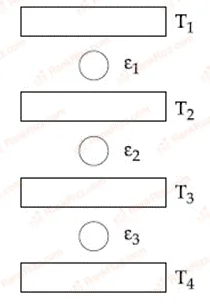
Three Carnot engines operate in series between a heat source at a temperature T1T_1 and a heat sink at temperature T4T_4 (see figure). There are two other reservoirs at temperature T2T_2 and T3T_3, as shown, with T1>T2>T3>T4T_1 > T_2 > T_3 > T_4. The three engines are equally efficient if:

Figure for JEE Main 2019 Physics question on Carnot engine and Carnot cycle
  1. A

    T2=(T1T42)1/3;T3=(T12T4)1/3T_2 = (T_1 T_4^2)^{1/3}; T_3 = (T_1^2 T_4)^{1/3}

  2. B

    T2=(T1T4)1/2;T3=(T12T4)1/3T_2 = (T_1 T_4)^{1/2}; T_3 = (T_1^2 T_4)^{1/3}

  3. C

    T2=(T12T4)1/3;T3=(T1T42)1/3T_2 = (T_1^2 T_4)^{1/3}; T_3 = (T_1 T_4^2)^{1/3}

  4. D

    T2=(T13T4)1/4;T3=(T1T43)1/4T_2 = (T_1^3 T_4)^{1/4}; T_3 = (T_1 T_4^3)^{1/4}

JEE MAIN 2019 · 12 APR S2Carnot engine and Carnot cycleTRANSCRIBED

A Carnot engine has an efficiency of 16\frac{1}{6}. When the temperature of the sink is reduced by 62°C, its efficiency is doubled. The temperatures of the source and the sink are, respectively,

  1. A

    124 °C, 62 °C

  2. B

    37 °C, 99 °C

  3. C

    99 °C, 37 °C

  4. D

    62 °C, 124 °C

JEE MAIN 2018 · 15 APR S1Carnot engine and Carnot cycleTRANSCRIBED

A Carnot's engine works as a refrigerator between 250 K and 300 K. It receives 500 cal heat from the reservoir at the lower temperature. The amount of work done in each cycle to operate the refrigerator is:

  1. A

    420 J

  2. B

    2100 J

  3. C

    772 J

  4. D

    2520 J

JEE MAIN 2018 · 15 APR S2Carnot engine and Carnot cycleTRANSCRIBED

Two Carnot engines A and B are operated in series. Engine A receives heat from a reservoir at 600 K and rejects heat to a reservoir at temperature T. Engine B receives heat rejected by engine A and in turn rejects it to a reservoir at 100 K. If the efficiencies of the two engines A and B are represented by ηA\eta_A and ηB\eta_B respectively, then what is the value of ηAηB\frac{\eta_A}{\eta_B}?

  1. A

    127\frac{12}{7}

  2. B

    125\frac{12}{5}

  3. C

    512\frac{5}{12}

  4. D

    712\frac{7}{12}

JEE MAIN 2016 · 10 APR ONLINECarnot engine and Carnot cycleTRANSCRIBED

A Carnot freezer takes heat from water at 0°C0°C inside it and rejects it to the room at a temperature of 27°C27°C. The latent heat of ice is 336×103336 \times 10^3 J kg−1^{-1}. If 5 kg of water at 0°C0°C is converted into ice at 0°C0°C by the freezer, then the energy consumed by the freezer is close to:

  1. A

    1.51×1051.51 \times 10^5 J

  2. B

    1.68×1061.68 \times 10^6 J

  3. C

    1.71×1071.71 \times 10^7 J

  4. D

    1.67×1051.67 \times 10^5 J

JEE MAIN 2014 · 12 APR ONLINECarnot engine and Carnot cycleTRANSCRIBED

A Carnot engine absorbs 1000 J of heat energy from a reservoir at 127°C and rejects 600 J of heat energy during each cycle. The efficiency of engine and temperature of sink will be:

  1. A

    20% and −43-43°C

  2. B

    40% and −33-33°C

  3. C

    50% and −20-20°C

  4. D

    70% and −10-10°C

JEE MAIN 2012Carnot engine and Carnot cycleTRANSCRIBED

A Carnot engine, whose efficiency is 40%40\%, takes in heat from a source maintained at a temperature of 500 K500\ K. It is desired to have an engine of efficiency 60%60\%. Then, the intake temperature for the same exhaust (sink) temperature must be

  1. A

    efficiency of Carnot engine cannot be made larger than 50%50\%

  2. B

    1200 K1200\ K

  3. C

    750 K750\ K

  4. D

    600 K600\ K

JEE MAIN 2012Carnot engine and Carnot cycleTRANSCRIBED

This question has Statement 1 and Statement 2. Of the four choices given after the Statements, choose the one that best describes the two Statements. Statement 1: An inventor claims to have constructed an engine that has an efficiency of 30%30\% when operated between the boiling and freezing points of water. This is not possible. Statement 2: The efficiency of a real engine is always less than the efficiency of a Carnot engine operating between the same two temperatures.

  1. A

    Statement 1 is true, Statement 2 is true, Statement 2 is not the correct explanation of Statement 1.

  2. B

    Statement 1 is true, Statement 2 is false.

  3. C

    Statement 1 is false, Statement 2 is true.

  4. D

    Statement 1 is true, Statement 2 is true, Statement 2 is the correct explanation of Statement 1.

JEE MAIN 2011Carnot engine and Carnot cycleTRANSCRIBED

A Carnot engine operating between temperatures T1T_1 and T2T_2 has efficiency 16\dfrac{1}{6}. When T2T_2 is lowered by 62 K62 \, \text{K}, its efficiency increases to 13\dfrac{1}{3}. Then T1T_1 and T2T_2 are, respectively:

  1. A

    372 K372 \, \text{K} and 330 K330 \, \text{K}

  2. B

    330 K330 \, \text{K} and 268 K268 \, \text{K}

  3. C

    310 K310 \, \text{K} and 248 K248 \, \text{K}

  4. D

    372 K372 \, \text{K} and 310 K310 \, \text{K}