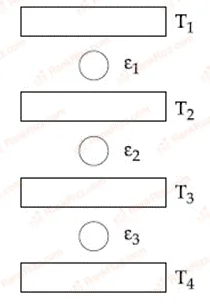
We are given three Carnot engines working one after the other (in series).
The temperatures of the four reservoirs, arranged from hottest to coldest, are T1, T2, T3, and T4 with T1>T2>T3>T4.
For any Carnot engine operating between a hot reservoir at temperature Th and a cold reservoir at Tc, the thermal efficiency is, by definition,
η=1−ThTc.
Because the engines are in series, the first engine works between T1 (hot) and T2 (cold), the second between T2 and T3, and the third between T3 and T4.
Their efficiencies are therefore
η1=1−T1T2,η2=1−T2T3,η3=1−T3T4.
The statement “the three engines are equally efficient’’ means
η1=η2=η3.
We first equate η1 and η2.
Starting with the equality
1−T1T2=1−T2T3,
we cancel the 1’s on both sides, giving
−T1T2=−T2T3.
Multiplying through by −1 to remove the negative sign, we have
T1T2=T2T3.
Cross-multiplication now yields
T22=T1T3,
and solving for T3 gives
T3=T1T22.−(1)
Next we equate η2 and η3.
Setting
1−T2T3=1−T3T4,
we again cancel the 1’s, obtaining
−T2T3=−T3T4.
After multiplying by −1, we have
T2T3=T3T4,
which upon cross-multiplication gives
T32=T2T4.
Solving this for T2 produces
T2=T4T32.−(2)
We now substitute the value of T3 from equation (1) into equation (2).
From (1) we have T3=T1T22, so its square is
T32=(T1T22)2=T12T24.
Putting this into (2), we get
T2=T4T12T24.
Simplifying the right-hand side gives
T2=T12T4T24.
To isolate T2, we multiply both sides by T12T4:
(T12T4)T2=T24.
Dividing both sides by T2 (which is positive by definition of temperature) yields
T12T4=T23.
Taking the cube root of both sides, we arrive at
T2=(T12T4)1/3.
With T2 now known, we substitute back into equation (1) to find T3:
T3=T1T22=T1((T12T4)1/3)2.
Because ((T12T4)1/3)2=(T12T4)2/3, we have
T3=T1(T12T4)2/3.
Splitting the power inside the numerator, (T12T4)2/3=T14/3T42/3, so
T3=T1T14/3T42/3=T14/3−1T42/3=T11/3T42/3.
Writing this in compact radical form, we recognize
T3=(T1T42)1/3.
We have therefore obtained
T2=(T12T4)1/3,T3=(T1T42)1/3.
Scanning the given answer choices, we see that these values correspond exactly to Option C.
Hence, the correct answer is Option C.