JEE MAIN 2021 · 27 AUG S2Thin lenses: lens formula, lens maker's formula and powerTRANSCRIBED
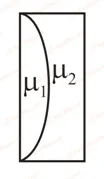
Curved surfaces of a plano-convex lens of refractive index μ1 and a plano-concave lens of refractive index μ2 have equal radius of curvature as shown in figure. Find the ratio of radius of curvature to the focal length of the combined lenses.
- A
μ2−μ11
- B
μ1−μ21
- C
μ2−μ1
- D
μ1−μ2
JEE MAIN 2021 · 20 JUL S1Thin lenses: lens formula, lens maker's formula and powerTRANSCRIBED
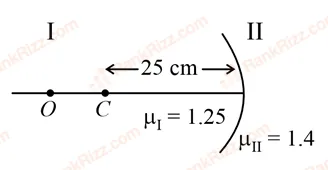
Region I and II are separated by a spherical surface of radius 25 cm. An object is kept in region I at a distance of 40 cm from the surface. The distance of the image from the surface is:
- A
- B
- C
- D
JEE MAIN 2021 · 27 AUG S1Thin lenses: lens formula, lens maker's formula and powerTRANSCRIBED
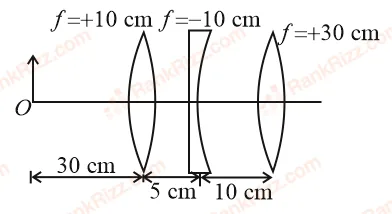
Find the distance of the image from object O, formed by the combination of lenses in the figure:
- A
- B
- C
- D
JEE MAIN 2021 · 26 AUG S2Thin lenses: lens formula, lens maker's formula and powerTRANSCRIBED
An object is placed at a distance of 12 cm from a convex lens. A convex mirror of focal length 15 cm is placed on another side of the lens at 8 cm as shown in the figure. The image of the object coincides with the object.
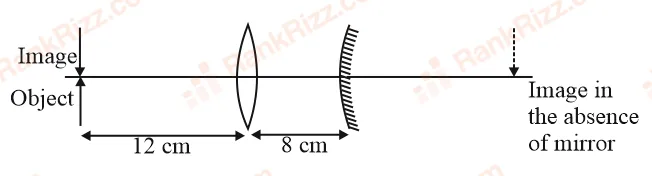
When the convex mirror is removed, a real and inverted image is formed at a position. The distance of the image from the object will be _________ cm
JEE MAIN 2021 · 25 FEB S1Thin lenses: lens formula, lens maker's formula and powerTRANSCRIBED
The same size images are formed by a convex lens when the object is placed at 20 cm or at 10 cm from the lens. The focal length of convex lens is ______
JEE MAIN 2020 · 06 SEP S1Thin lenses: lens formula, lens maker's formula and powerTRANSCRIBED
A point like object is placed at distance of 1m in front of a convex lens of focal length 0.5m. A plane mirror is placed at a distance of 2m behind the lens. The position and nature of the image formed by the system is:
- A
2.6m from the mirror, real
- B
1m from the mirror, virtual
- C
1m from the mirror, real
- D
2.6m from the mirror, virtual
JEE MAIN 2020 · 07 JAN S2Thin lenses: lens formula, lens maker's formula and powerTRANSCRIBED
A thin lens made of glass (refractive index = 1.5) of focal length f=16 cm is immersed in a liquid of refractive index 1.42. If its focal length in liquid is fl, then the ratio fl/f is closest to the integer:
- A
- B
- C
- D
JEE MAIN 2020 · 05 SEP S1Thin lenses: lens formula, lens maker's formula and powerTRANSCRIBED
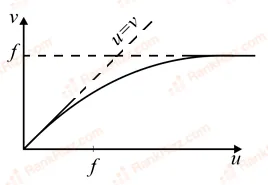
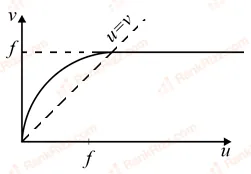
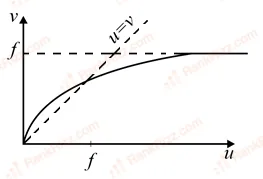
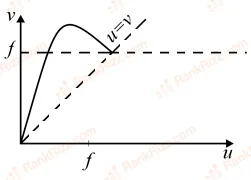
For a concave lens of focal length f, the relation between object and image distance u and v, respectively, from its pole can best be represented by (u=v is the reference line):
- A
- B
- C
- D
JEE MAIN 2020 · 06 SEP S2Thin lenses: lens formula, lens maker's formula and powerTRANSCRIBED
A double convex lens has power P and same radii of curvature R of both the surfaces. The radius of curvature of a surface of a plano-convex lens made of the same material with power 1.5P is:
- A
- B
- C
- D
JEE MAIN 2020 · 04 SEP S2Thin lenses: lens formula, lens maker's formula and powerTRANSCRIBED
The distance between an object and a screen is 100 cm. A lens can produce real image of the object on the screen for two different positions between the screen and the object. The distance between these two positions is 40 cm. If the power of the lens is close to (100N)D where N is an integer, the value of N is __________
JEE MAIN 2020 · 08 JAN S1Thin lenses: lens formula, lens maker's formula and powerTRANSCRIBED
A point object in air is in front of the curved surface of a plano-convex lens. The radius of curvature of the curved surface is 30 cm and the refractive index of the lens material is 1.5, then the focal length of the lens (in cm) is
JEE MAIN 2019 · 11 JAN S1Thin lenses: lens formula, lens maker's formula and powerTRANSCRIBED
An object is at a distance of 20 m from a convex lens of focal length 0.3 m. The lens forms an image of the object. If the object moves away from the lens at a speed of 5 m/s the speed and direction of the image will be
- A
2.26×10⁻³ m/s away from the lens
- B
0.92×10⁻³ m/s away from the lens
- C
3.22×10⁻³ m/s towards the lens
- D
1.16×10⁻³ m/s towards the lens
JEE MAIN 2019 · 12 JAN S2Thin lenses: lens formula, lens maker's formula and powerTRANSCRIBED
A plano-convex lens (focal length f2, refractive index μ2, radius of curvature R) fits exactly into a plano-concave lens (focal length f1, refractive index μ1, radius of curvature R). Their plane surfaces are parallel to each other. Then, the focal length of the combination will be:
- A
μ2−μ1R
- B
- C
- D
f1+f22f1f2
JEE MAIN 2019 · 10 APR S2Thin lenses: lens formula, lens maker's formula and powerTRANSCRIBED
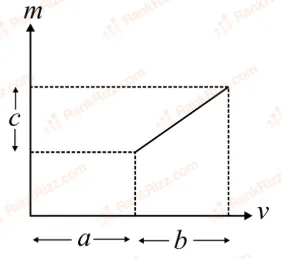
The graph shows how the magnification m produced by a thin lens varies with image distance v. The focal length of the lens used is
- A
- B
- C
- D
JEE MAIN 2019 · 10 JAN S1Thin lenses: lens formula, lens maker's formula and powerTRANSCRIBED
A plano-convex lens of refractive index μ1 and focal length f1 is kept in contact with another plano-concave lens of refractive index μ2 and focal length f2. If the radius of curvature of their spherical faces is R each and f1=2f2, the μ1 and μ2 are related as:
- A
2μ2−μ1=1
- B
3μ2−2μ1=1
- C
μ1+μ2=3
- D
2μ1−μ2=1
JEE MAIN 2019 · 12 JAN S1Thin lenses: lens formula, lens maker's formula and powerTRANSCRIBED
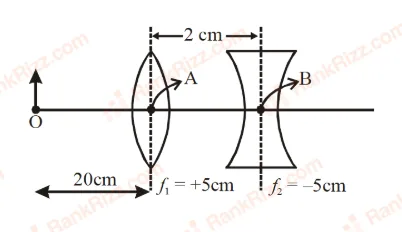
What is the position and nature of image formed by lens combination shown in figure? (f1, f2 are focal lengths)
- A
40 cm from point B at right; real
- B
320 cm from point B at right, real
- C
70 cm from point B at right; real
- D
70 cm from point B at left; virtual
JEE MAIN 2019 · 12 JAN S2Thin lenses: lens formula, lens maker's formula and powerTRANSCRIBED
Formation of real image using a biconvex lens is shown below.
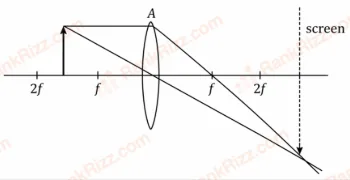
If the whole set up is immersed in water without disturbing the object and the screen positions, what will one observe on the screen?
- A
- B
- C
- D
JEE MAIN 2019 · 09 APR S2Thin lenses: lens formula, lens maker's formula and powerTRANSCRIBED
A convex lens of focal length 20 cm produces images of the same magnification 2 when an object is kept at two distances x1 and x2 (x1>x2) from the lens. The ratio of x1 and x2 is:
- A
- B
- C
- D
JEE MAIN 2019 · 08 APR S1Thin lenses: lens formula, lens maker's formula and powerTRANSCRIBED
An upright object is placed at a distance of 40 cm in front of a convergent lens of focal length 20 cm. A convergent mirror of focal length 10 cm is placed at a distance of 60 cm on the other side of the lens. The position and size of the final image will be:
- A
40 cm from the convergent lens, twice the size of the object
- B
20 cm from the convergent mirror, twice the size of the object
- C
40 cm from the convergent lens, same size of the object
- D
20 cm from the convergent mirror, same size of the object
JEE MAIN 2019 · 10 APR S1Thin lenses: lens formula, lens maker's formula and powerTRANSCRIBED
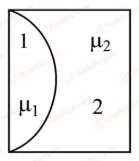
One plano-convex and one plano-concave lens of the same radius of curvature R but of different materials are joined side by side as shown in the figure. If the refractive index of the material of 1 is μ1 and that of 2 is μ2, then the focal length of the combination is:
- A
2−(μ1−μ2)R
- B
2(μ1−μ2)R
- C
μ1−μ22R
- D
μ1−μ2R